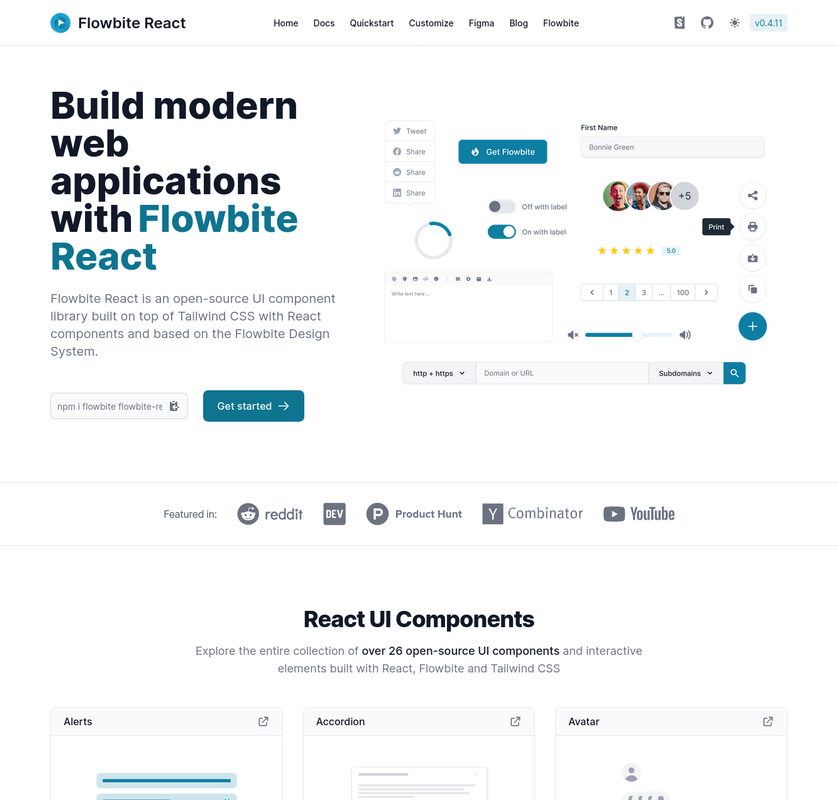
flowbite-react is an open source collection of UI components, built in React, with utility classes from Tailwind CSS that you can use as a starting point for user interfaces and websites.
Table of Contents
Documentation
Documentation for flowbite-react is not yet finished.
If you want to browse the components, visit flowbite-react.com.
If you want to learn more about Flowbite, visit Flowbite docs.
Getting started
Learn how to get started with Flowbite React and start leveraging the interactive React components coupled with Flowbite and Tailwind CSS.
You'll need to be familiar with Node.js and npm, and have npm installed. You should be comfortable installing packages with npm, and experience creating web apps with React and Tailwind CSS will be very helpful.
Setup Tailwind CSS
Install Tailwind CSS:
npm i autoprefixer postcss tailwindcss
npx tailwindcss init -p
Point Tailwind CSS to files you have className=".." in:
module.exports = {
content: ['./src/**/*.{js,jsx,ts,tsx}' ],
theme: {
extend: {},
},
plugins: [],
};
Add Tailwind CSS to a CSS file:
@tailwind base;
@tailwind components;
@tailwind utilities;
Install Flowbite React
- Run the following command to install
flowbite-react:
npm i flowbite-react
- Add the Flowbite plugin to
tailwind.config.js, and include content from flowbite-react:
export default {
content: [
'node_modules/flowbite-react/lib/esm/**/*.js',
],
plugins: [
require('flowbite/plugin'),
],
};
Try it out
How you use Flowbite React depends on your project setup. In general, you can just import the components you want to use from flowbite-react and use them in a React .jsx file:
import { Button } from 'flowbite-react';

export default function MyPage() {
  return (
    <div>
      <Button>Click me</Button>
    </div>
  );
}
Next steps
Next.js
If you're using Next.js, you can follow the Next.js install guide, which includes a Next.js starter project with Flowbite React already set up.
Dark mode
If you want to add a dark mode switcher to your app, you can follow the dark mode guide.
Customization
If you want to customize Flowbite React component, you can follow the theme guide.
Contributing
If you want to contribute to Flowbite React, you can follow the contributing guide.
Components
Please note that some components in the vanilla Flowbite library are not yet available in Flowbite React.
| Accordion | Alert | Avatar |

|

|

|
| Banner | Badge | Breadcrumb |

|

|

|
| Button | Button group | Card |

|

|

|
| Carousel | Datepicker | Dropdown |

|

|

|
| Footer | Forms | List group |

|

|

|
| Modal | Navbar | Pagination |

|

|

|
| Progress bar | Rating | Sidebar |

|

|

|
| Spinner | Table | Tabs |

|

|

|
| Tooltip | Timeline | Toast |

|

|

|
| Sticky Banner | | |
|
| | |
If you need help or just want to discuss about the library join the community on Github:
⌨️ Discuss about Flowbite on GitHub
For casual chatting with others using the library:
💬 Join the Flowbite Discord Server
Contributing
Thank you for your interest in helping! Visit our guide on contributing to get started.
Figma
If you need the Figma files for the components you can check out our website for more information:
🎨 Get access to the Figma design files
Copyright and license
The Flowbite name and logos are trademarks of Bergside Srl.
📝 Read about the licensing terms
📀 Brand guideline and trademark usage agreement