








Security News
Deno 2.6 + Socket: Supply Chain Defense In Your CLI
Deno 2.6 introduces deno audit with a new --socket flag that plugs directly into Socket to bring supply chain security checks into the Deno CLI.
By Sarah Gooding - Dec 12, 2025
@ts-graphviz/core
Advanced tools





Models and functions provided to users for the ts-graphviz library.
🔗







It is part of the ts-graphviz library, which is split into modular packages to improve maintainability, flexibility, and ease of use.
The package adheres to object-oriented programming principles, allowing for:
@ts-graphviz/core supports several patterns for creating and manipulating graphs:
The most straightforward approach is to instantiate the model classes directly:
// Create a directed graph
const graph = new Digraph();
// Create nodes with attributes
const node1 = new Node('node1', { color: 'red' });
const node2 = new Node('node2', { color: 'blue' });
// Create an edge between nodes with attributes
const edge = new Edge([node1, node2], { label: 'Edge Label' });
// Add elements to the graph
graph.addNode(node1);
graph.addNode(node2);
graph.addEdge(edge);
Graph models provide factory methods to create and automatically add elements:
// Create a directed graph
const graph = new Digraph();

// Create and add nodes using factory methods
const node1 = graph.createNode('node1', { color: 'red' });
const node2 = graph.createNode('node2', { color: 'blue' });

// Create and add an edge using factory method
graph.createEdge([node1, node2], { label: 'Edge Label' });
Graphs can be composed with subgraphs to create hierarchical structures:
// Create a directed graph
const graph = new Digraph();

// Create a subgraph
const subgraph = new Subgraph('cluster_0');

// Create nodes in the subgraph
const node1 = new Node('node1');
const node2 = new Node('node2');

// Add nodes to the subgraph
subgraph.addNode(node1);
subgraph.addNode(node2);

// Add the subgraph to the main graph
graph.addSubgraph(subgraph);
@ts-graphviz/core provides several mechanisms for customizing and extending its functionality:
You can create custom graph element classes by extending the base classes:
class MyCustomNode extends Node {
  constructor(id: string) {
    super(`node_${id}`, {
      label: `Custom Node ${id}`,
      shape: 'box'
    });
  }
}

class MyCustomEdge extends Edge {
  constructor(targets: EdgeTargetTuple) {
    super(targets, {
      color: 'blue',
      penwidth: '2.0'
    });
  }
}

// Use custom classes
const node1 = new MyCustomNode('A');
const node2 = new MyCustomNode('B');
const edge = new MyCustomEdge([node1, node2]);
The Models Context API allows you to specify which model classes should be used when creating graph element.
This is implemented through the with method on graph models:
// Create a directed graph
const graph = new Digraph();

// Set up the context with custom classes
graph.with({
  Node: MyCustomNode,
  Edge: MyCustomEdge
});

// Now factory methods will use the custom classes
const nodeA = graph.createNode('A'); // Creates a MyCustomNode
const nodeB = graph.createNode('B'); // Creates a MyCustomNode
const edge = graph.createEdge([nodeA, nodeB]); // Creates a MyCustomEdge
@ts-graphviz/core integrates with @ts-graphviz/ast to convert between the object model and the DOT language.
This integration enables:
The main conversion functions that link @ts-graphviz/core with @ts-graphviz/ast are:
fromModel: Converts a graph model to an ASTtoModel: Converts an AST to a graph modelThese are then used by the main ts-graphviz package to implement the toDot and fromDot functions.
Thanks goes to these wonderful people (emoji key):
This project follows the all-contributors specification. Contributions of any kind welcome!
See CHANGELOG.md for more details.
This software is released under the MIT License, see LICENSE.
The 'graphviz' package is a Node.js wrapper for the Graphviz command-line tool. It allows you to generate DOT files and render them to various formats like PNG, PDF, etc. Unlike @ts-graphviz/core, it relies on the Graphviz installation on your system.
The 'viz.js' package is a JavaScript port of Graphviz that runs in the browser and Node.js. It allows you to render DOT files directly in the browser without needing a Graphviz installation. It is more focused on rendering rather than programmatic graph creation.
The 'd3-graphviz' package integrates Graphviz with D3.js, allowing you to create and manipulate graphs using D3's data-driven approach. It is more suitable for dynamic and interactive visualizations compared to @ts-graphviz/core.
FAQs
Graphviz Models for Object-Oriented Programming
The npm package @ts-graphviz/core receives a total of 715,902 weekly downloads. As such, @ts-graphviz/core popularity was classified as popular.
We found that @ts-graphviz/core demonstrated a healthy version release cadence and project activity because the last version was released less than a year ago. It has 1 open source maintainer collaborating on the project.
Did you know?

Socket for GitHub automatically highlights issues in each pull request and monitors the health of all your open source dependencies. Discover the contents of your packages and block harmful activity before you install or update your dependencies.
Security News
Deno 2.6 introduces deno audit with a new --socket flag that plugs directly into Socket to bring supply chain security checks into the Deno CLI.
Security News
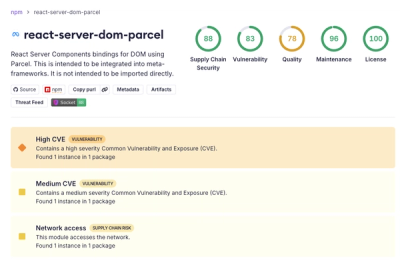
New DoS and source code exposure bugs in React Server Components and Next.js: what’s affected and how to update safely.

Security News
Socket CEO Feross Aboukhadijeh joins Software Engineering Daily to discuss modern software supply chain attacks and rising AI-driven security risks.