

Company News
Socket Has Acquired Secure Annex
Socket has acquired Secure Annex to expand extension security across browsers, IDEs, and AI tools.
By Feross Aboukhadijeh - Apr 28, 2026
@ultimate/ngerrors
Advanced tools


 ngErrors

Why use ngErrors, how to install and include.
Form validation made easy for reactive forms. Typically you'd do something like this:
<input type="text" formControlName="foo">
<div *ngIf="form.get('foo').hasError('required') && form.get('foo').touched">
Field is required
</div>
<div *ngIf="form.get('foo').hasError('minlength') && form.get('foo').dirty">
Min length is 5
</div>
With ngErrors, we've taken a simple declarative approach that cleans up your templates:
<input type="text" formControlName="foo">
<div ngErrors="foo">
  <div ngError="required" when="touched">
    Field is required
  </div>
  <div ngError="minlength" when="dirty">
    Min length is 5
  </div>
</div>
Check out the documentation below for all the syntax we provide.
yarn add @ultimate/ngerrors

# OR

npm i @ultimate/ngerrors
Just add ngErrors to your module:
import { NgErrorsModule } from '@ultimate/ngerrors';

@NgModule({ imports: [ NgErrorsModule ] })
The ngErrors directive works by dynamically fetching your FormControl under-the-hood, so simply take your formControlName value and pass it into ngErrors:
<input type="text" formControlName="username">
<div ngErrors="username">
  // ...
</div>
This needs to be on a parent container that will encapsulate child ngError directives.
The ngError directive takes either a string or array as arguments. The argument you pass in corresponds to any active errors exposed on your control, such as "required" or "minlength":
<input type="text" formControlName="username">
<div ngErrors="username">
  <div ngError="minlength">
    Min length is 5
  </div>
</div>
Note: when using array syntax,
[]bindings are needed
Using an error, will show the error message when either condition are true:
<input type="text" formControlName="username">
<div ngErrors="username">
  <div [ngError]="['minlength', 'maxlength']">
    Min length is 5, max length is 10
  </div>
</div>
The when directive takes either a string or array as arguments. It allows you to specify when you wish to display the error based on the control state, such as "dirty" or "touched":
<input type="text" formControlName="username">
<div ngErrors="username">
  <div ngError="minlength" when="dirty">
    Min length is 5
  </div>
</div>
It also comes in array format for multiple rules:
<input type="text" formControlName="username">
<div ngErrors="username">
  <div [ngError]="minlength" [when]="['dirty', 'touched']">
    Min length is 5
  </div>
</div>
You can optionally data-bind and dynamically create validation errors with ngErrors:
<input type="text" formControlName="username">
<div ngErrors="person.username">
  <div *ngFor="let error of errors" [ngError]="error.name" [when]="error.rules">
    {{ error.text }}
  </div>
</div>
With corresponding component class:
@Component({...})
export class MyComponent {
  errors = [
    { name: 'required', text: 'This field is required', rules: ['touched', 'dirty'] },
    { name: 'minlength', text: 'Min length is 5', rules: ['dirty'] }
  ];
}
ngErrors also supports FormGroups with control names using dot notation:
<div formGroupName="person">
  <input type="text" formControlName="username">
  <div ngErrors="person.username">
    <div ngError="minlength" [when]="['dirty', 'touched']">
      Min length is 5
    </div>
  </div>
</div>
FAQs
A declarative validation module for reactive forms
The npm package @ultimate/ngerrors receives a total of 7 weekly downloads. As such, @ultimate/ngerrors popularity was classified as not popular.
We found that @ultimate/ngerrors demonstrated a not healthy version release cadence and project activity because the last version was released a year ago. It has 3 open source maintainers collaborating on the project.
Did you know?

Socket for GitHub automatically highlights issues in each pull request and monitors the health of all your open source dependencies. Discover the contents of your packages and block harmful activity before you install or update your dependencies.
Company News
Socket has acquired Secure Annex to expand extension security across browsers, IDEs, and AI tools.

Research
/Security News
Socket is tracking cloned Open VSX extensions tied to GlassWorm, with several updated from benign-looking sleepers into malware delivery vehicles.
Product
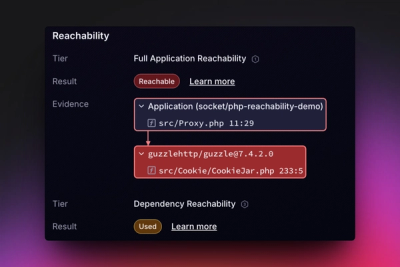
Reachability analysis for PHP is now available in experimental, helping teams identify which vulnerabilities are actually exploitable.