

Research
Active Supply Chain Attack Compromises @antv Packages on npm
Active npm supply chain attack compromises @antv packages in a fast-moving malicious publish wave tied to Mini Shai-Hulud.
By Socket Research Team - May 19, 2026
@vennbase/core
Advanced tools

Build multi-user apps without writing a single access rule.
Vennbase is a TypeScript client-side database for collaborative, local-first web apps — with no backend to run, no server to pay for, and no access control rules to misconfigure. Users sign in with their Puter account. Your app only sees the user's subset of the data stored in Puter.
// Write
const board = db.create("boards", { title: "Launch checklist" }).value;
db.create("cards", { text: "Ship it", done: false, createdAt: Date.now() }, { in: board });
// Read (React)
const { rows: cards = [] } = useQuery(db, "cards", {
in: board,
orderBy: "createdAt",
order: "asc",
});
// Share
const { shareLink } = useShareLink(db, board, "editor");
Write your frontend. Vennbase handles the rest.
Every piece of data in Vennbase is a row. A row belongs to a collection defined in your schema, holds typed fields, and has its own identity.
Rows can be nested. A card lives inside a board; a recentBoard lives inside the built-in user collection. The parent relationship defines visibility — gaining access to a parent automatically grants access to its children.
Access is explicit-grant only. To let someone into a row, generate a share link and send it to them. They accept it, they're in. There are no rule expressions to write and no policy surface to misconfigure.
| Document | Description |
|---|---|
PATTERNS.md | Recipe-style app patterns for blind inboxes, index-key projections, resource claims, and other real-world Vennbase designs. |
pnpm add @vennbase/core
React apps: pnpm add @vennbase/react @vennbase/core.
Define your collections once. TypeScript infers field types throughout the SDK automatically.
import { collection, defineSchema, field } from "@vennbase/core";

export const schema = defineSchema({
  boards: collection({
    fields: {
      title: field.string(),
    },
  }),
  recentBoards: collection({
    in: ["user"],
    fields: {
      boardRef: field.ref("boards").indexKey(),
      openedAt: field.number().indexKey(),
    },
  }),
  cards: collection({
    in: ["boards"],
    fields: {
      text: field.string(),
      done: field.boolean(),
      createdAt: field.number().indexKey(),
    },
  }),
});

export type Schema = typeof schema;
collection({ in: [...] }) — in lists the allowed parent collections.field.string() / .number() / .boolean() / .date() / .ref(collection) — typed fields; chain .indexKey(), .optional(), or .default(value) as neededFields are for metadata that you want to query. Mark fields with .indexKey() when they should be stored in the parent query index.
Only .indexKey() fields can be used in where and orderBy.
Important: select: "indexKeys" returns a projection of only .indexKey() fields. Before adding .indexKey(), assume submitters with index-key-query access may read that field.
The canonical CRDT pattern is: row fields hold metadata and row refs, while the CRDT document holds the collaborative value state for that row.
Create one Vennbase instance for your app and pass it an appBaseUrl so that share links point back to your app:
import { Vennbase } from "@vennbase/core";
import { schema } from "./schema";

export const db = new Vennbase({ schema, appBaseUrl: window.location.origin });
import { useSession } from "@vennbase/react";

function AppShell() {
  const session = useSession(db);

  if (session.status === "loading") {
    return <p>Checking session…</p>;
  }

  if (!session.session?.signedIn) {
    return <button onClick={() => void session.signIn()}>Log in with Puter</button>;
  }

  return <App />;
}
// Create a top-level row
const board = db.create("boards", { title: "Launch checklist" }).value;

// Create a child row — pass the parent row or row ref
db.create("cards", { text: "Write README", done: false, createdAt: Date.now() }, { in: board });
db.create("cards", { text: "Publish to npm", done: false, createdAt: Date.now() }, { in: board });
create and update are synchronous optimistic writes. Use .value on the returned receipt when you want the row handle immediately.
To update fields on an existing row:
db.update("cards", card, { done: true });
Vennbase queries always run within a known scope. For cards, that scope is a board, so you pass in: board. For collections declared as in: ["user"], pass in: CURRENT_USER.
Queries never mean "all accessible rows". in is always required, and collections not declared in another cannot be queried.
import { CURRENT_USER } from "@vennbase/core";

const recentBoards = await db.query("recentBoards", {
  in: CURRENT_USER,
  orderBy: "openedAt",
  order: "desc",
  limit: 10,
});
// Multi-parent queries run in parallel, then merge and sort their results
const cards = await db.query("cards", {
  in: [todoBoard, bugsBoard],
  orderBy: "createdAt",
  order: "asc",
  limit: 20,
});
@vennbase/react ships a useQuery hook that polls for changes and re-renders automatically:
import { useQuery } from "@vennbase/react";

const { rows: cards = [], isLoading } = useQuery(db, "cards", {
  in: board,
  orderBy: "createdAt",
  order: "asc",
});
The default query result is a full row handle. Full rows are locatable and reusable: they expose ref, owner, fields, row membership APIs, parent-link APIs, and can be passed back into row workflows.
Anonymous queries are intentionally weaker:
const slots = await db.query("bookings", {
  in: bookingRoot,
  select: "indexKeys",
  orderBy: "slotStartMs",
});
They return objects shaped like { kind: "index-key-projection", id, collection, fields }, where fields contains only values declared .indexKey(). These are index-key projections only. They are not row refs, cannot be reopened, and cannot be passed to row-handle APIs.
Access to a row is always explicit. There is no rule system to misconfigure — no typo in a policy expression that accidentally exposes everything. A user either holds a valid invite token or they don't.
In React, prefer useShareLink(db, row, "editor") for the sender and useAcceptInviteFromUrl(db, ...) for the recipient. Underneath, readable invites still follow the same three-step flow:
// 1. Generate a token for the row you want to share
const shareToken = db.createShareToken(board, "editor").value;

// 2. Build a link the recipient can open in their browser
const link = db.createShareLink(board, shareToken);
// → "https://yourapp.com/?db=..."

// 3. Recipient opens the link; your app calls acceptInvite
const sharedBoard = await db.acceptInvite(link);
If you do not need the token separately, you can create the link directly from a role:
const editorLink = db.createShareLink(board, "editor").value;
acceptInvite accepts either a full invite URL or a pre-parsed { ref, shareToken? } object from db.parseInvite(input). In React, useAcceptInviteFromUrl(db, ...) handles the common invite-landing flow for you.
For blind inbox workflows, create a submitter link instead:
const submissionLink = db.createShareLink(board, "submitter").value;
const joined = await db.joinInvite(submissionLink);
// joined.role === "submitter"
joinInvite is idempotent, so call it whenever you need it.
"submitter" members can create child rows under the shared parent and can run db.query(..., { select: "indexKeys" }) to see only index-key projections from sibling rows. Index-key projections expose kind, id, collection, and index-key-only fields; they do not include row refs, base URLs, owners, or other locator metadata. Submitters still cannot read the parent row, fetch full sibling rows, inspect members, or use sync. Child rows they own are still their own rows, so if they persist a child RowRef somewhere readable, they can reopen that row later and update it or remove its shared parent link for cancel/edit flows.
Once users have joined a row you can inspect and manage the member list:
// Flat list of usernames
const members = await db.listMembers(board);

// With roles
const detailed = await db.listDirectMembers(board);
// → [{ username: "alice", role: "editor" }, ...]

// Add or remove manually
await db.addMember(board, "bob", "editor").committed;
await db.removeMember(board, "eve").committed;
Membership inherited through a parent row is visible via listEffectiveMembers.
Vennbase includes a CRDT message bridge. Connect any CRDT library to a row and all members receive each other's updates in real time.
Sending CRDT updates requires "editor" access, but all members can poll and receive them.
In React, here is the recommended Yjs integration:
import * as Y from "yjs";
import { createYjsAdapter } from "@vennbase/yjs";
import { useCrdt } from "@vennbase/react";

const adapter = createYjsAdapter(Y);
const { value: doc, flush } = useCrdt(board, adapter);

// Write to doc normally, then push immediately when needed
await flush();
@vennbase/yjs uses your app's yjs instance instead of bundling its own runtime, which avoids the multi-runtime Yjs failure mode.
packages/todo-app is the code from this README assembled into a working app — boards, recent boards, cards, and share links. Run it with:
pnpm --filter todo-app dev
For a fuller picture of how the pieces fit together in a real app, read packages/woof-app. It uses CRDT-backed live chat, user-scoped history rows for room restore, child rows with per-user metadata, and role-aware UI — the patterns you'll reach for once basic reads and writes are working.
pnpm --filter woof-app dev
packages/appointment-app is the clearest example of the Vennbase access-control philosophy in a full app: explicit grants, a blind booking inbox, and minimal anonymous sibling visibility via select: "indexKeys". It demonstrates convergent client-side claim resolution, not hard capacity enforcement. Read PATTERNS.md for a recipe-style walkthrough of each pattern.
pnpm --filter appointment-app dev
Vennbase| Method | Description |
|---|---|
new Vennbase({ schema, appBaseUrl? }) | Create a Vennbase instance. Pass appBaseUrl so share links point back to your app. |
getSession() | Check whether the current browser already has a Puter session. |
signIn() | Start the Puter sign-in flow. Call this from a user gesture such as a button click. |
whoAmI() | Returns { username } for the signed-in Puter user. |
create(collection, fields, options?) | Create a row optimistically and return a MutationReceipt<RowHandle> immediately. Pass { in: parent } for child rows, where parent can be a RowHandle or RowRef. For user-scoped collections, pass { in: CURRENT_USER }. Most apps use .value; await .committed when you need remote confirmation. |
update(collection, row, fields) | Merge field updates onto a row optimistically and return a MutationReceipt<RowHandle> immediately. row can be a RowHandle or RowRef. |
getRow(row) | Fetch a row by typed reference. |
query(collection, options) | Load rows under a parent, with optional index, order, and limit. Pass in, including CURRENT_USER for user-scoped collections. Default queries return locatable RowHandle values; select: "indexKeys" returns non-reopenable index-key projections. |
watchQuery(collection, options, callbacks) | Subscribe to repeated query refreshes via callbacks.onChange. Pass in, including CURRENT_USER for user-scoped collections. Returns a handle with .disconnect(). The callback receives either full RowHandle values or index-key projections depending on select. |
createShareToken(row, role) | Generate a share token optimistically and return a MutationReceipt<ShareToken>. .value is usable locally right away; await .committed before another client must be able to use it. |
getExistingShareToken(row, role) | Return the existing token for the requested role if one exists, or null. |
createShareLink(row, shareToken) | Build a shareable URL containing a serialized row ref and token. |
createShareLink(row, role) | Generate a future-valid share link for that role and return it as a MutationReceipt<string>. .value is the local URL immediately; .committed resolves when recipients can rely on it remotely. |
parseInvite(input) | Parse an invite URL into { ref, shareToken? }. |
joinInvite(input) | Idempotently join a row via invite URL or parsed invite object without opening it, and return { ref, role }. |
acceptInvite(input) | Join a readable invite and return its handle. Use it for "editor", "contributor", or "viewer" invites; "submitter" invites should use joinInvite(...). |
saveRow(key, row) | Persist one current row for the signed-in user under your app-defined key. |
openSavedRow(key, collection) | Re-open the saved row for the signed-in user as the expected collection, or null. Throws if the stored row belongs to a different collection. |
clearSavedRow(key) | Remove the saved row for the signed-in user. |
listMembers(row) | Returns string[] of all member usernames. |
listDirectMembers(row) | Returns { username, role }[] for direct members. |
listEffectiveMembers(row) | Returns resolved membership including grants inherited from parents. |
addMember(row, username, role) | Grant a user access and return a MutationReceipt<void>. Roles: "editor", "contributor", "viewer", and "submitter". "editor" can update fields, manage members, manage parents, and send CRDT messages; "contributor" can read the row and submit only rows they own under it; "viewer" is read-only; "submitter" is can add children under this parent, and may run only select: "indexKeys" queries there. Inherited "contributor" access becomes "viewer" on descendants. |
removeMember(row, username) | Revoke a user's access and return a MutationReceipt<void>. |
addParent(child, parent) | Link a row to an additional parent after creation and return a MutationReceipt<void>. |
removeParent(child, parent) | Unlink a row from a parent and return a MutationReceipt<void>. |
listParents(child) | Returns all parent references for a row. |
connectCrdt(row, callbacks) | Bridge a CRDT onto the row's message stream. Returns a CrdtConnection. |
RowHandle| Member | Description |
|---|---|
.fields | Current field snapshot, typed from your schema. Treat it as read-only; the object is replaced when fields change. |
.collection | The collection this row belongs to. |
.ref | Portable RowRef object for persistence, invites, ref-typed fields, and reopening the row later. |
.id / .owner | Row identity metadata. |
.refresh() | Re-fetch fields from the server. Resolves to the latest field snapshot. |
.connectCrdt(callbacks) | Shorthand for db.connectCrdt(row, callbacks). |
.in.add(parent) / .in.remove(parent) / .in.list() | Manage parent links. |
.members.add(username, role) / .members.remove(username) / .members.list() | Manage membership. |
MutationReceipt<T>| Member | Description |
|---|---|
.value | The optimistic value available immediately. For create and update, this is the RowHandle. |
.committed | Promise that resolves to the final value once the write is confirmed remotely. Rejects if the write fails. |
.status | Current write status: "pending", "committed", or "failed". |
.error | The rejection reason after a failed write. Otherwise undefined. |
FAQs
A multi-user database for apps that have no backend.
The npm package @vennbase/core receives a total of 0 weekly downloads. As such, @vennbase/core popularity was classified as not popular.
We found that @vennbase/core demonstrated a healthy version release cadence and project activity because the last version was released less than a year ago. It has 1 open source maintainer collaborating on the project.
Did you know?

Socket for GitHub automatically highlights issues in each pull request and monitors the health of all your open source dependencies. Discover the contents of your packages and block harmful activity before you install or update your dependencies.
Research
Active npm supply chain attack compromises @antv packages in a fast-moving malicious publish wave tied to Mini Shai-Hulud.
Security News
/Research
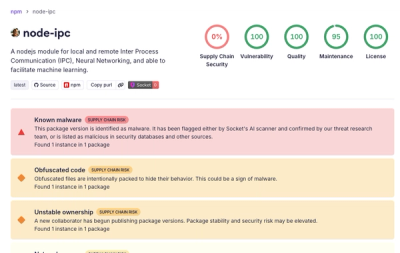
Socket detected malicious node-ipc versions with obfuscated stealer/backdoor behavior in a developing npm supply chain attack.

Security News
TeamPCP and BreachForums are promoting a Shai-Hulud supply chain attack contest with a $1,000 prize for the biggest package compromise.