

Product
Introducing Data Exports
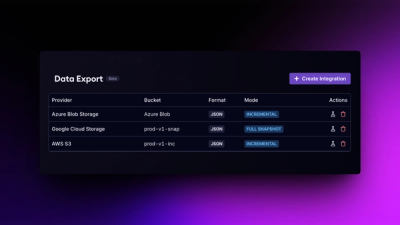
Export Socket alert data to your own cloud storage in JSON, CSV, or Parquet, with flexible snapshot or incremental delivery.
By Ola Adekola - Apr 23, 2026
@vltpkg/spec
Advanced tools
This is a library for parsing package specifiers.
Namings · Specifiers · Usage · Properties
Specifiers are primarily used in the following cases:
vlt add foo@1.xpackage.json) where dependencies are listed,
like "dependencies": { "foo": "1.x" }A "named" specifier is one with the full name included, separated from
the specifier by a @ character, such as foo@1.x or
@vltpkg/spec@1.0.0. The name in these cases would be foo and
@vltpkg/spec, respectively.
Note that it does not always correspond to the "name" in the
manifest of the resolved package! For example, foo@npm:react@latest
would resolve to the latest version of react, but would be named
foo in the dependency graph, and loaded as import('foo').
The following specifier types are supported:
workspace:... - Provide a semver range, or one of ~, *, or ^
to match against a dependency that exists in a workspace project of
a monorepo. The package name must exist as a workspace project in
the monorepo. If a semver range is provided, then it must match the
referenced workspace package version. Otherwise:
* - Fill in whatever version is in the workspace, without any
prefix. So, if ./packages/foo depends on bar@workspace*, and
bar is version 1.2.3, then foo will be published with
{ "dependencies": { "bar": "1.2.3" }}~ or ^ - Publish with the version found in the monorepo,
prefixed by the character. So in the example above, it'd be
bar@~1.2.3 or bar@^1.2.3, respectively.semver range - A valid semver range (including the empty string or
a single semver version). This is resolved against the default
registry. If the spec is a valid semver range, then no further
parsing is done.
git+ssh://<url>[selector] or git+https://<url>[selector] - A
git+ssh or git+https url will be checked out by git. If no 'git
selector' is provided, then it will attempt to install from the
default version. The git selector can be:
#committish Any valid committish value will be checked out.
So, shasum, branch, tag, etc., would all work.#semver:<range> If a semver range is provided, it will select
over all the tags that are valid semver versions, and pick the
highest version number that satisfies the range.::-separated series of
key:value pairs. Currently only path:<path in repo> is
supported, for referencing packages living below the root of the
repository, as in a monorepo. For example,
tcompare@github:tapjs/tapjs#bf457f24::path:src/tcomparehttps://some-host.com/path/to/file.tgz - An https or http URL to a
tarball will resolve to itself.
file:///path/to/file - A file URL will resolve to itself. If it is
a directory, it will be reified as a symbolic link to the folder
specified. If it is a file, it will be treated as a tarball that
gets unpacked into place. Relative paths are resolved from the
package with the dependency.
registry:<registry url>#<name>[@version range or dist-tag] - This
will use the specified registry url, and look up the name and
version on that registry.
If a registry shorthand is defined in the options, then you can use
it as an alias for that registry. Currently, the only shorthand that
is enabled by default is npm:<name>[@version-range] as a shorthand
for registry:https://registry.npmjs.org/#<name>[@version-range].
If a git repository shorthand is defined in the options, then you
can use that shorthand prefix as an alias for that git host.
Currently, github:, bitbucket:, gitlab:, and gist: are
supported by default.
Anything else will be treated as a dist-tag in the registry
packument. For example, foo@latest or blah@legacy-v2
import { Spec, type SpecOptions } from '@vltpkg/spec'

// optional: create some registry shorthands
const opts: SpecOptions = {
  registries: {
    // internal company registry or something
    acmereg: 'https://dev.acme.internal/npm',
  },
  gitHosts: {
    github: 'git+ssh://git@github.com:$1/$2',
    // the $# pieces here are replaced by the path-separated
    // portions, so eg `github:user/project#whatever
    acmegit: 'git+ssh://git@dev.acme.internal/git/$1/$2/$3',
  }
}

const lodash = Spec.parse('lodash@latest')
// which is the same as:
const lodash = Spec.parse('lodash@npm:lodash@latest')
// which is the same as:
const lodash = Spec.parse(
  'lodash@registry:https://registry.npmjs.org/#lodash@latest'
)

// pull from github
const ghProject = Spec.parse('abbrev@github:npm/abbrev-js#main', opts)

// pull from GitHub package registry
const ghPackage = Spec.parse(
  '@octocat/hello-world',
  'gh:@octocat/hello-world@1.0.0',
  opts,
)

// pull from our internal hosts using the acme shorthand names
const fooFromAcmeReg = Spec.parse('foo@acmereg:foo@1.2', opts)
const fooFromAcmeReg = Spec.parse(
  'foo@acmegit:department/team/monorepo#main;directory:packages/foo',
  opts,
)
'registry', 'git',
'file', 'remote', catalog or workspace.foo in foo@1.x1.x in foo@1.xtype === 'git':
::-separated set of key:value fieldsgitSelector parsed into a Record objectgithub, gitlab, bitbucket, etc.type === 'registry':
npm:x@2.x or
an explicit registry url like
registry:https://registry.npmjs.org#x@2.x.type === 'file':
type === 'remote':
FAQs
Package specifier library
The npm package @vltpkg/spec receives a total of 129,293 weekly downloads. As such, @vltpkg/spec popularity was classified as popular.
We found that @vltpkg/spec demonstrated a healthy version release cadence and project activity because the last version was released less than a year ago. It has 6 open source maintainers collaborating on the project.
Did you know?

Socket for GitHub automatically highlights issues in each pull request and monitors the health of all your open source dependencies. Discover the contents of your packages and block harmful activity before you install or update your dependencies.
Product
Export Socket alert data to your own cloud storage in JSON, CSV, or Parquet, with flexible snapshot or incremental delivery.
Research
/Security News
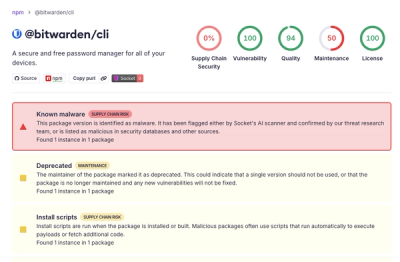
Bitwarden CLI 2026.4.0 was compromised in the Checkmarx supply chain campaign after attackers abused a GitHub Action in Bitwarden’s CI/CD pipeline.

Research
/Security News
Docker and Socket have uncovered malicious Checkmarx KICS images and suspicious code extension releases in a broader supply chain compromise.