


Security News
Deno 2.6 + Socket: Supply Chain Defense In Your CLI
Deno 2.6 introduces deno audit with a new --socket flag that plugs directly into Socket to bring supply chain security checks into the Deno CLI.
By Sarah Gooding - Dec 12, 2025
@wbg-mde/r-script
Advanced tools
A simple little module for passing data from NodeJS to R (and back again). Panapps customized version of r-script package for WBG-metadata-editor.
A simple little module for passing data from NodeJS to R (and back again).
Data passed from node is converted into a list and loaded into the R environment as the variable input. No special syntax in R is needed. For better portability/reliability, it's recommended to load packages with needs (comes packaged inside the module — no installation required).
npm install r-script
var R = require("r-script");
// example.js

var out = R("ex-sync.R")
  .data("hello world", 20)
  .callSync();

console.log(out);

// [ 'oedorlwlh l', 'oldlrhelwo ', 'erllol dhow', ' lwrellodoh', 'holdlerw ol',
//   'lrlewdhol o', 'lll wohdeor', 'hwrlledl oo', 'elrooh lwld', 'ewrlo lhdlo',
//   'hlloroelwd', 'h eodollwlr', 'wr ldleohlo', 'or ohldlwel', 'lohe lowlrd',
//   'rhdwoelllo ', 'owhorldell ', 'rlle ohdolw', 'rhlwolle od', 'woro helldl' ]
# ex-sync.R
needs(magrittr)
set.seed(512)
do.call(rep, input) %>%
  strsplit(NULL) %>%
  sapply(sample) %>%
  apply(2, paste, collapse = "")
// example.js

var attitude = JSON.parse(
  require("fs").readFileSync("example/attitude.json", "utf8"));

R("example/ex-async.R")
  .data({df: attitude, nGroups: 3, fxn: "mean" })
  .call(function(err, d) {
    if (err) throw err;
    console.log(d);
  });

// [ { group: '(40,55]', rating: 46.7143, advance: 41.1429 },
//   { group: '(55,70]', rating: 64.6154, advance: 41.9231 },
//   { group: '(70,85]', rating: 77.2, advance: 45.5 } ]
# ex-async.R
needs(dplyr)
attach(input[[1]])

return("early returns are ignored")
cat("so are undirected calls to cat")
print("or print")
cat("unless directed to a file", file = "out.Rout")

# output of final expression is returned to node
df %>%
  mutate(group = cut(rating, nGroups, ordered = T)) %>%
  group_by(group) %>%
  summarize_each(funs_(fxn)) %>%
  select(group, rating, advance) %>%
  mutate(group = as.character(group))
R(path)
Creates a new object that will source the R script specified by path.
R.data(...)
Adds data to the object and returns itself. You can give any number of arguments of different types.
R.call([options], callback)
Calls R. Any previously supplied data is stringified into JSON and passed to R, where it's converted into a list and loaded into the R environment as the variable input. On completion, the callback is invoked with two arguments: any error and the output from R, parsed back into a Javascript object.
Additional arguments for the conversion from R to JSON can be specified as options (see documentation for toJSON from the R package jsonlite for defaults).
R.callSync([options])
The same as above, but calls R synchronously.
FAQs
A simple little module for passing data from NodeJS to R (and back again). Panapps customized version of r-script package for WBG-metadata-editor.
The npm package @wbg-mde/r-script receives a total of 2 weekly downloads. As such, @wbg-mde/r-script popularity was classified as not popular.
We found that @wbg-mde/r-script demonstrated a not healthy version release cadence and project activity because the last version was released a year ago. It has 1 open source maintainer collaborating on the project.
Did you know?

Socket for GitHub automatically highlights issues in each pull request and monitors the health of all your open source dependencies. Discover the contents of your packages and block harmful activity before you install or update your dependencies.
Security News
Deno 2.6 introduces deno audit with a new --socket flag that plugs directly into Socket to bring supply chain security checks into the Deno CLI.
Security News
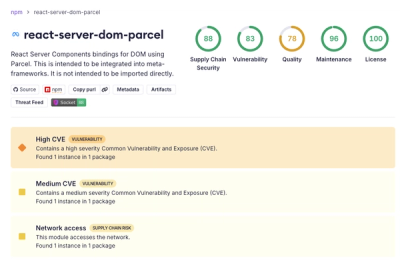
New DoS and source code exposure bugs in React Server Components and Next.js: what’s affected and how to update safely.

Security News
Socket CEO Feross Aboukhadijeh joins Software Engineering Daily to discuss modern software supply chain attacks and rising AI-driven security risks.