


Security News
Deno 2.6 + Socket: Supply Chain Defense In Your CLI
Deno 2.6 introduces deno audit with a new --socket flag that plugs directly into Socket to bring supply chain security checks into the Deno CLI.
By Sarah Gooding - Dec 12, 2025
@zilahir/gatsby-source-wordpress
Advanced tools
Fork of Gatsby source plugin for building websites using the Wordpress CMS as a data source.
Source plugin for pulling data into Gatsby from WordPress sites using the WordPress REST API.
An example site for this plugin is available.
This module currently pulls the following entities from WordPress:
functions.php)We welcome PRs adding support for data from other plugins.
npm install --save gatsby-source-wordpress
First, you need a way to pass environment variables to the build process, so secrets and other secured data aren't committed to source control. We recommend using dotenv which will then expose environment variables. Read more about dotenv and using environment variables here. Then we can use these environment variables and configure our plugin.
// In your gatsby-config.js
module.exports = {
  plugins: [
    /*
    * Gatsby's data processing layer begins with “source”
    * plugins. Here the site sources its data from Wordpress.
    */
    {
      resolve: "gatsby-source-wordpress",
      options: {
        /*
        * The base URL of the Wordpress site without the trailingslash and the protocol. This is required.
        * Example : 'gatsbyjsexamplewordpress.wordpress.com' or 'www.example-site.com'
        */
        baseUrl: "gatsbyjsexamplewordpress.wordpress.com",
        // The protocol. This can be http or https.
        protocol: "http",
        // Indicates whether the site is hosted on wordpress.com.
        // If false, then the assumption is made that the site is self hosted.
        // If true, then the plugin will source its content on wordpress.com using the JSON REST API V2.
        // If your site is hosted on wordpress.org, then set this to false.
        hostingWPCOM: false,
        // If useACF is true, then the source plugin will try to import the Wordpress ACF Plugin contents.
        // This feature is untested for sites hosted on wordpress.com.
        // Defaults to true.
        useACF: true,
        // Include specific ACF Option Pages that have a set post ID
        // Regardless if an ID is set, the default options route will still be retrieved
        // Must be using V3 of ACF to REST to include these routes
        // Example: `["option_page_1", "option_page_2"]` will include the proper ACF option
        // routes with the ID option_page_1 and option_page_2
        // Dashes in IDs will be converted to underscores for use in GraphQL
        acfOptionPageIds: [],
        auth: {
          // If auth.user and auth.pass are filled, then the source plugin will be allowed
          // to access endpoints that are protected with .htaccess.
          htaccess_user: "your-htaccess-username",
          htaccess_pass: "your-htaccess-password",
          htaccess_sendImmediately: false,

          // If hostingWPCOM is true then you will need to communicate with wordpress.com API
          // in order to do that you need to create an app (of type Web) at https://developer.wordpress.com/apps/
          // then add your clientId, clientSecret, username, and password here
          // Learn about environment variables: https://www.gatsbyjs.org/docs/environment-variables
          // If two-factor authentication is enabled then you need to create an Application-Specific Password,
          // see https://en.support.wordpress.com/security/two-step-authentication/#application-specific-passwords
          wpcom_app_clientSecret: process.env.WORDPRESS_CLIENT_SECRET,
          wpcom_app_clientId: "54793",
          wpcom_user: "gatsbyjswpexample@gmail.com",
          wpcom_pass: process.env.WORDPRESS_PASSWORD,

          // If you use "JWT Authentication for WP REST API" (https://wordpress.org/plugins/jwt-authentication-for-wp-rest-api/)
          // plugin, you can specify user and password to obtain access token and use authenticated requests against wordpress REST API.
          jwt_user: process.env.JWT_USER,
          jwt_pass: process.env.JWT_PASSWORD,
        },
        // Set verboseOutput to true to display a verbose output on `npm run develop` or `npm run build`
        // It can help you debug specific API Endpoints problems.
        verboseOutput: false,
        // Set how many pages are retrieved per API request.
        perPage: 100,
        // Search and Replace Urls across WordPress content.
        searchAndReplaceContentUrls: {
          sourceUrl: "https://source-url.com",
          replacementUrl: "https://replacement-url.com",
        },
        // Set how many simultaneous requests are sent at once.
        concurrentRequests: 10,
        // Set WP REST API routes whitelists
        // and blacklists using glob patterns.
        // Defaults to whitelist the routes shown
        // in the example below.
        // See: https://github.com/isaacs/minimatch
        // Example:  `["/*/*/comments", "/yoast/**"]`
        // ` will either include or exclude routes ending in `comments` and
        // all routes that begin with `yoast` from fetch.
        // Whitelisted routes using glob patterns
        includedRoutes: [
          "/*/*/categories",
          "/*/*/posts",
          "/*/*/pages",
          "/*/*/media",
          "/*/*/tags",
          "/*/*/taxonomies",
          "/*/*/users",
        ],
        // Blacklisted routes using glob patterns
        excludedRoutes: ["/*/*/posts/1456"],
        // use a custom normalizer which is applied after the built-in ones.
        normalizer: function({ entities }) {
          return entities
        },
      },
    },
  ],
}
These plugins were tested. We welcome PRs adding support for data from other plugins.
Custom Post Types : it will work seamlessly, no further option needs to be activated. ("Show in REST API" setting needs to be set to true on the custom post in the plugin settings for this to work. It's set to "false" by default.)
ACF The option useACF: true
must be activated in your site's gatsby-config.js.
acf: { ... } fields's contents from any entity which has it
attached (pages, posts, medias, ... you choose from in WordPress backend
while creating a Group of Fields).WP-API-MENUS which gives you the menus and menu locations endpoint.
WPML-REST-API which adds the current locale and available translations to all post types translated with WPML.
wp-rest-polylang which adds the current locale and available translations to all post types translated with Polylang.
Set hostingWPCOM: true.
You will need to provide an API Key.
Note : you don't need this for Wordpress.org hosting in which your WordPress will behave like a self-hosted instance.
Before you run your first query, ensure the WordPress JSON API is working correctly by visiting /wp-json at your WordPress install. The result should be similar to the WordPress demo API.
If you see a page on your site, rather than the JSON output, check if your permalink settings are set to “Plain”. After changing this to any of the other settings, the JSON API should be accessible.
By default gatsby-source-wordpress plugin will fetch data from all endpoints provided by introspection /wp-json response. To customize the routes fetched, two configuration options are available: includeRoutes for whitelisting and excludeRoutes for blacklisting. Both options expect an array of glob patterns. Glob matching is done by minimatch. To test your glob patterns, use this tool. You can inspect discovered routes by using verboseOutput: true configuration option.
If an endpoint is whitelisted and not blacklisted, it will be fetched. Otherwise, it will be ignored.
includedRoutes: [
  "/*/*/posts",
  "/*/*/pages",
  "/*/*/media",
  "/*/*/categories",
  "/*/*/tags",
  "/*/*/taxonomies",
  "/*/*/users",
],
Which would include most commonly used endpoints:
and would skip pulling Comments.
You can query nodes created from Wordpress using GraphQL like the following: Note : Learn to use the GraphQL tool and Ctrl+Spacebar at http://localhost:3000/___graphiql to discover the types and properties of your GraphQL model.
{
  allWordpressPost {
    edges {
      node {
        id
        slug
        title
        content
        excerpt
        date
        modified
      }
    }
  }
}
{
  allWordpressPage {
    edges {
      node {
        id
        title
        content
        excerpt
        date
        modified
        slug
        status
      }
    }
  }
}
Same thing for other type of entity (tag, media, categories, ...).
In the following example, ${Manufacturer} will be replaced by the endpoint
prefix and ${Endpoint} by the name of the endpoint.
To know what's what, check the URL of the endpoint. You can set verboseOutput: true in order to get more information of what's executed by the source plugin
behind the scene.
For example the following URL:
http://my-blog.wordpress.com/wp-json/acf/v2/options
acfoptionsFor example the following URL:
http://my-blog.wordpress.com/wp-api-menus/v2/menu-locations
wpapimenusmenulocations{
allWordpress${Manufacturer}${Endpoint} {
edges {
node {
id
type
// Put your fields here
}
}
}
}
Whether you are using V2 or V3 of ACF to REST, the query below will return options as the default ACF Options page data.
If you have specified acfOptionPageIds in your site's gatsby-config.js (ex: option_page_1), then they will be accessible by their ID:
{
  allWordpressAcfOptions {
    edges {
      node{
        option_page_1 {
          test_acf
        }
        options {
          test_acf
        }
      }
    }
  }
}
Mention the apparition of childWordpressAcfField in the query below :
{
  allWordpressPost {
    edges {
      node {
        id
        slug
        title
        content
        excerpt
        date
        modified
        author
        featured_media
        template
        categories
        tags
        acf {
         // use ___GraphiQL debugger and Ctrl+Spacebar to describe your model.
        }
      }
    }
  }
}
Mention the apparition of childWordpressAcfField in the query below :
{
  allWordpressPage {
    edges {
      node {
        id
        title
        content
        excerpt
        date
        modified
        slug
        author
        featured_media
        template
        acf {
         // use ___GraphiQL debugger and Ctrl+Spacebar to describe your model.
        }
      }
    }
  }
}
ACF Flexible Content returns an array of objects with different types and are handled differently than other fields.
To access those fields, instead of using their field name, you need to use
[field_name]_[post_type] (if you have field named page_builder in
your WordPress pages you would need to use page_builder_page).
To access data stored in these fields, you need to use GraphQL
inline fragments. This
require you to know types of nodes. The easiest way to get the types of nodes is to use
___GraphiQL debugger and run the below query (adjust post type and field name):
{
  allWordpressPage {
    edges {
      node {
        title
        acf {
          page_builder_page {
            __typename
          }
        }
      }
    }
  }
}
When you have node type names, you can use them to create inline fragments.
Full example:
{
  allWordpressPage {
    edges {
      node {
        title
        acf {
          page_builder_page {
            __typename
            ... on WordPressAcf_hero {
              title
              subtitle
            }
            ... on WordpressAcf_text {
              text
            }
            ... on WordpressAcf_image {
              image {
                localFile {
                  childImageSharp {
                    fluid(maxWidth: 800) {
                      ...GatsbyImageSharpFluid_withWebp
                    }
                  }
                }
              }
            }
          }
        }
      }
    }
  }
}
{
  allWordpressPost {
    edges {
      node {
        id
        slug
        title
        content
        excerpt
        date
        modified
        author
        featured_media
        template
        categories
        tags
        wpml_current_locale
        wpml_translations {
          locale
          wordpress_id
          post_title
          href
        }
      }
    }
  }
}
{
  allWordpressPage {
    edges {
      node {
        id
        title
        content
        excerpt
        date
        modified
        slug
        author
        featured_media
        template
        wpml_current_locale
        wpml_translations {
          locale
          wordpress_id
          post_title
          href
        }
      }
    }
  }
}
{
  allWordpressPost {
    edges {
      node {
        id
        slug
        title
        content
        excerpt
        date
        modified
        author
        featured_media
        template
        categories
        tags
        polylang_current_lang
        polylang_translations {
          id
          slug
          title
          content
          excerpt
          date
          modified
          author
          featured_media
          template
          categories
          tags
          polylang_current_lang
        }
      }
    }
  }
}
{
  allWordpressPage {
    edges {
      node {
        id
        title
        content
        excerpt
        date
        modified
        slug
        author
        featured_media
        template
        polylang_current_lang
        polylang_translations {
          id
          title
          content
          excerpt
          date
          modified
          slug
          author
          featured_media
          template
          polylang_current_lang
        }
      }
    }
  }
}
To use image processing you need gatsby-transformer-sharp, gatsby-plugin-sharp and their
dependencies gatsby-image and gatsby-source-filesystem in your gatsby-config.js.
You can apply image processing to:
Image Object or Image URL or field name must be featured_media),Image processing of inline images added in wordpress WYSIWIG editor is currently not supported.
To access image processing in your queries you need to use this pattern:
{
  imageFieldName {
    localFile {
      childImageSharp {
        ...ImageFragment
      }
    }
  }
}
Full example:
{
  allWordpressPost {
    edges {
      node {
        title
        featured_media {
          localFile {
            childImageSharp {
              fixed(width: 500, height: 300) {
                ...GatsbyImageSharpFixed_withWebp
              }
            }
          }
        }
        acf {
          image {
            localFile {
              childImageSharp {
                fluid(maxWidth: 500) {
                  ...GatsbyImageSharpFluid_withWebp
                }
              }
            }
          }
          gallery {
            localFile {
              childImageSharp {
                resize(width: 180, height: 180) {
                  src
                }
              }
            }
          }
        }
      }
    }
  }
}
To learn more about image processing check
The plugin uses the concept of normalizers to transform the json data from WordPress into
GraphQL nodes. You can extend the normalizers by passing a custom function to your gatsby-config.js.
You have a custom post type movie and a related custom taxonomy genre in your WordPress site. Since
gatsby-source-wordpress doesn't know about the relation of the two, we can build an additional normalizer function to map the movie GraphQL nodes to the genre nodes:
function mapMoviesToGenres({ entities }) {
  const genres = entities.filter(e => e.__type === `wordpress__wp_genre`)

  return entities.map(e => {
    if (e.__type === `wordpress__wp_movie`) {
      let hasGenres = e.genres && Array.isArray(e.genres) && e.categories.length
      // Replace genres with links to their nodes.
      if (hasGenres) {
        e.genres___NODE = e.genres.map(
          c => genres.find(gObj => c === gObj.wordpress_id).id
        )
        delete e.genres
      }
    }
    return e
  })

  return entities
}
In your gatsby-config.js you can then pass the function to the plugin options:
module.exports = {
  plugins: [
    {
      resolve: "gatsby-source-wordpress",
      options: {
        // ...
        normalizer: mapMoviesToGenres,
      },
    },
  ],
}
Next to the entities, the object passed to the custom normalizer function also contains other helpful Gatsby functions
and also your wordpress-source-plugin options from gatsby-config.js. To learn more about the passed object see the source code.
gatsby-node.js exampleconst _ = require(`lodash`)
const Promise = require(`bluebird`)
const path = require(`path`)
const slash = require(`slash`)
// Implement the Gatsby API “createPages”. This is
// called after the Gatsby bootstrap is finished so you have
// access to any information necessary to programmatically
// create pages.
// Will create pages for WordPress pages (route : /{slug})
// Will create pages for WordPress posts (route : /post/{slug})
exports.createPages = ({ graphql, actions }) => {
const { createPage } = actions
return new Promise((resolve, reject) => {
// The “graphql” function allows us to run arbitrary
// queries against the local WordPress graphql schema. Think of
// it like the site has a built-in database constructed
// from the fetched data that you can run queries against.
// ==== PAGES (WORDPRESS NATIVE) ====
graphql(
`
{
allWordpressPage {
edges {
node {
id
slug
status
template
}
}
}
}
`
)
.then(result => {
if (result.errors) {
console.log(result.errors)
reject(result.errors)
}
// Create Page pages.
const pageTemplate = path.resolve("./src/templates/page.js")
// We want to create a detailed page for each
// page node. We'll just use the WordPress Slug for the slug.
// The Page ID is prefixed with 'PAGE_'
_.each(result.data.allWordpressPage.edges, edge => {
// Gatsby uses Redux to manage its internal state.
// Plugins and sites can use functions like "createPage"
// to interact with Gatsby.
createPage({
// Each page is required to have a `path` as well
// as a template component. The `context` is
// optional but is often necessary so the template
// can query data specific to each page.
path: `/${edge.node.slug}/`,
component: slash(pageTemplate),
context: {
id: edge.node.id,
},
})
})
})
// ==== END PAGES ====
// ==== POSTS (WORDPRESS NATIVE AND ACF) ====
.then(() => {
graphql(
`
{
allWordpressPost {
edges {
node {
id
slug
status
template
format
}
}
}
}
`
).then(result => {
if (result.errors) {
console.log(result.errors)
reject(result.errors)
}
const postTemplate = path.resolve("./src/templates/post.js")
// We want to create a detailed page for each
// post node. We'll just use the WordPress Slug for the slug.
// The Post ID is prefixed with 'POST_'
_.each(result.data.allWordpressPost.edges, edge => {
createPage({
path: `/${edge.node.slug}/`,
component: slash(postTemplate),
context: {
id: edge.node.id,
},
})
})
resolve()
})
})
// ==== END POSTS ====
})
}
ACF returns false in cases where there is no data to be returned. This can cause conflicting data types in GraphQL and often leads to the error: GraphQL Error Unknown field {field} on type {type}.
To solve this, you can use the acf/format_value filter. There are 2 possible ways to use this:
acf/format_value – filter for every fieldacf/format_value/type={$field_type} – filter for a specific field based on it’s typeUsing the following function, you can check for an empty field and if it's empty return null.
if (!function_exists('acf_nullify_empty')) {
    /**
     * Return `null` if an empty value is returned from ACF.
     *
     * @param mixed $value
     * @param mixed $post_id
     * @param array $field
     *
     * @return mixed
     */
    function acf_nullify_empty($value, $post_id, $field) {
        if (empty($value)) {
            return null;
        }
        return $value;
    }
}
You can then apply this function to all ACF fields using the following code snippet:
add_filter('acf/format_value', 'acf_nullify_empty', 100, 3);
Or if you would prefer to target specific fields, you can use the acf/format_value/type={$field_type} filter. Here are some examples:
add_filter('acf/format_value/type=image', 'acf_nullify_empty', 100, 3);
add_filter('acf/format_value/type=gallery', 'acf_nullify_empty', 100, 3);
add_filter('acf/format_value/type=repeater', 'acf_nullify_empty', 100, 3);
This code should be added as a plugin (recommended), or within the functions.php of a theme.
localFile on type [image field]WordPress has a known issue that can affect how media objects are returned through the REST API.
During the upload process to the WordPress media library, the post_parent value (seen here in the wp_posts table) is set to the ID of the post the image is attached to. This value is unable to be changed by any WordPress administration actions.
When the post an image is attached to becomes inaccessible (e.g. from changing visibility settings, or deleting the post), the image itself is restricted in the REST API:
   {
      "code":"rest_forbidden",
      "message":"You don't have permission to do this.",
      "data":{
         "status":403
      }
   }
which prevents Gatsby from retrieving it.
In order to resolve this, you can manually change the post_parent value of the image record to 0 in the database. The only side effect of this change is that the image will no longer appear in the "Uploaded to this post" filter in the Add Media dialog in the WordPress administration area.
When running locally, or in other situations that may involve self-signed certificates, you may run into the error: The request failed with error code "DEPTH_ZERO_SELF_SIGNED_CERT".
To solve this, you can disable Node.js' rejection of unauthorized certificates by adding the following to gatsby-node.js:
process.env.NODE_TLS_REJECT_UNAUTHORIZED = "0"
FAQs
Fork of Gatsby source plugin for building websites using the Wordpress CMS as a data source.
We found that @zilahir/gatsby-source-wordpress demonstrated a not healthy version release cadence and project activity because the last version was released a year ago. It has 1 open source maintainer collaborating on the project.
Did you know?

Socket for GitHub automatically highlights issues in each pull request and monitors the health of all your open source dependencies. Discover the contents of your packages and block harmful activity before you install or update your dependencies.
Security News
Deno 2.6 introduces deno audit with a new --socket flag that plugs directly into Socket to bring supply chain security checks into the Deno CLI.
Security News
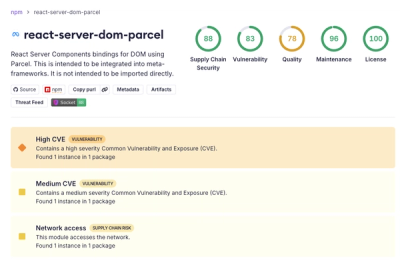
New DoS and source code exposure bugs in React Server Components and Next.js: what’s affected and how to update safely.

Security News
Socket CEO Feross Aboukhadijeh joins Software Engineering Daily to discuss modern software supply chain attacks and rising AI-driven security risks.