

Product
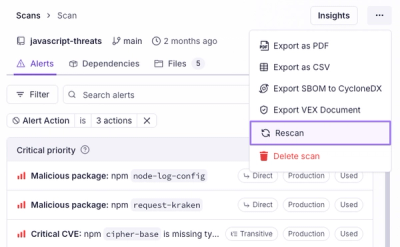
Introducing Immutable Scans
Scan results now load faster and remain consistent over time, with stable URLs and on-demand rescans for fresh security data.
By Nolan Lawson - Jan 23, 2026
apps is a node module for creating and validating Heroku app.json files. It works in node.js and the browser.
The app.json schema is defined using the JSON Schema specification and is validated with the awesome revalidator node module.
See the schema at schema.js.
Download the module from npm:
npm install apps --save
Require it in your script:
var App = require("apps")
If browserify isn't your thing, use the pre-compiled browser-ready bundle in
dist/app.js. Include this file in your html page and it will create
window.App for you.
Instantiate with a JSON filename:
var app = new App(__dirname + "/path/to/app.json")
Instantiate with a JSON string:
var json = "{name: \"small-sharp-tool\", description: \"This app does one little thing, and does it well.\"}"
var app = new App(json)
Instantiate with a JavaScript object:
var app = new App({
  name: "small-sharp-tool",
  description: "This app does one little thing, and does it well.",
  keywords: ["productivity", "HTML5", "scalpel"],
  urls: {
    website: "https://small-sharp-tool.github.io",
    success: "/getting-started"
  },
  env: {
    BUILDPACK_URL: "https://github.com/stomita/heroku-buildpack-phantomjs",
  },
  addons: [
    "openredis",
    "mongolab:shared-single-small"
  ]
})
Once you've instantiated an app, you can validate it:
Validates the app manifest and returns true or false
Returns null if app manifest is valid.
Returns an array of error objects if invalid:
[
  {property: "name", message: "is required"},
  {property: "website", message: "is not a valid url"}
]
Return an object with valid and errors, per the revalidator
module's
validation function.
Return a pretty JSON string representation of the manifest, without any superfluous properties.
Make a web request to concoction for a list of addon prices.
You can fetch app manifests straight from GitHub. The
github-raw-cors-proxy service is used
to make the app.json file downloadable from browsers.
var App = require("apps")
App.fetch('zeke/harp-slideshow-template', function(err, manifest) {
  console.log(err, manifest)
})
Generates an example manifest from example content in the schema.
App.example
npm install
npm test
App
  instantiation
    ✓ accepts a filename
    ✓ accepts a JSON string
    ✓ accepts a JavaScript object
  validation
    ✓ returns null for .errors if app is valid
    ✓ requires name
    ✓ does not allow empty-string name
    ✓ validates website url
    ✓ validates repository url
    ✓ validates logo url
  .toJSON()
    ✓ render pretty JSON
    ✓ ignores properties that are not part of the schema
  .getAddonsPrices()
    ✓ fetches a remote list of addons and their total Price (526ms)
  App.fetch()
    ✓ downloads remote manifests with github shorthand (271ms)
    ✓ downloads remote manifests with fully-qualified github URLs (201ms)
  App.example
    ✓ builds an example manifest from properties found in the schema
    ✓ is valid
    ✓ has expected properties
To prepare a browser-ready bundle in dist/apps.js, run the following:
npm run build
MIT
FAQs
Create, validate, and render Heroku app.json manifests
The npm package apps receives a total of 62 weekly downloads. As such, apps popularity was classified as not popular.
We found that apps demonstrated a not healthy version release cadence and project activity because the last version was released a year ago. It has 1 open source maintainer collaborating on the project.
Did you know?

Socket for GitHub automatically highlights issues in each pull request and monitors the health of all your open source dependencies. Discover the contents of your packages and block harmful activity before you install or update your dependencies.
Product
Scan results now load faster and remain consistent over time, with stable URLs and on-demand rescans for fresh security data.
Product
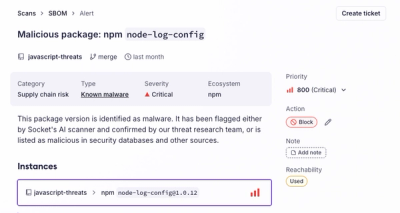
Socket's new Alert Details page is designed to surface more context, with a clearer layout, reachability dependency chains, and structured review.
Product
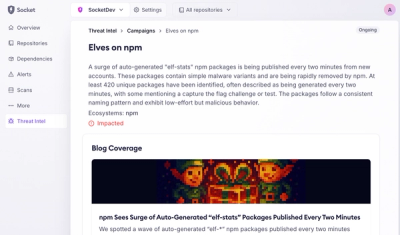
Campaign-level threat intelligence in Socket now shows when active supply chain attacks affect your repositories and packages.