


Security News
Deno 2.6 + Socket: Supply Chain Defense In Your CLI
Deno 2.6 introduces deno audit with a new --socket flag that plugs directly into Socket to bring supply chain security checks into the Deno CLI.
By Sarah Gooding - Dec 12, 2025
astro-script
Advanced tools
Astro Script is a simple component to make it easier to manage script tags in your Astro components and pages.
Once you have setup your Astro project simply run the following command:
# yarn
yarn add astro-script
# npm
npm i astro-script
You can then import the component like this:
---
import { AstroScript } from "astro-script";
// or import Spa from 'astro-spa/Spa.astro'
---

<AstroScript src="/script.js" />
And that's it, you're now ready to go!
There are two ways to add scripts to AstroScript. You can either add them to the src prop or put them inside the <AstroScript></AstroScript> tags. The following example shows both ways:
---
import { AstroScript } from "astro-script";
---

// Add script to src prop
<AstroScript src="/script.js" />
<AstroScript src={Astro.resolve("../relative/path/to/script.js")} />

// Add script to <AstroScript />
<AstroScript>
  <script> console.log("Hello World"); </script>
</AstroScript>
The src prop also supports an array of paths. The following example shows how to add multiple scripts:
---
import { AstroScript } from "astro-script";
---

// Add multiple scripts to src prop
<AstroScript src={["/script1.js", "/script2.js"]} />
You can also pass multiple script tags inside the <AstroScript></AstroScript> tag. The following example shows how to add multiple scripts:
---
import { AstroScript } from "astro-script";
---

// Add multiple scripts to <AstroScript />
<AstroScript>
  <script> console.log("Hello World"); </script>
  <script> console.log("Hello World"); </script>
</AstroScript>
AstroScript also works with external scripts. The following example shows how to add an external script:
---
import { AstroScript } from "astro-script";
---

// Add external script to src prop
<AstroScript src="https://example.com/script.js" />
<AstroScript src={["https://example.com/script1.js", "https://example.com/script2.js"]} />
AstroScript worksIf the src prop is present, AstroScript will first fetch the external scripts and read the internal scripts from the filesystem referenced in the src prop. It'll then merge the scripts and minify & inline them if enabled. If inline is set to false, it'll create a .js file at ${publicPath}/astro-script. The name of the file will a 8 digit truncated hash of the scripts.
If you have passed the scripts inside the <AstroScript></AstroScript> tag, AstroScript will read the scripts from the <script> tags and merge them & minify them if enabled. Any elements other than <script> tags will be ignored.
By default, AstroScript won't run in development mode. If the src prop is present, it'll loop through them and create a script tag for each script. And if you have passed the scripts inside the <AstroScript></AstroScript> tag, the scripts will be left as is.
<script hoist> vs <AstroScript>Starting with v0.20.2, Astro provides the ability to hoist your script tags to the top of the page and bundle them. On the other hand, AstroScript will not hoist the scripts to the top of the page. Instead it will allow you to bundle them at the exact point you want them to be bundled. It also allows you to bundle external scripts.
Type: string or string[]
Default: undefined
The source(s) of the script(s). You can resolve the sources using the Astro.resolve API or you can pass a path relative to the public folder. If the path is relative to the public folder, it must start with /.
Type: boolean
Default: true
Whether or not the scripts should be inline.
Type: boolean
Default: true
Whether or not the scripts should be minified. If true the scripts will be minified using terser.
Type: MinifyOptions (check the link below)
Default: {}
The minify configuration options supported by terser. For more info check the minify options supported by terser.
Type: string
Default: public
The public path of the project.
Type: boolean
Default: import.meta.env !== "development"
Whether or not the optimizations will be performed in development mode.
src prop is present, any <script> tags inside the <AstroScript></AstroScript> tag will be ignored.Astro.resolve can't have extensions other than .js. Because AstroScript doesn't have ability to perform transformation of .jsx, .ts, .tsx, .mjs, .cjs files.dev to true.dev to true you should add the ${publicPath}/astro-script directory to your .gitignore file. Otherwise, you may end up pushing lots of redundant files to your Github repo and CI.FAQs
A simple script management component for Astro
The npm package astro-script receives a total of 2 weekly downloads. As such, astro-script popularity was classified as not popular.
We found that astro-script demonstrated a not healthy version release cadence and project activity because the last version was released a year ago. It has 1 open source maintainer collaborating on the project.
Did you know?

Socket for GitHub automatically highlights issues in each pull request and monitors the health of all your open source dependencies. Discover the contents of your packages and block harmful activity before you install or update your dependencies.
Security News
Deno 2.6 introduces deno audit with a new --socket flag that plugs directly into Socket to bring supply chain security checks into the Deno CLI.
Security News
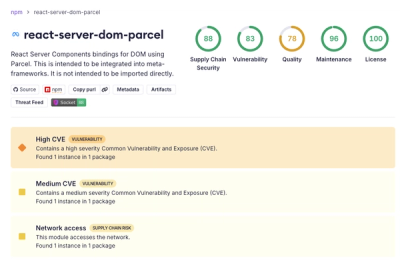
New DoS and source code exposure bugs in React Server Components and Next.js: what’s affected and how to update safely.

Security News
Socket CEO Feross Aboukhadijeh joins Software Engineering Daily to discuss modern software supply chain attacks and rising AI-driven security risks.