

Security News
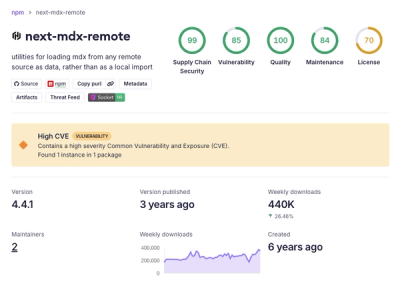
High-Severity RCE Vulnerability Disclosed in next-mdx-remote
HashiCorp disclosed a high-severity RCE in next-mdx-remote affecting versions 4.3.0 to 5.x when compiling untrusted MDX on the server.
By Sarah Gooding - Feb 12, 2026
babelify-cache
Advanced tools

Babel browserify transform.
As of Babel 6.0.0 there are no plugins included by default. For babelify to be useful, you must also include some presets and/or plugins.
# Babel 7
$ npm install --save-dev babelify @babel/core
# Babel 6
$ npm install --save-dev babelify@8 babel-core
$ browserify script.js -o bundle.js -t [ babelify --presets [ @babel/preset-env @babel/preset-react ] --plugins [ @babel/plugin-transform-class-properties ] ]
var fs = require("fs");
var browserify = require("browserify");
browserify("./script.js")
  .transform("babelify", {presets: ["@babel/preset-env", "@babel/preset-react"]})
  .bundle()
  .pipe(fs.createWriteStream("bundle.js"));
NOTE: Presets and plugins need to be installed as separate modules. For the above examples to work, you'd need to also install @babel/preset-env and @babel/preset-react:
$ npm install --save-dev @babel/preset-env @babel/preset-react
Selected options are discussed below. See the babel docs for the complete list of options.
Options may be passed in via standard browserify ways:
$ browserify -t [ babelify --presets [ @babel/preset-env @babel/preset-react ] ]
browserify().transform("babelify", {presets: ["@babel/preset-env", "@babel/preset-react"]});
var babelify = require("babelify");
browserify().transform(babelify, {presets: ["@babel/preset-env", "@babel/preset-react"]});
Or, with the configure method:
browserify().transform(babelify.configure({
  presets: ["@babel/preset-env", "@babel/preset-react"]
}));
By default, all files with the extensions .js, .es, .es6 and .jsx are compiled. You can change this by passing an array of extensions.
NOTE: This will override the default ones so if you want to use any of them you have to add them back.
browserify().transform("babelify", {extensions: [".babel"]});
$ browserify -t [ babelify --extensions .babel ]
Now you can use:
import NavBar from "nav-bar.babel";
var Panels = require("panels.babel");
NOTE: By default, Browserify will only lookup .js and .json files when the extension is omitted (like node's require). To lookup additional extensions, use browserify's extensions option.
browserify({
  extensions: [".babel"]
}).transform("babelify", {
  extensions: [".babel"]
});
$ browserify --extensions=.babel -t [ babelify --extensions .babel ]
Now you can omit the extension and compile .babel files:
import NavBar from "nav-bar";
var Panels = require("panels");
By default, browserify sets the source map sources paths relative to the basedir (or to process.cwd() if not set). To make the sources paths absolute, set the sourceMapsAbsolute option on babelify:
browserify().transform("babelify", {
  sourceMapsAbsolute: true
});
$ browserify -t [ babelify --sourceMapsAbsolute ]
browserify().transform(babelify.configure({
  // Optional ignore regex - if any filenames **do** match this regex then
  // they aren't compiled
  ignore: /regex/,

  // Optional only regex - if any filenames **don't** match this regex
  // then they aren't compiled
  only: /my_es6_folder/
}))
$ browserify -t [ babelify --ignore regex --only my_es6_folder ]
Babelify emits a babelify event with Babel's full result object as the first
argument, and the filename as the second. Browserify doesn't pass-through the
events emitted by a transform, so it's necessary to get a reference to the
transform instance before you can attach a listener for the event:
var b = browserify().transform(babelify);

b.on("transform", function(tr) {
  if (tr instanceof babelify) {
    tr.once("babelify", function(result, filename) {
      result; // => { code, map, ast, metadata }
    });
  }
});
node_modules being transformed?This is the default browserify behavior.
A possible solution is to add:
{
  "browserify": {
    "transform": ["babelify"]
  }
}
to the root of all your modules package.json that you want to be transformed. If you'd like to
specify options then you can use:
{
  "browserify": {
    "transform": [["babelify", { "presets": ["@babel/preset-env"] }]]
  }
}
Another solution (proceed with caution!) is to run babelify as a global transform. Use the babel ignore option to narrow the number of files transformed:
browserify().transform("babelify", {
  global: true,
  ignore: /\/node_modules\/(?!app\/)/
});
The above example will result in a transform that also includes the app module in node_modules: the global flag transform all files, and the ignore regular expression then excludes all those in the node_modules directory except those that are in node_modules/app (since ?! will match if the given suffix is absent).
To use source maps, enable them in browserify with the debug option:
browserify({debug: true}).transform("babelify");
$ browserify -d -t [ babelify ]
If you want the source maps to be of the post-transpiled code, then leave debug on, but turn off babelify's sourceMaps:
browserify({debug: true}).transform("babelify", {sourceMaps: false});
$ browserify -d -t [ babelify --no-sourceMaps ]
FAQs
Babel browserify transform
We found that babelify-cache demonstrated a not healthy version release cadence and project activity because the last version was released a year ago. It has 1 open source maintainer collaborating on the project.
Did you know?

Socket for GitHub automatically highlights issues in each pull request and monitors the health of all your open source dependencies. Discover the contents of your packages and block harmful activity before you install or update your dependencies.
Security News
HashiCorp disclosed a high-severity RCE in next-mdx-remote affecting versions 4.3.0 to 5.x when compiling untrusted MDX on the server.

Security News
Security researchers report widespread abuse of OpenClaw skills to deliver info-stealing malware, exposing a new supply chain risk as agent ecosystems scale.

Security News
Claude Opus 4.6 has uncovered more than 500 open source vulnerabilities, raising new considerations for disclosure, triage, and patching at scale.