Node.js & Typescript Bitget API SDK








Node.js connector for the Bitget APIs and WebSockets:
- Complete integration with all Bitget APIs.
- TypeScript support (with type declarations for most API requests & responses).
- Over 100 integration tests making real API calls & WebSocket connections, validating any changes before they reach npm.
- Robust WebSocket integration with configurable connection heartbeats & automatic reconnect then resubscribe workflows.
- Officially listed Node.js SDK in Bitget API docs.
- Browser support (via webpack bundle - see "Browser Usage" below).
Installation
npm install --save bitget-api
Issues & Discussion
Related projects
Check out my related projects:
- Try my connectors:
- Try my misc utilities:
- Check out my examples:
Documentation
Most methods pass values as-is into HTTP requests. These can be populated using parameters specified by Bitget's API documentation, or check the type definition in each class within this repository (see table below for convenient links to each class).
Structure
This connector is fully compatible with both TypeScript and pure JavaScript projects, while the connector is written in TypeScript. A pure JavaScript version can be built using npm run build, which is also the version published to npm.
The version on npm is the output from the build command and can be used in projects without TypeScript (although TypeScript is definitely recommended).
- src - the whole connector written in TypeScript
- lib - the JavaScript version of the project (built from TypeScript). This should not be edited directly, as it will be overwritten with each release.
- dist - the webpack bundle of the project for use in browser environments (see guidance on webpack below).
- examples - some implementation examples & demonstrations. Contributions are welcome!
REST API Clients
Each REST API group has a dedicated REST client. To avoid confusion, here are the available REST clients and the corresponding API groups:
Examples for using each client can be found in:
If you're missing an example, you're welcome to request one. Priority will be given to github sponsors.
Usage
First, create API credentials on Bitget's website.
All REST clients have can be used in a similar way. However, method names, parameters and responses may vary depending on the API category you're using!
Not sure which function to call or which parameters to use? Click the class name in the table above to look at all the function names (they are in the same order as the official API docs), and check the API docs for a list of endpoints/paramters/responses.
const {
SpotClient,
FuturesClient,
BrokerClient,
} = require('bitget-api');
const API_KEY = 'xxx';
const API_SECRET = 'yyy';
const API_PASS = 'zzz';
const client = new SpotClient({
apiKey: API_KEY,
apiSecret: API_SECRET,
apiPass: API_PASS,
},
);
client.getApiKeyInfo()
.then(result => {
console.log("getApiKeyInfo result: ", result);
})
.catch(err => {
console.error("getApiKeyInfo error: ", err);
});
const symbol = 'BTCUSDT_SPBL';
client.getCandles(symbol, '1min');
.then(result => {
console.log("getCandles result: ", result);
})
.catch(err => {
console.error("getCandles error: ", err);
});
WebSockets
For more examples, including how to use websockets with bitget, check the examples and test folders.
Logging
Customise logging
Pass a custom logger which supports the log methods silly, debug, notice, info, warning and error, or override methods from the default logger as desired.
const { WebsocketClient, DefaultLogger } = require('bitget-api');
DefaultLogger.silly = () => {};
const ws = new WebsocketClient(
{
apiKey: 'API_KEY',
apiSecret: 'API_SECRET',
apiPass: 'API_PASS',
},
DefaultLogger,
);
Debug HTTP requests
In rare situations, you may want to see the raw HTTP requets being built as well as the API response. These can be enabled by setting the BITGETTRACE env var to true.
Browser Usage
Import
This is the "modern" way, allowing the package to be directly imported into frontend projects with full typescript support.
- Install these dependencies
npm install crypto-browserify stream-browserify
- Add this to your
tsconfig.json
{
  "compilerOptions": {
    "paths": {
      "crypto": [
        "./node_modules/crypto-browserify"
      ],
      "stream": [
        "./node_modules/stream-browserify"
      ]
}
- Declare this in the global context of your application (ex: in polyfills for angular)
(window as any).global = window;
Webpack
This is the "old" way of using this package on webpages. This will build a minified js bundle that can be pulled in using a script tag on a website.
Build a bundle using webpack:
npm installnpm buildnpm pack
The bundle can be found in dist/. Altough usage should be largely consistent, smaller differences will exist. Documentation is still TODO - contributions welcome.
Contributions & Thanks
Donations
tiagosiebler
Support my efforts to make algo trading accessible to all - register with my referral links:
Contributions & Pull Requests
Contributions are encouraged, I will review any incoming pull requests. See the issues tab for todo items.
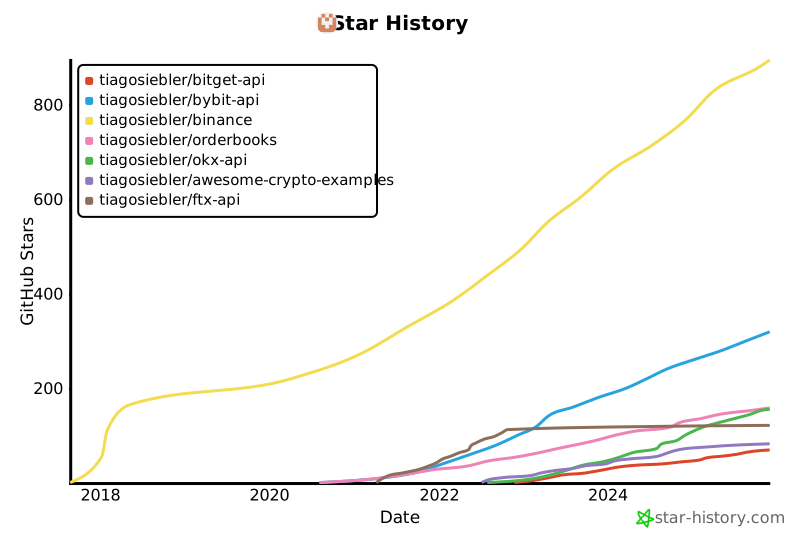
Star History