

Product
Socket for Jira Is Now Available
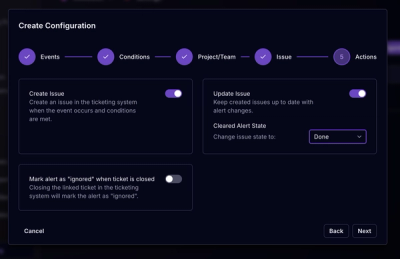
Socket for Jira lets teams turn alerts into Jira tickets with manual creation, automated ticketing rules, and two-way sync.
By Jeppe Hasseriis - Apr 20, 2026
cors-express-middleware
Advanced tools




CORS is a node.js package for providing a Connect/Express middleware that can be used to enable CORS with various options.
Follow me (@troygoode) on Twitter!
This is a Node.js module available through the
npm registry. Installation is done using the
npm install command:
$ npm install cors
var express = require('express')
var cors = require('cors')
var app = express()

app.use(cors())

app.get('/products/:id', function (req, res, next) {
  res.json({msg: 'This is CORS-enabled for all origins!'})
})

app.listen(80, function () {
  console.log('CORS-enabled web server listening on port 80')
})
var express = require('express')
var cors = require('cors')
var app = express()

app.get('/products/:id', cors(), function (req, res, next) {
  res.json({msg: 'This is CORS-enabled for a Single Route'})
})

app.listen(80, function () {
  console.log('CORS-enabled web server listening on port 80')
})
var express = require('express')
var cors = require('cors')
var app = express()

var corsOptions = {
  origin: 'http://example.com',
  optionsSuccessStatus: 200 // some legacy browsers (IE11, various SmartTVs) choke on 204
}

app.get('/products/:id', cors(corsOptions), function (req, res, next) {
  res.json({msg: 'This is CORS-enabled for only example.com.'})
})

app.listen(80, function () {
  console.log('CORS-enabled web server listening on port 80')
})
This module supports validating the origin dynamically using a function provided
to the origin option. This function will be passed a string that is the origin
(or undefined if the request has no origin), and a callback with the signature
callback(error, origin).
The origin argument to the callback can be any value allowed for the origin
option of the middleware, except a function. See the
configuration options section for more information on all
the possible value types.
This function is designed to allow the dynamic loading of allowed origin(s) from a backing datasource, like a database.
var express = require('express')
var cors = require('cors')
var app = express()

var corsOptions = {
  origin: function (origin, callback) {
    // db.loadOrigins is an example call to load
    // a list of origins from a backing database
    db.loadOrigins(function (error, origins) {
      callback(error, origins)
    })
  }
}

app.get('/products/:id', cors(corsOptions), function (req, res, next) {
  res.json({msg: 'This is CORS-enabled for an allowed domain.'})
})

app.listen(80, function () {
  console.log('CORS-enabled web server listening on port 80')
})
Certain CORS requests are considered 'complex' and require an initial
OPTIONS request (called the "pre-flight request"). An example of a
'complex' CORS request is one that uses an HTTP verb other than
GET/HEAD/POST (such as DELETE) or that uses custom headers. To enable
pre-flighting, you must add a new OPTIONS handler for the route you want
to support:
var express = require('express')
var cors = require('cors')
var app = express()

app.options('/products/:id', cors()) // enable pre-flight request for DELETE request
app.del('/products/:id', cors(), function (req, res, next) {
  res.json({msg: 'This is CORS-enabled for all origins!'})
})

app.listen(80, function () {
  console.log('CORS-enabled web server listening on port 80')
})
You can also enable pre-flight across-the-board like so:
app.options('*', cors()) // include before other routes
NOTE: When using this middleware as an application level middleware (for
example, app.use(cors())), pre-flight requests are already handled for all
routes.
var express = require('express')
var cors = require('cors')
var app = express()

var allowlist = ['http://example1.com', 'http://example2.com']
var corsOptionsDelegate = function (req, callback) {
  var corsOptions;
  if (allowlist.indexOf(req.header('Origin')) !== -1) {
    corsOptions = { origin: true } // reflect (enable) the requested origin in the CORS response
  } else {
    corsOptions = { origin: false } // disable CORS for this request
  }
  callback(null, corsOptions) // callback expects two parameters: error and options
}

app.get('/products/:id', cors(corsOptionsDelegate), function (req, res, next) {
  res.json({msg: 'This is CORS-enabled for an allowed domain.'})
})

app.listen(80, function () {
  console.log('CORS-enabled web server listening on port 80')
})
origin: Configures the Access-Control-Allow-Origin CORS header. Possible values:
Boolean - set origin to true to reflect the request origin, as defined by req.header('Origin'), or set it to false to disable CORS.String - set origin to a specific origin. For example if you set it to "http://example.com" only requests from "http://example.com" will be allowed.RegExp - set origin to a regular expression pattern which will be used to test the request origin. If it's a match, the request origin will be reflected. For example the pattern /example\.com$/ will reflect any request that is coming from an origin ending with "example.com".Array - set origin to an array of valid origins. Each origin can be a String or a RegExp. For example ["http://example1.com", /\.example2\.com$/] will accept any request from "http://example1.com" or from a subdomain of "example2.com".Function - set origin to a function implementing some custom logic. The function takes the request origin as the first parameter and a callback (called as callback(err, origin), where origin is a non-function value of the origin option) as the second.methods: Configures the Access-Control-Allow-Methods CORS header. Expects a comma-delimited string (ex: 'GET,PUT,POST') or an array (ex: ['GET', 'PUT', 'POST']).allowedHeaders: Configures the Access-Control-Allow-Headers CORS header. Expects a comma-delimited string (ex: 'Content-Type,Authorization') or an array (ex: ['Content-Type', 'Authorization']). If not specified, defaults to reflecting the headers specified in the request's Access-Control-Request-Headers header.exposedHeaders: Configures the Access-Control-Expose-Headers CORS header. Expects a comma-delimited string (ex: 'Content-Range,X-Content-Range') or an array (ex: ['Content-Range', 'X-Content-Range']). If not specified, no custom headers are exposed.credentials: Configures the Access-Control-Allow-Credentials CORS header. Set to true to pass the header, otherwise it is omitted.maxAge: Configures the Access-Control-Max-Age CORS header. Set to an integer to pass the header, otherwise it is omitted.preflightContinue: Pass the CORS preflight response to the next handler.optionsSuccessStatus: Provides a status code to use for successful OPTIONS requests, since some legacy browsers (IE11, various SmartTVs) choke on 204.The default configuration is the equivalent of:
{
  "origin": "*",
  "methods": "GET,HEAD,PUT,PATCH,POST,DELETE",
  "preflightContinue": false,
  "optionsSuccessStatus": 204
}
For details on the effect of each CORS header, read this article on web.dev.
A demo that illustrates CORS working (and not working) using React is available here: https://node-cors-client.netlify.com
Code for that demo can be found here:
FAQs
Node.js CORS middleware
We found that cors-express-middleware demonstrated a not healthy version release cadence and project activity because the last version was released a year ago. It has 1 open source maintainer collaborating on the project.
Did you know?

Socket for GitHub automatically highlights issues in each pull request and monitors the health of all your open source dependencies. Discover the contents of your packages and block harmful activity before you install or update your dependencies.
Product
Socket for Jira lets teams turn alerts into Jira tickets with manual creation, automated ticketing rules, and two-way sync.
Company News
Socket won two 2026 Reppy Awards from RepVue, ranking in the top 5% of all sales orgs. AE Alexandra Lister shares what it's like to grow a sales career here.

Security News
NIST will stop enriching most CVEs under a new risk-based model, narrowing the NVD's scope as vulnerability submissions continue to surge.