

Product
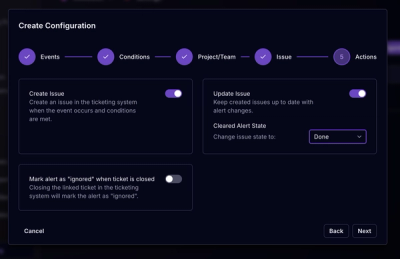
Socket for Jira Is Now Available
Socket for Jira lets teams turn alerts into Jira tickets with manual creation, automated ticketing rules, and two-way sync.
By Jeppe Hasseriis - Apr 20, 2026
A Node.js implementation of EDHOC (Ephemeral Diffie-Hellman Over COSE) protocol for lightweight authenticated key exchange in IoT and other constrained environments.
A pure TypeScript implementation of the Ephemeral Diffie-Hellman Over COSE (EDHOC) protocol, as specified in RFC 9528. It provides an efficient and lightweight way to establish secure communication with minimal overhead.
EDHOC is designed for lightweight communication and is particularly suitable for protocols like CoAP and OSCORE, but can work independently of the application and transport layers, ensuring minimal overhead while maintaining strong security guarantees. The library provides a default software implementation for X.509 credentials, with support for additional formats such as C509, CWT, and CCS coming soon. It also includes a software-based cryptographic implementation utilizing @noble/curves. Additionally, it exposes credential and cryptographic API interfaces to allow for custom implementations, such as PKCS#11-based solutions.
@noble/curvesInstall the package via npm:
npm install edhoc
The simplest EDHOC handshake using pre-shared keys (Method 0):
import { EDHOC, EdhocMethod, EdhocSuite } from 'node-edhoc';

// ...

const initiator = new EDHOC(10, [ EdhocMethod.Method0 ], [ EdhocSuite.Suite0 ], credentialsManager, cryptoManager);
const responder = new EDHOC(20, [ EdhocMethod.Method0 ], [ EdhocSuite.Suite0 ], credentialsManager, cryptoManager);

// Message 1: Initiator → Responder
const message1 = await initiator.composeMessage1();
await responder.processMessage1(message1);

// Message 2: Responder → Initiator
const message2 = await responder.composeMessage2();
await initiator.processMessage2(message2);

// Message 3: Initiator → Responder
const message3 = await initiator.composeMessage3();
await responder.processMessage3(message3);

// ...
You can include additional authorization data in EDHOC messages:
// initiator.js
const ead_1 = [{
  label: 1000,
  value: Buffer.from('External Data')
}];

const message1 = await initiator.composeMessage1(ead_1);

// responder.js
const receivedEAD = await responder.processMessage1(message1);
Using X.509 certificates for authentication:
import {
  EDHOC,
  X509CertificateCredentialManager,
  DefaultEdhocCryptoManager
} from 'node-edhoc';

// Setup credential managers
const initiatorCreds = new X509CertificateCredentialManager(
  [initiatorCert],
  initiatorKeyID
);
initiatorCreds.addTrustedCA(trustedCA);

// Setup crypto managers
const initiatorCrypto = new DefaultEdhocCryptoManager();

// Initialize EDHOC with certificate-based auth
const initiator = new EDHOC(
  10,
  [ EdhocMethod.Method0 ],
  [ EdhocSuite.Suite2 ],
  initiatorCreds,
  initiatorCrypto
);
import {
  EDHOC,
  EdhocMethod,
  EdhocSuite,
  X509CertificateCredentialManager,
  DefaultEdhocCryptoManager,
} from 'node-edhoc';

// Set up credentials with the private key
const credMgr = new X509CertificateCredentialManager([myCert], myPrivateKey);
credMgr.addTrustedCA(caCert);

// Set up crypto
const crypto = new DefaultEdhocCryptoManager();

const session = new EDHOC(
  10,
  [EdhocMethod.Method0],
  [EdhocSuite.Suite2],
  credMgr,
  crypto,
);
CCS (CWT Claims Set) credentials are lightweight CBOR-encoded identity documents
commonly used in constrained IoT environments. Each CCS is a CBOR map containing
a subject name and a COSE_Key with the party's public key, identified by a kid
(key ID) value.
import cbor from 'cbor';
import {
  EDHOC,
  EdhocMethod,
  EdhocSuite,
  CCSCredentialManager,
  DefaultEdhocCryptoManager,
} from 'node-edhoc';

// --- Step 1: Build CCS credentials as CBOR ---
//
// A CCS follows the structure from RFC 8747 (cnf claim) with a COSE_Key (RFC 9052):
//
//   {
//     2: "subject-name",      / sub: subject identifier /
//     8: {                    / cnf: confirmation claim  /
//       1: {                  / COSE_Key                 /
//         1: kty,             /   key type (2 = EC2)     /
//         2: kid_bstr,        /   kid as bstr            /
//        -1: crv,             /   curve (1 = P-256)      /
//        -2: x_coord,         /   x-coordinate (32 B)    /
//        -3: y_coord          /   y-coordinate (32 B)    /
//       }
//     }
//   }

function buildCCS(
  subject: string,
  kid: number,
  curve: number,
  publicKeyX: Buffer,
  publicKeyY: Buffer,
): Buffer {
  // kid on the wire is a 1-byte bstr containing the CBOR encoding of the kid value
  const kidCborByte = kid >= 0 ? kid : (0x20 | (-(kid + 1)));

  const coseKey = new Map<number, any>();
  coseKey.set(1, 2);                          // kty: EC2
  coseKey.set(2, Buffer.from([kidCborByte])); // kid
  coseKey.set(-1, curve);                     // crv: P-256 = 1
  coseKey.set(-2, publicKeyX);                // x (32 bytes)
  coseKey.set(-3, publicKeyY);                // y (32 bytes)

  const ccs = new Map<number, any>();
  ccs.set(2, subject);                        // sub
  ccs.set(8, new Map([[1, coseKey]]));         // cnf → COSE_Key

  return cbor.encode(ccs);
}

// Example using RFC 9529 Chapter 3 test vector values (P-256):
const myPublicKeyX  = Buffer.from('ac75e9ece3e50bfc8ed60399889522405c47bf16df96660a41298cb4307f7eb6', 'hex');
const myPublicKeyY  = Buffer.from('6e5de611388a4b8a8211334ac7d37ecb52a387d257e6db3c2a93df21ff3affc8', 'hex');
const myCCS = buildCCS('42-50-31-FF-EF-37-32-39', -12, 1, myPublicKeyX, myPublicKeyY);

const peerPublicKeyX = Buffer.from('bbc34960526ea4d32e940cad2a234148ddc21791a12afbcbac93622046dd44f0', 'hex');
const peerPublicKeyY = Buffer.from('4519e257236b2a0ce2023f0931f1f386ca7afda64fcde0108c224c51eabf6072', 'hex');
const peerCCS = buildCCS('example.edu', -19, 1, peerPublicKeyX, peerPublicKeyY);

// --- Step 2: Register credentials ---

const credMgr = new CCSCredentialManager();
credMgr.addOwnCredential(-12, myCCS, myPublicKeyX, myPrivateKey);      // kid, CCS bytes, public key (x-only), private key
credMgr.addPeerCredential(-19, peerCCS, peerPublicKeyX);               // kid, CCS bytes, public key (x-only)

// --- Step 3: Set up crypto ---

const crypto = new DefaultEdhocCryptoManager();

// --- Step 4: Create session (Method 3 = StaticDH both sides) ---

const session = new EDHOC(
  10,
  [EdhocMethod.Method3],
  [EdhocSuite.Suite2],
  credMgr,
  crypto,
);
After a successful handshake, you can export the OSCORE security context:
const initiatorContext = await initiator.exportOSCORE();
const responderContext = await responder.exportOSCORE();

console.log('Master Secret:', initiatorContext.masterSecret);
console.log('Master Salt:', initiatorContext.masterSalt);
console.log('Sender ID:', initiatorContext.senderId);
console.log('Recipient ID:', initiatorContext.recipientId);
Perform a key update for an existing OSCORE context:
const keyUpdateContext = Buffer.from('new-entropy-data');

// Update keys for both parties
await initiator.keyUpdate(keyUpdateContext);
await responder.keyUpdate(keyUpdateContext);

// Export new OSCORE context
const newContext = await initiator.exportOSCORE();
Export application-specific keys:
// Export a 32-byte key with label 40001
const key = await initiator.exportKey(40001, 32);
For more detailed examples and API documentation, please refer to our API Documentation.
For detailed documentation, refer to:
Contributions are welcome! To contribute:
Please ensure your code follows the existing style and structure of the project.
This project is licensed under the MIT License.
This implementation is based on the EDHOC specification as defined in RFC 9528. Special thanks to the developers of libedhoc for their foundational work on EDHOC in C.
FAQs
A Node.js implementation of EDHOC (Ephemeral Diffie-Hellman Over COSE) protocol for lightweight authenticated key exchange in IoT and other constrained environments.
The npm package edhoc receives a total of 78 weekly downloads. As such, edhoc popularity was classified as not popular.
We found that edhoc demonstrated a healthy version release cadence and project activity because the last version was released less than a year ago. It has 1 open source maintainer collaborating on the project.
Did you know?

Socket for GitHub automatically highlights issues in each pull request and monitors the health of all your open source dependencies. Discover the contents of your packages and block harmful activity before you install or update your dependencies.
Product
Socket for Jira lets teams turn alerts into Jira tickets with manual creation, automated ticketing rules, and two-way sync.
Company News
Socket won two 2026 Reppy Awards from RepVue, ranking in the top 5% of all sales orgs. AE Alexandra Lister shares what it's like to grow a sales career here.

Security News
NIST will stop enriching most CVEs under a new risk-based model, narrowing the NVD's scope as vulnerability submissions continue to surge.