


Company News
Socket Has Acquired Secure Annex
Socket has acquired Secure Annex to expand extension security across browsers, IDEs, and AI tools.
By Feross Aboukhadijeh - Apr 28, 2026



elm-css lets you define CSS in Elm. (For an Elm styling system that is a
complete departure from CSS, check out style-elements.)
Here's an example of how to define some elm-css styles:
module MyCss exposing (..)

import Css exposing (..)
import Css.Elements exposing (body, li)
import Css.Namespace exposing (namespace)


type CssClasses
    = NavBar


type CssIds
    = Page


css =
    (stylesheet << namespace "dreamwriter")
    [ body
        [ overflowX auto
        , minWidth (px 1280)
        ]
    , id Page
        [ backgroundColor (rgb 200 128 64)
        , color (hex "CCFFFF")
        , width (pct 100)
        , height (pct 100)
        , boxSizing borderBox
        , padding (px 8)
        , margin zero
        ]
    , class NavBar
        [ margin zero
        , padding zero
        , children
            [ li
                [ (display inlineBlock) |> important
                , color primaryAccentColor
                ]
            ]
        ]
    ]


primaryAccentColor =
    hex "ccffaa"
Here's what you can do with this code:
.css file from it.NavBar and Page with your Elm view code, so your classes and IDs can never get out of sync due to a typo or refactor.elm-css works hard to prevent invalid styles from being generated; for example,
if you write color "blah" or margin (rgb 1 2 3), you'll get a type mismatch. If you write (rgb 3000 0 -3) you'll get a build-time validation error (RGB values must be between 0 and 255) if you try to compile it to a stylesheet.
elm-css draws inspiration from the excellent Sass, Stylus, and CSS Modules. It includes popular features like:
There are two popular approaches to using it; you can use either or combine both of these, depending on your needs and preferences.
One way to use elm-css is for inline styles, using the asPairs function:
styles =
    Css.asPairs >> Html.Attributes.style

button [ styles [ position absolute, left (px 5) ] ]
    [ text "Whee!" ]
This approach is the simplest way to get started with elm-css. One advantage of inline styles is that these can be dynamically changed at runtime; a limitation is that CSS pseudo-classes and pseudo-elements cannot be used with inline styles.
You can also use elm-css as a CSS preprocessor which generates separate .css files.
To do this, you will need to install both the node module and the Elm library:
npm install -g elm-css
elm package install rtfeldman/elm-css
Then you'll need a special module with a port for elm-css to access:
port module Stylesheets exposing (..)

import Css.File exposing (CssFileStructure, CssCompilerProgram)
import MyCss


port files : CssFileStructure -> Cmd msg


fileStructure : CssFileStructure
fileStructure =
    Css.File.toFileStructure
        [ ( "index.css", Css.File.compile [ MyCss.css ] ) ]


main : CssCompilerProgram
main =
    Css.File.compiler files fileStructure
Run elm-css on the file containing this Stylesheets module.
Then include that css file in your web page.
The above elm-css stylesheet compiles to the following .css file:
body {
    overflow-x: auto;
    min-width: 1280px;
}

#dreamwriterPage {
    background-color: rgb(200, 128, 64);
    color: #CCFFFF;
    width: 100%;
    height: 100%;
    box-sizing: border-box;
    padding: 8px;
    margin: 0;
}

.dreamwriterNavBar {
    margin: 0;
    padding: 0;
}

.dreamwriterNavBar > li {
    display: inline-block !important;
    color: #ccffaa;
}
Try it out! (make sure you already have elm installed, e.g. with npm install -g elm)
$ npm install -g elm-css
$ git clone https://github.com/rtfeldman/elm-css.git
$ cd elm-css/examples
$ elm-css src/Stylesheets.elm
$ less homepage.css
A gentle introduction to some of the features of elm-css is also available in
the tutorial.
There are a few examples to check out!
elm-css with Elm view codeHere's how to use elm-css in your projects:
In your Elm code, use the same union types to represent classes and ids. Then they can't get out of sync with your CSS. To do this, you'll need special versions the of id, class, and classList functions from elm-html.
Install the handy package that combines elm-html and elm-css:
elm package install rtfeldman/elm-css-helpers
The Elm.CssHelpers.withNamespace returns a record full of handy functions. Use that, and then construct Html using classes and ids defined in your union types. For example:
module MyView exposing (..)


import Html.CssHelpers
import MyCss


{ id, class, classList } =
    Html.CssHelpers.withNamespace "dreamwriter"


view =
    Html.div []
        [ Html.div [ class [ MyCss.NavBar ] ] [ Html.text "this has the NavBar class" ]
        , Html.div [ id MyCss.Page ] [ Html.text "this has the Page id" ]
        ]
elm-css is still in development. Not all CSS properties have been added yet.
If you run into this problem, elm-css includes the property function. It takes
two Strings; the property key, and its value.
e.g.
We want z-index, but suppose elm-css did not implement it. We would define it ourselves:
import Css exposing (..)

zIndex : Int -> Mixin
zIndex i =
    property "z-index" <| toString i
Now zIndex 9999 is available to use inside our Stylesheet.
FAQs
Elm-based CSS Preprocessor
The npm package elm-css receives a total of 57 weekly downloads. As such, elm-css popularity was classified as not popular.
We found that elm-css demonstrated a not healthy version release cadence and project activity because the last version was released a year ago. It has 1 open source maintainer collaborating on the project.
Did you know?

Socket for GitHub automatically highlights issues in each pull request and monitors the health of all your open source dependencies. Discover the contents of your packages and block harmful activity before you install or update your dependencies.
Company News
Socket has acquired Secure Annex to expand extension security across browsers, IDEs, and AI tools.

Research
/Security News
Socket is tracking cloned Open VSX extensions tied to GlassWorm, with several updated from benign-looking sleepers into malware delivery vehicles.
Product
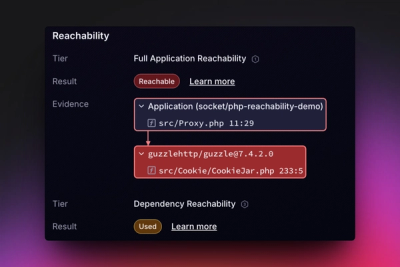
Reachability analysis for PHP is now available in experimental, helping teams identify which vulnerabilities are actually exploitable.