Security News
curl Shuts Down Bug Bounty Program After Flood of AI Slop Reports
A surge of AI-generated vulnerability reports has pushed open source maintainers to rethink bug bounties and tighten security disclosure processes.
Process execution for humans
Sindre's open source work is supported by the community
Special thanks to:
Execa runs commands in your script, application or library. Unlike shells, it is optimized for programmatic usage. Built on top of the child_process core module.
zx.npx.PATHEXT, graceful termination, and more.Uint8Arrays, iterables, objects and almost any other type.stdout and stderr similar to what is printed on the terminal.npm install execa
Execution:
Input/output:
Advanced usage:
import {execa} from 'execa';
const {stdout} = await execa`npm run build`;
// Print command's output
console.log(stdout);
import {$} from 'execa';
const {stdout: name} = await $`cat package.json`.pipe`grep name`;
console.log(name);
const branch = await $`git branch --show-current`;
await $`dep deploy --branch=${branch}`;
await Promise.all([
$`sleep 1`,
$`sleep 2`,
$`sleep 3`,
]);
const directoryName = 'foo bar';
await $`mkdir /tmp/${directoryName}`;
$ npm install -D eslint
await execa({preferLocal: true})`eslint`;
const {stdout, pipedFrom} = await execa`npm run build`
.pipe`sort`
.pipe`head -n 2`;
// Output of `npm run build | sort | head -n 2`
console.log(stdout);
// Output of `npm run build | sort`
console.log(pipedFrom[0].stdout);
// Output of `npm run build`
console.log(pipedFrom[0].pipedFrom[0].stdout);
const {all} = await execa({all: true})`npm run build`;
// stdout + stderr, interleaved
console.log(all);
const {stdout} = await execa({stdout: ['pipe', 'inherit']})`npm run build`;
// stdout is also printed to the terminal
console.log(stdout);
const getInputString = () => { /* ... */ };
const {stdout} = await execa({input: getInputString()})`sort`;
console.log(stdout);
// Similar to: npm run build < input.txt
await execa({stdin: {file: 'input.txt'}})`npm run build`;
// Similar to: npm run build > output.txt
await execa({stdout: {file: 'output.txt'}})`npm run build`;
const {stdout} = await execa({lines: true})`npm run build`;
// Print first 10 lines
console.log(stdout.slice(0, 10).join('\n'));
for await (const line of execa`npm run build`) {
if (line.includes('WARN')) {
console.warn(line);
}
}
let count = 0;
// Filter out secret lines, then prepend the line number
const transform = function * (line) {
if (!line.includes('secret')) {
yield `[${count++}] ${line}`;
}
};
await execa({stdout: transform})`npm run build`;
const response = await fetch('https://example.com');
await execa({stdin: response.body})`sort`;
import {execa} from 'execa';
import {pipeline} from 'node:stream/promises';
import {createReadStream, createWriteStream} from 'node:fs';
await pipeline(
createReadStream('./input.txt'),
execa`node ./transform.js`.duplex(),
createWriteStream('./output.txt'),
);
// parent.js
import {execaNode} from 'execa';
const subprocess = execaNode`child.js`;
await subprocess.sendMessage('Hello from parent');
const message = await subprocess.getOneMessage();
console.log(message); // 'Hello from child'
// child.js
import {getOneMessage, sendMessage} from 'execa';
const message = await getOneMessage(); // 'Hello from parent'
const newMessage = message.replace('parent', 'child'); // 'Hello from child'
await sendMessage(newMessage);
// main.js
import {execaNode} from 'execa';
const ipcInput = [
{task: 'lint', ignore: /test\.js/},
{task: 'copy', files: new Set(['main.js', 'index.js']),
}];
await execaNode({ipcInput})`build.js`;
// build.js
import {getOneMessage} from 'execa';
const ipcInput = await getOneMessage();
// main.js
import {execaNode} from 'execa';
const {ipcOutput} = await execaNode`build.js`;
console.log(ipcOutput[0]); // {kind: 'start', timestamp: date}
console.log(ipcOutput[1]); // {kind: 'stop', timestamp: date}
// build.js
import {sendMessage} from 'execa';
const runBuild = () => { /* ... */ };
await sendMessage({kind: 'start', timestamp: new Date()});
await runBuild();
await sendMessage({kind: 'stop', timestamp: new Date()});
// main.js
import {execaNode} from 'execa';
const controller = new AbortController();
setTimeout(() => {
controller.abort();
}, 5000);
await execaNode({
cancelSignal: controller.signal,
gracefulCancel: true,
})`build.js`;
// build.js
import {getCancelSignal} from 'execa';
const cancelSignal = await getCancelSignal();
const url = 'https://example.com/build/info';
const response = await fetch(url, {signal: cancelSignal});
import {execa, ExecaError} from 'execa';
try {
await execa`unknown command`;
} catch (error) {
if (error instanceof ExecaError) {
console.log(error);
}
/*
ExecaError: Command failed with ENOENT: unknown command
spawn unknown ENOENT
at ...
at ... {
shortMessage: 'Command failed with ENOENT: unknown command\nspawn unknown ENOENT',
originalMessage: 'spawn unknown ENOENT',
command: 'unknown command',
escapedCommand: 'unknown command',
cwd: '/path/to/cwd',
durationMs: 28.217566,
failed: true,
timedOut: false,
isCanceled: false,
isTerminated: false,
isMaxBuffer: false,
code: 'ENOENT',
stdout: '',
stderr: '',
stdio: [undefined, '', ''],
pipedFrom: []
[cause]: Error: spawn unknown ENOENT
at ...
at ... {
errno: -2,
code: 'ENOENT',
syscall: 'spawn unknown',
path: 'unknown',
spawnargs: [ 'command' ]
}
}
*/
}
await execa`npm run build`;
await execa`npm run test`;
import {execa as execa_} from 'execa';
import {createLogger, transports} from 'winston';
// Log to a file using Winston
const transport = new transports.File({filename: 'logs.txt'});
const logger = createLogger({transports: [transport]});
const LOG_LEVELS = {
command: 'info',
output: 'verbose',
ipc: 'verbose',
error: 'error',
duration: 'info',
};
const execa = execa_({
verbose(verboseLine, {message, ...verboseObject}) {
const level = LOG_LEVELS[verboseObject.type];
logger[level](message, verboseObject);
},
});
await execa`npm run build`;
await execa`npm run test`;
ShellJS is a portable Unix shell commands implementation for Node.js. It offers a higher-level API for executing commands but does not support returning promises natively.
Cross-spawn is a cross-platform solution for spawning child processes. It aims to solve compatibility issues on Windows but does not provide a promise-based API.
FAQs
Process execution for humans
The npm package execa receives a total of 119,162,776 weekly downloads. As such, execa popularity was classified as popular.
We found that execa demonstrated a healthy version release cadence and project activity because the last version was released less than a year ago.Β It has 2 open source maintainers collaborating on the project.
Did you know?

Socket for GitHub automatically highlights issues in each pull request and monitors the health of all your open source dependencies. Discover the contents of your packages and block harmful activity before you install or update your dependencies.

Security News
A surge of AI-generated vulnerability reports has pushed open source maintainers to rethink bug bounties and tighten security disclosure processes.

Product
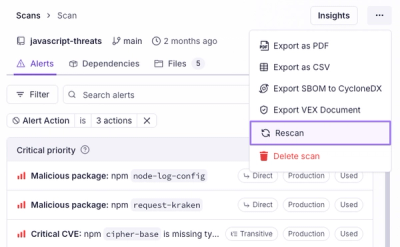
Scan results now load faster and remain consistent over time, with stable URLs and on-demand rescans for fresh security data.

Product
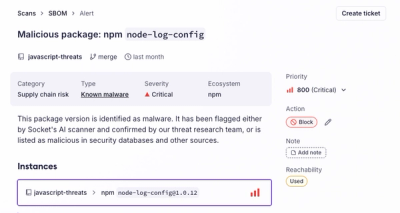
Socket's new Alert Details page is designed to surface more context, with a clearer layout, reachability dependency chains, and structured review.