

Security News
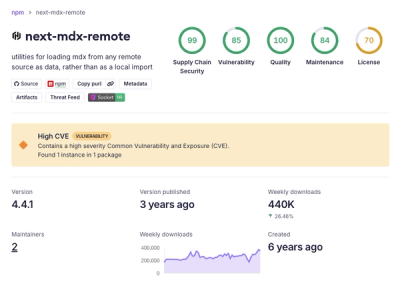
High-Severity RCE Vulnerability Disclosed in next-mdx-remote
HashiCorp disclosed a high-severity RCE in next-mdx-remote affecting versions 4.3.0 to 5.x when compiling untrusted MDX on the server.
By Sarah Gooding - Feb 12, 2026


Recursively resolve templates in an object, string or array.
v0.2.0 API changes
The top-level export now returns a function that takes an options object, which then returns the function to use.
var expand = require('expand');
var resolve = expand({regex: /:(\w+)/});
resolve(':a/:b', {a: 'foo', b: 'bar'});
//=> 'foo/bar'
Install with npm
$ npm i expand --save
var expand = require('expand')();
expand({a: '<%= b %>', b: 'c'});
//=> {a: 'c', b: 'c'}

expand({a: '<%= b.c.d %>', b: {c: {d: 'eee'}}});
//=> {a: 'eee', b: {c: {d: 'eee' }}}
Params
expand(valueToExpand, dataToUse, options);
value {String|Array|Object}: The value with templates to resolve.data {Object}: Pass the data to use for resolving templates. If the first argument is an object, this is optional.options {Object}: Pass the regex to use for matching templates.returns {any}: Returns a string, object or array based on what was passed.Example
If an object is passed, only the first argument is strictly necessary.
expand({a: '<%= b %>', b: '<%= c %>', c: 'It worked!'});
//=> {a: 'It worked!', b: 'It worked!', c: 'It worked!'}
expand({a: {c: '<%= d %>'}, d: {f: 'g'}});
//=>  {a: {c: {f: 'g'}}, d: {f: 'g'}};
expand(['<%= a %>'], {a: 'b'});
//=> ['b']
expand('<%= a %>', {a: 'b'});
//=> 'b'
expand(['<%= a %>', '<%= b %>'], {a: 'b', b: 'c'});
//=> ['b', 'c']
var data = {a: {b: {c: 'd'}}};
expand({foo: '<%= a.b.c %>'}, data);
//=> {foo: 'd'}
var data = {a: '<%= b %>', b: '<%= c %>', c: 'the end!'};
expand('<%= a %>', data);
//=> 'the end!'
var str = '<%= a %>/<%= b %>';
expand(str, {a: 'foo', b: 'bar'});
//=> 'foo/bar'
var data = {
  a: {
    c: '<%= d %>/<%= e %>'
  },
  d: 'ddd',
  e: 'eee'
};
expand(data).a.c;
//=> 'ddd/eee'
var data = {
  a: '<%= b %>/<%= c %>',
  b: 'xxx',
  c: '<%= y %>',
  y: 'zzz'
};
expand('<%= a %>', data);
//=> 'xxx/zzz'
var ctx = {
  foo: 'bar',
  c: {
    d: {
      e: function (str) {
        return str.toUpperCase();
      }
    }
  }
};
expand('abc <%= c.d.e(foo) %> xyz', ctx);
//=> 'abc BAR xyz'
Options may be passed as the third argument. Currently options.regex is the only option.
var data = {a: 'bbb', c: 'ddd', e: 'fff'};
expand({foo: ':c/:e'}, data, {regex: /:([(\w ),]+)/});
//=> {foo: 'ddd/fff'}
var data = {
  a: {c: ':d/:e/:upper(f)'},
  d: 'ddd',
  e: 'eee',
  f: 'foo',
  upper: function (str) {
    return str.toUpperCase();
  }
};

var result = expand(data, data, {regex: /:([(\w ),]+)/});
console.log(result.a.c);
//=> 'ddd/eee/FOO'
a.b.c) to get a nested value from an object. | homepage'a.b.c') paths. | homepageHere are some great libs by other authors. My needs for expand differed enough to create a new library, but these are definitely worth a look:
Install dev dependencies:
$ npm i -d && npm test
Pull requests and stars are always welcome. For bugs and feature requests, please create an issue.
Jon Schlinkert
Copyright © 2015 Jon Schlinkert Released under the MIT license.
This file was generated by verb-cli on September 17, 2015.
FAQs
Recursively resolve templates in an object, string or array.
The npm package expand receives a total of 3,459 weekly downloads. As such, expand popularity was classified as popular.
We found that expand demonstrated a not healthy version release cadence and project activity because the last version was released a year ago. It has 2 open source maintainers collaborating on the project.
Did you know?

Socket for GitHub automatically highlights issues in each pull request and monitors the health of all your open source dependencies. Discover the contents of your packages and block harmful activity before you install or update your dependencies.
Security News
HashiCorp disclosed a high-severity RCE in next-mdx-remote affecting versions 4.3.0 to 5.x when compiling untrusted MDX on the server.

Security News
Security researchers report widespread abuse of OpenClaw skills to deliver info-stealing malware, exposing a new supply chain risk as agent ecosystems scale.

Security News
Claude Opus 4.6 has uncovered more than 500 open source vulnerabilities, raising new considerations for disclosure, triage, and patching at scale.