

Product
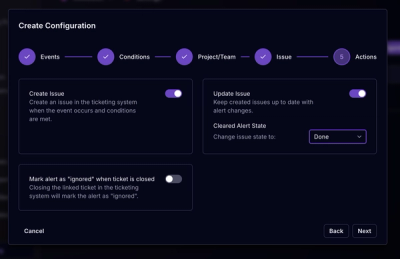
Socket for Jira Is Now Available
Socket for Jira lets teams turn alerts into Jira tickets with manual creation, automated ticketing rules, and two-way sync.
By Jeppe Hasseriis - Apr 20, 2026
fastify-webpack-hot
Advanced tools
A Fastify plugin for serving files emitted by Webpack with Hot Module Replacement (HMR).



A Fastify plugin for serving files emitted by Webpack with Hot Module Replacement (HMR).
import webpack from 'webpack';
import {
fastifyWebpackHot,
} from 'fastify-webpack-hot';
const compiler = webpack({
entry: [
'fastify-webpack-hot/client',
path.resolve(__dirname, '../app/main.js'),
],
mode: 'development',
plugins: [
new webpack.HotModuleReplacementPlugin(),
],
});
void app.register(fastifyWebpackHot, {
compiler,
});
ReactRefreshWebpackPlugin)Stats instance is accessible under request.webpack.stats:
app.get('*', async (request, reply) => {
  const stats = request.webpack.stats.toJson({
    all: false,
    entrypoints: true,
  });

  // ...
);
The most common use case for accessing stats is for identifying and constructing the entrypoint assets, e.g.
for (const asset of stats.entrypoints?.main.assets ?? []) {
  if (asset.name.endsWith('.js')) {
    htmlBody +=
      '<script defer="defer" src="/' + asset.name + '"></script>\n';
  }
}
You can access Output File System by referencing compiler.outputFileSystem. However, this will have the type of OutputFileSystem, which is incompatible with memfs, which is used by this package. Therefore, a better way to access outputFileSystem is by referencing request.webpack.outputFileSystem:
app.get('*', async (request, reply) => {
  const stats = JSON.parse(
    await request.webpack.outputFileSystem.promises.readFile(
      path.join(__dirname, '../dist/stats.json'),
      'utf8'
    )
  );

  // ...
);
This example shows how you would access stats.json generated by webpack-stats-plugin.
Note: You likely won't need to use this because fastify-webpack-hot automatically detects which assets have been generated and serves them at output.publicPath.
This plugin is compatible with compression-webpack-plugin, i.e. This plugin will serve compressed files if the following conditions are true:
.br or .gz)accept-encoding headerExample compression-webpack-plugin configuration:
new CompressionPlugin({
  algorithm: 'brotliCompress',
  deleteOriginalAssets: false,
  filename: '[path][base].br',
  compressionOptions: {
    level: zlib.constants.BROTLI_MIN_QUALITY,
  },
  minRatio: 0.8,
  test: /\.(js|css|html|svg)$/,
  threshold: 10_240,
})
Note: You may also try using fastify-compress, however, beware of the outstanding issue that may cause the server to crash (fastify-compress#215).
serverSideRenderwriteToDiskMultiCompilerAccept-RangesAll of the above are relatively straightforward to implement, however, I didn't have a use-case for them. If you have a use-case, please raise a PR.
This project uses roarr logger to output the program's state.
Export ROARR_LOG=true environment variable to enable log printing to stdout.
Use roarr-cli program to pretty-print the logs.
FAQs
A Fastify plugin for serving files emitted by Webpack with Hot Module Replacement (HMR).
We found that fastify-webpack-hot demonstrated a not healthy version release cadence and project activity because the last version was released a year ago. It has 1 open source maintainer collaborating on the project.
Did you know?

Socket for GitHub automatically highlights issues in each pull request and monitors the health of all your open source dependencies. Discover the contents of your packages and block harmful activity before you install or update your dependencies.
Product
Socket for Jira lets teams turn alerts into Jira tickets with manual creation, automated ticketing rules, and two-way sync.
Company News
Socket won two 2026 Reppy Awards from RepVue, ranking in the top 5% of all sales orgs. AE Alexandra Lister shares what it's like to grow a sales career here.

Security News
NIST will stop enriching most CVEs under a new risk-based model, narrowing the NVD's scope as vulnerability submissions continue to surge.