


Security News
Deno 2.6 + Socket: Supply Chain Defense In Your CLI
Deno 2.6 introduces deno audit with a new --socket flag that plugs directly into Socket to bring supply chain security checks into the Deno CLI.
By Sarah Gooding - Dec 12, 2025
friendly-linkedlist
Advanced tools
Supply Linkedlist stardard and more useful Methods
Install with npm:
$ npm install --save friendly-linkedlist
const LinkedList = require('friendly-linkedlist');

const linkedList = new LinkedList([1, 2, 3, 4, 5]);
linkedList.getFirst();
constructor(array) Create a LinkedList, array is optional..add(value, index) Inserts the specified value at the specified position in this list.addAll(array, index) Appends all of the values in the specified collection to the end of this list, in the order that they are returned by the specified array list.addFirst() Inserts the specified value at the beginning of this list..addLast() Appends the specified value to the end of this list..set(value, index) Replaces the node value at the specified position in this list with the specified value..push() Pushes an value onto the stack represented by this list..getFirst() Returns the first node value in this list..getLast() Returns the last node value in this list..indexOf(value) Returns the index of the first occurrence of the specified node value in this list, or -1 if this list does not contain the node value..lastIndexOf() Returns the index of the last occurrence of the specified node value in this list, or -1 if this list does not contain the node value..getNode(index) Returns the specified position node in this list..getFirstNode() Returns the first node in this list..getLastNode() Returns the last node in this list..indexOfNode(node) Returns the index of the first occurrence of the specified node in this list, or -1 if this list does not contain the node..lastIndexOfNode() Returns the index of the last occurrence of the specified node in this list, or -1 if this list does not contain the node..remove(index) Removes the node at the specified position in this list..removeFirst() Removes and returns the first node from this list..removeLast() Removes and returns the last node from this list..pop() Pops an node from the stack represented by this list..removeIndexOf(value) Removes the first occurrence of the specified node value in this list (when traversing the list from head to tail)..removeIndexOfNode(node) Removes the first occurrence of the specified node in this list (when traversing the list from head to tail)..removeFirstIndexOf(value) Removes the first occurrence of the specified node value in this list (when traversing the list from head to tail)..removeFirstIndexOfNode(node) Removes the first occurrence of the specified node value in this list (when traversing the list from head to tail)..removeLastIndexOf(value) Removes the last occurrence of the specified node value in this list (when traversing the list from head to tail)..removeLastIndexOfNode(node) Removes the last occurrence of the specified node in this list (when traversing the list from head to tail)..size() Returns the number of nodes in this list..add() Returns true if this list contains the specified node value..contains(value) Returns true if this list contains the specified node value..containsNode(node) Returns true if this list contains the specified node..clone() Returns a deep copy of this LinkedList..toArray() Returns an array containing all of the nodes in this list in proper sequence (from first to last node).FAQs
friendly-linkedlist
The npm package friendly-linkedlist receives a total of 1 weekly downloads. As such, friendly-linkedlist popularity was classified as not popular.
We found that friendly-linkedlist demonstrated a not healthy version release cadence and project activity because the last version was released a year ago. It has 1 open source maintainer collaborating on the project.
Did you know?

Socket for GitHub automatically highlights issues in each pull request and monitors the health of all your open source dependencies. Discover the contents of your packages and block harmful activity before you install or update your dependencies.
Security News
Deno 2.6 introduces deno audit with a new --socket flag that plugs directly into Socket to bring supply chain security checks into the Deno CLI.
Security News
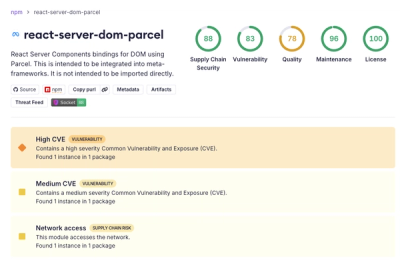
New DoS and source code exposure bugs in React Server Components and Next.js: what’s affected and how to update safely.

Security News
Socket CEO Feross Aboukhadijeh joins Software Engineering Daily to discuss modern software supply chain attacks and rising AI-driven security risks.