


Security News
Deno 2.6 + Socket: Supply Chain Defense In Your CLI
Deno 2.6 introduces deno audit with a new --socket flag that plugs directly into Socket to bring supply chain security checks into the Deno CLI.
By Sarah Gooding - Dec 12, 2025
gatsby-source-graphql
Advanced tools
Plugin for connecting arbitrary GraphQL APIs to Gatsby's GraphQL. Remote schemas are stitched together by declaring an arbitrary type name that wraps the remote schema Query type (typeName below), and putting the remote schema under a field of the Gatsby GraphQL query (fieldName below).
npm install gatsby-source-graphql
If the remote GraphQL API needs authentication, you should pass environment variables to the build process, so credentials aren't committed to source control. We recommend using dotenv, which will then expose environment variables. Read more about dotenv and using environment variables here. Then we can use these environment variables via process.env and configure our plugin.
// In your gatsby-config.js
module.exports = {
  plugins: [
    // Simple config, passing URL
    {
      resolve: "gatsby-source-graphql",
      options: {
        // Arbitrary name for the remote schema Query type
        typeName: "SWAPI",
        // Field under which the remote schema will be accessible. You'll use this in your Gatsby query
        fieldName: "swapi",
        // Url to query from
        url: "https://swapi-graphql.netlify.app/.netlify/functions/index",
      },
    },

    // Advanced config, passing parameters to apollo-link
    {
      resolve: "gatsby-source-graphql",
      options: {
        typeName: "GitHub",
        fieldName: "github",
        url: "https://api.github.com/graphql",
        // HTTP headers
        headers: {
          // Learn about environment variables: https://gatsby.dev/env-vars
          Authorization: `Bearer ${process.env.GITHUB_TOKEN}`,
        },
        // HTTP headers alternatively accepts a function (allows async)
        headers: async () => {
          return {
            Authorization: await getAuthorizationToken(),
          }
        },
        // Additional options to pass to node-fetch
        fetchOptions: {},
      },
    },

    // Advanced config, using a custom fetch function
    {
      resolve: "gatsby-source-graphql",
      options: {
        typeName: "GitHub",
        fieldName: "github",
        url: "https://api.github.com/graphql",
        // A `fetch`-compatible API to use when making requests.
        fetch: (uri, options = {}) =>
          fetch(uri, { ...options, headers: sign(options.headers) }),
      },
    },

    // Complex situations: creating arbitrary Apollo Link
    {
      resolve: "gatsby-source-graphql",
      options: {
        typeName: "GitHub",
        fieldName: "github",
        // Create Apollo Link manually. Can return a Promise.
        createLink: pluginOptions => {
          return createHttpLink({
            uri: "https://api.github.com/graphql",
            headers: {
              Authorization: `Bearer ${process.env.GITHUB_TOKEN}`,
            },
            fetch,
          })
        },
      },
    },
  ],
}
{
  # This is the fieldName you've defined in the config
  swapi {
    allSpecies {
      name
    }
  }
  github {
    viewer {
      email
    }
  }
}
By default, the schema is introspected from the remote schema. The schema is cached in the .cache directory, and refreshing the schema requires deleting the cache (e.g. by restarting gatsby develop).
To control schema consumption, you can alternatively construct the schema definition by passing a createSchema callback. This way you could, for example, read schema SDL or introspection JSON. When the createSchema callback is used, the schema isn't cached. createSchema can return a GraphQLSchema instance, or a Promise resolving to one.
const fs = require("fs")
const { buildSchema, buildClientSchema } = require("graphql")

module.exports = {
  plugins: [
    {
      resolve: "gatsby-source-graphql",
      options: {
        typeName: "SWAPI",
        fieldName: "swapi",
        url: "https://api.graphcms.com/simple/v1/swapi",

        createSchema: async () => {
          const json = JSON.parse(
            fs.readFileSync(`${__dirname}/introspection.json`)
          )
          return buildClientSchema(json.data)
        },
      },
    },
    {
      resolve: "gatsby-source-graphql",
      options: {
        typeName: "SWAPI",
        fieldName: "swapi",
        url: "https://api.graphcms.com/simple/v1/swapi",

        createSchema: async () => {
          const sdl = fs.readFileSync(`${__dirname}/schema.sdl`).toString()
          return buildSchema(sdl)
        },
      },
    },
  ],
}
Network requests can fail, return errors or take too long. Use Apollo Link to add retries, error handling, logging and more to your GraphQL requests.
Use the plugin's createLink option to add a custom Apollo Link to your GraphQL requests.
You can compose different types of links, depending on the functionality you're trying to achieve. The most common links are:
apollo-link-retry for retrying queries that fail or time outapollo-link-error for error handlingapollo-link-http for sending queries in http requests (used by default)For more explanation of how Apollo Links work together, check out this Medium article: Productionizing Apollo Links.
Here's an example of using the HTTP link with retries (using apollo-link-retry):
// gatsby-config.js
const { createHttpLink } = require(`apollo-link-http`)
const { RetryLink } = require(`apollo-link-retry`)

const retryLink = new RetryLink({
  delay: {
    initial: 100,
    max: 2000,
    jitter: true,
  },
  attempts: {
    max: 5,
    retryIf: (error, operation) =>
      Boolean(error) && ![500, 400].includes(error.statusCode),
  },
})

module.exports = {
  plugins: [
    {
      resolve: "gatsby-source-graphql",
      options: {
        typeName: "SWAPI",
        fieldName: "swapi",
        url: "https://api.graphcms.com/simple/v1/swapi",

        // `pluginOptions`: all plugin options
        //   (i.e. in this example object with keys `typeName`, `fieldName`, `url`, `createLink`)
        createLink: pluginOptions =>
          ApolloLink.from([
            retryLink,
            createHttpLink({ url: pluginOptions.url }),
          ]),
      },
    },
  ],
}
It's possible to modify the remote schema, via a transformSchema option which customizes the way the default schema is transformed before it is merged on the Gatsby schema by the stitching process.
The transformSchema function gets an object argument with the following fields:
The return value is expected to be the final schema used for stitching.
Below an example configuration that uses the default implementation (equivalent to not using the transformSchema option at all):
const { wrapSchema } = require(`@graphql-tools/wrap`)
const { linkToExecutor } = require(`@graphql-tools/links`)

module.exports = {
  plugins: [
    {
      resolve: "gatsby-source-graphql",
      options: {
        typeName: "SWAPI",
        fieldName: "swapi",
        url: "https://api.graphcms.com/simple/v1/swapi",
        transformSchema: ({
          schema,
          link,
          resolver,
          defaultTransforms,
          options,
        }) => {
          return wrapSchema(
            {
              schema,
              executor: linkToExecutor(link),
            },
            defaultTransforms
          )
        }
    },
  ]
}
For details, refer to https://www.graphql-tools.com/docs/schema-wrapping.
An use case for this feature can be seen in this issue.
By default, gatsby-source-graphql will only refetch the data once the server is restarted. It's also possible to configure the plugin to periodically refetch the data. The option is called refetchInterval and specifies the timeout in seconds.
module.exports = {
  plugins: [
    // Simple config, passing URL
    {
      resolve: "gatsby-source-graphql",
      options: {
        // Arbitrary name for the remote schema Query type
        typeName: "SWAPI",
        // Field under which the remote schema will be accessible. You'll use this in your Gatsby query
        fieldName: "swapi",
        // Url to query from
        url: "https://api.graphcms.com/simple/v1/swapi",

        // refetch interval in seconds
        refetchInterval: 60,
      },
    },
  ],
}
By default, gatsby-source-graphql executes each query in a separate network request.
But the plugin also supports query batching to improve query performance.
Caveat: Batching is only possible for queries starting at approximately the same time. In other words it is bounded by the number of parallel GraphQL queries executed by Gatsby (by default it is 4).
Fortunately, we can increase the number of queries executed in parallel by setting the environment variable
GATSBY_EXPERIMENTAL_QUERY_CONCURRENCY to a higher value and setting the batch option of the plugin
to true.
Example:
cross-env GATSBY_EXPERIMENTAL_QUERY_CONCURRENCY=20 gatsby develop
With plugin config:
const fs = require("fs")
const { buildSchema, buildClientSchema } = require("graphql")

module.exports = {
  plugins: [
    {
      resolve: "gatsby-source-graphql",
      options: {
        typeName: "SWAPI",
        fieldName: "swapi",
        url: "https://api.graphcms.com/simple/v1/swapi",
        batch: true,
      },
    },
  ],
}
By default, the plugin batches up to 5 queries. You can override this by passing
dataLoaderOptions and set a maxBatchSize:
const fs = require("fs")
const { buildSchema, buildClientSchema } = require("graphql")

module.exports = {
  plugins: [
    {
      resolve: "gatsby-source-graphql",
      options: {
        typeName: "SWAPI",
        fieldName: "swapi",
        url: "https://api.graphcms.com/simple/v1/swapi",
        batch: true,
        // See https://github.com/graphql/dataloader#new-dataloaderbatchloadfn--options
        // for a full list of DataLoader options
        dataLoaderOptions: {
          maxBatchSize: 10,
        },
      },
    },
  ],
}
Having 20 parallel queries with 5 queries per batch means we are still running 4 batches in parallel.
Each project is unique so try tuning those two variables and see what works best for you. We've seen up to 5-10x speed-up for some setups.
Under the hood gatsby-source-graphql uses DataLoader
for query batching. It merges all queries from a batch to a single query that gets sent to the
server in a single network request.
Consider the following example where both of these queries are run:
{
  query: `query(id: Int!) {
    node(id: $id) {
      foo
    }
  }`,
  variables: { id: 1 },
}
{
  query: `query(id: Int!) {
    node(id: $id) {
      bar
    }
  }`,
  variables: { id: 2 },
}
They will be merged into a single query:
{
  query: `
    query(
      $gatsby0_id: Int!
      $gatsby1_id: Int!
    ) {
      gatsby0_node: node(id: $gatsby0_id) {
        foo
      }
      gatsby1_node: node(id: $gatsby1_id) {
        bar
      }
    }
  `,
  variables: {
    gatsby0_id: 1,
    gatsby1_id: 2,
  }
}
Then gatsby-source-graphql splits the result of this single query into multiple results
and delivers it back to Gatsby as if it executed multiple queries:
{
  data: {
    gatsby0_node: { foo: `foo` },
    gatsby1_node: { bar: `bar` },
  },
}
is transformed back to:
[
  { data { node: { foo: `foo` } } },
  { data { node: { bar: `bar` } } },
]
Note that if any query result contains errors the whole batch will fail.
If your server supports apollo-style query batching you can also try
HttpLinkDataLoader.
Pass it to the gatsby-source-graphql plugin via the createLink option.
This strategy is usually slower than query merging but provides better error reporting.
FAQs
Gatsby plugin which adds a third-party GraphQL API to Gatsby GraphQL
The npm package gatsby-source-graphql receives a total of 19,728 weekly downloads. As such, gatsby-source-graphql popularity was classified as popular.
We found that gatsby-source-graphql demonstrated a healthy version release cadence and project activity because the last version was released less than a year ago. It has 7 open source maintainers collaborating on the project.
Did you know?

Socket for GitHub automatically highlights issues in each pull request and monitors the health of all your open source dependencies. Discover the contents of your packages and block harmful activity before you install or update your dependencies.
Security News
Deno 2.6 introduces deno audit with a new --socket flag that plugs directly into Socket to bring supply chain security checks into the Deno CLI.
Security News
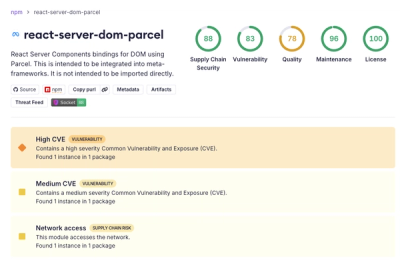
New DoS and source code exposure bugs in React Server Components and Next.js: what’s affected and how to update safely.

Security News
Socket CEO Feross Aboukhadijeh joins Software Engineering Daily to discuss modern software supply chain attacks and rising AI-driven security risks.