

Product
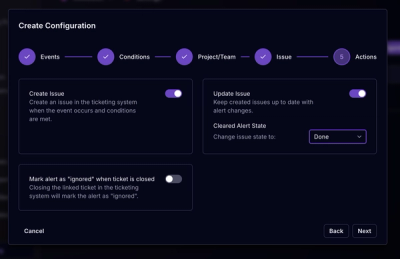
Socket for Jira Is Now Available
Socket for Jira lets teams turn alerts into Jira tickets with manual creation, automated ticketing rules, and two-way sync.
By Jeppe Hasseriis - Apr 20, 2026
geoip-lite
Advanced tools
A native NodeJS API for the GeoLite data from MaxMind.
This product includes GeoLite data created by MaxMind, available from http://maxmind.com/
NOTE You MUST update the data files after installation. The MaxMind license does not allow us to distribute the latest version of the data files with this package. Follow the instructions under update the datafiles for details.
MaxMind provides a set of data files for IP to Geo mapping along with opensource libraries to parse and lookup these data files. One would typically write a wrapper around their C API to get access to this data in other languages (like JavaScript).
GeoIP-lite instead attempts to be a fully native JavaScript library. A converter script converts the CSV files from MaxMind into an internal binary format (note that this is different from the binary data format provided by MaxMind). The geoip module uses this binary file to lookup IP addresses and return the country, region and city that it maps to.
Both IPv4 and IPv6 addresses are supported, however since the GeoLite IPv6 database does not currently contain any city or region information, city, region and postal code lookups are only supported for IPv4.
I was really aiming for a fast JavaScript native implementation for geomapping of IPs. My prime motivator was the fact that it was really hard to get libgeoip built for Mac OSX without using the library from MacPorts.
geoip-lite is a fully JavaScript implementation of the MaxMind geoip API. It is not as fully featured as bindings that use libgeoip.
By reducing scope, this package is significantly faster at doing lookups. On average, an IPv4 lookup takes under 0.5 microseconds and
an IPv6 lookup takes about 1.3 microseconds.
var geoip = require('geoip-lite');

var ip = "207.97.227.239";
var geo = geoip.lookup(ip);

console.log(geo);
{ range: [ 3479298048, 3479300095 ],
  country: 'US',
  region: 'TX',
  eu: '0',
  timezone: 'America/Chicago',
  city: 'San Antonio',
  ll: [ 29.4969, -98.4032 ],
  metro: 641,
  area: 1000 }
$ npm install geoip-lite
Run cd node_modules/geoip-lite && npm run-script updatedb license_key=YOUR_LICENSE_KEY to update the data files. (Replace YOUR_LICENSE_KEY with your license key obtained from maxmind.com)
You can create a maxmind account here
NOTE that this requires a lot of RAM. It is known to fail on on a Digital Ocean or AWS micro instance.
There are no plans to change this. geoip-lite stores all data in RAM in order to be fast.
geoip-lite is completely synchronous. There are no callbacks involved. All blocking file IO is done at startup time, so all runtime calls are executed in-memory and are fast. Startup may take up to 200ms while it reads into memory and indexes data files.
If you have an IP address in dotted quad notation, IPv6 colon notation, or a 32 bit unsigned integer (treated
as an IPv4 address), pass it to the lookup method. Note that you should remove any [ and ] around an
IPv6 address before passing it to this method.
var geo = geoip.lookup(ip);
If the IP address was found, the lookup method returns an object with the following structure:
{
   range: [ <low bound of IP block>, <high bound of IP block> ],
   country: 'XX',                 // 2 letter ISO-3166-1 country code
   region: 'RR',                  // Up to 3 alphanumeric variable length characters as ISO 3166-2 code
                                  // For US states this is the 2 letter state
                                  // For the United Kingdom this could be ENG as a country like “England
                                  // FIPS 10-4 subcountry code
   eu: '0',                       // 1 if the country is a member state of the European Union, 0 otherwise.
   timezone: 'Country/Zone',      // Timezone from IANA Time Zone Database
   city: "City Name",             // This is the full city name
   ll: [<latitude>, <longitude>], // The latitude and longitude of the city
   metro: <metro code>,           // Metro code
   area: <accuracy_radius>        // The approximate accuracy radius (km), around the latitude and longitude
}
The actual values for the range array depend on whether the IP is IPv4 or IPv6 and should be
considered internal to geoip-lite. To get a human readable format, pass them to geoip.pretty()
If the IP address was not found, the lookup returns null
If you have a 32 bit unsigned integer, or a number returned as part of the range array from the lookup method,
the pretty method can be used to turn it into a human readable string.
console.log("The IP is %s", geoip.pretty(ip));
This method returns a string if the input was in a format that geoip-lite can recognise, else it returns the
input itself.
This package contains an update script that can pull the files from MaxMind and handle the conversion from CSV. A npm script alias has been setup to make this process easy. Please keep in mind this requires internet and MaxMind rate limits that amount of downloads on their servers.
You will need, at minimum, a free license key obtained from maxmind.com to run the update script.
Package stores checksums of MaxMind data and by default only downloads them if checksums have changed.
#update data if new data is available
npm run-script updatedb license_key=YOUR_LICENSE_KEY

#force udpate data even if checkums have not changed
npm run-script updatedb-force license_key=YOUR_LICENSE_KEY
You can also run it by doing:
node ./node_modules/geoip-lite/scripts/updatedb.js license_key=YOUR_LICENSE_KEY
If you have a server running geoip-lite, and you want to reload its geo data, after you finished update, without a restart.
You can do it programmatically, calling after scheduled data updates
//Synchronously
geoip.reloadDataSync();

//Asynchronously
geoip.reloadData(function(){
    console.log("Done");
});
You can enable the data watcher to automatically refresh in-memory geo data when a file changes in the data directory.
geoip.startWatchingDataUpdate();
This tool can be used with npm run-script updatedb to periodically update geo data on a running server.
The following environment variables can be set.
# Override the default node_modules/geoip-lite/tmp dir
GEOTMPDIR=/some/path

# Override the default node_modules/geoip-lite/data dir
GEODATADIR=/some/path
This package includes the GeoLite database from MaxMind. This database is not the most accurate database available,
however it is the best available for free. You can use the commercial GeoIP database from MaxMind with better
accuracy by buying a license from MaxMind, and then using the conversion utility to convert it to a format that
geoip-lite understands. You will need to use the .csv files from MaxMind for conversion.
Also note that on occassion, the library may take up to 5 seconds to load into memory. This is largely dependent on how busy your disk is at that time. It can take as little as 200ms on a lightly loaded disk. This is a one time cost though, and you make it up at run time with very fast lookups.
Quick test on memory consumption shows that the library uses around 135 MB RSS per process, with the bulk of that being the binary data buffers held in external memory.
    var geoip = require('geoip-lite');
    console.log(process.memoryUsage());
    /**
    * Outputs:
    * {
    *     rss: 141557760,
    *     heapTotal: 6815744,
    *     heapUsed: 4063232,
    *     external: 110378968,
    *     arrayBuffers: 108851048
    * }
    **/
If your use-case requires doing less than 100 queries through the lifetime of your application or if you need really fast latency on start-up, you might want to look into fast-geoip a package with a compatible API that is optimized for serverless environments and provides faster boot times and lower memory consumption at the expense of longer lookup times.
geoip-lite is Copyright Philip Tellis philip@bluesmoon.info and other contributors, and the latest version of the code is
available at https://github.com/bluesmoon/node-geoip
There are two licenses for the code and data. See the LICENSE file for details.
The maxmind package provides access to MaxMind's GeoIP2 and GeoLite2 databases. It offers more detailed and accurate geolocation data compared to geoip-lite, but requires downloading and updating the database files regularly. It also supports additional data points such as ISP and organization information.
The ipstack package is a wrapper for the ipstack API, which provides IP geolocation data. It offers a wide range of data points, including country, region, city, ZIP code, latitude, longitude, and more. Unlike geoip-lite, it requires an API key and makes external HTTP requests, which may introduce latency.
The ipinfo package is a client for the IPinfo.io API, which provides IP geolocation and other related data. It offers detailed information such as country, region, city, postal code, latitude, longitude, and ASN. Similar to ipstack, it requires an API key and makes external HTTP requests.
FAQs
A light weight native JavaScript implementation of GeoIP API from MaxMind
The npm package geoip-lite receives a total of 343,280 weekly downloads. As such, geoip-lite popularity was classified as popular.
We found that geoip-lite demonstrated a healthy version release cadence and project activity because the last version was released less than a year ago. It has 1 open source maintainer collaborating on the project.
Did you know?

Socket for GitHub automatically highlights issues in each pull request and monitors the health of all your open source dependencies. Discover the contents of your packages and block harmful activity before you install or update your dependencies.
Product
Socket for Jira lets teams turn alerts into Jira tickets with manual creation, automated ticketing rules, and two-way sync.

Company News
Socket won two 2026 Reppy Awards from RepVue, ranking in the top 5% of all sales orgs. AE Alexandra Lister shares what it's like to grow a sales career here.

Security News
NIST will stop enriching most CVEs under a new risk-based model, narrowing the NVD's scope as vulnerability submissions continue to surge.