


Security News
Deno 2.6 + Socket: Supply Chain Defense In Your CLI
Deno 2.6 introduces deno audit with a new --socket flag that plugs directly into Socket to bring supply chain security checks into the Deno CLI.
By Sarah Gooding - Dec 12, 2025
graphql-lambda
Advanced tools
Ready-to-use Node.js GraphQL server for AWS Lambda (with subscriptions)

This is a AWS Lambda integration of GraphQL Server with Subscriptions support.
Heavily inspired on aws-lambda-graphql module.
Also based on Apollo Server (a community-maintained open-source GraphQL server that works with many Node.js HTTP server frameworks).
npm install graphql-lambda
serverless deploy) examples:Following the same GraphQL SDL setup as in graphql-lambda-sdl-example, define your Schemas and subscriptions in a file called schema.ts
import { pubSub, withFilter } from "../lambda";

type MessageType = 'greeting' | 'test';

type Message = {
  text: string;
  type: MessageType;
};

type SendMessageArgs = {
  text: string;
  type: MessageType;
};

export const typeDefs = /* GraphQL */ `
  enum MessageType {
    greeting
    test
  }
  type Message {
    id: ID!
    text: String!
    type: MessageType!
  }
  type Mutation {
    sendMessage(text: String!, type: MessageType = greeting): Message!
  }
  type Query {
    serverTime: Float!
  }
  type Subscription {
    messageFeed(type: MessageType): Message!
  }
`;

export const resolvers = {
  Mutation: {
    async sendMessage(ctx: any, { text, type }: SendMessageArgs) {
      const payload: Message = { text, type };

      await pubSub.publish('NEW_MESSAGE', payload);

      return payload;
    },
  },
  Query: {
    serverTime: () => Date.now(),
  },
  Subscription: {
    messageFeed: {
      resolve: (rootValue: Message) => {
        // root value is the payload from sendMessage mutation
        return rootValue;
      },
      subscribe: withFilter(
        pubSub.subscribe('NEW_MESSAGE'),
        (rootValue: Message, args: { type: null | MessageType }) => {
          // this can be async too :)
          if (args.type == null) {
            return true;
          }

          return args.type === rootValue.type;
        },
      ),
    },
  },
};
In a file named lambda.ts place the following code:
import { APIGatewayProxyEvent } from "aws-lambda";
import {
  PubSub,
  SubscriptionManager,
  ApiGatewayConnectionManager,
  ISubscriptionEvent,
  IEventStore,
  APIGatewayWebSocketEvent,
} from "graphql-lambda";

import { SQS } from "aws-sdk";

export class SQSQueue implements IEventStore {
  public events: ISubscriptionEvent[];
  private sqs: SQS;

  constructor() {
    this.sqs = new SQS();
  }

  publish = async (event: ISubscriptionEvent | APIGatewayProxyEvent | APIGatewayWebSocketEvent): Promise<void> => {
    var params = {
      QueueUrl: process.env.sqsfifo,
      MessageGroupId: "0",
      MessageBody: JSON.stringify(event),
    };
    await this.sqs.sendMessage(params).promise();
  };
}

export const eventStore = new SQSQueue();
export const pubSub = new PubSub({ eventStore });
export const subscriptionManager = new SubscriptionManager({
  subscriptionManagerStorage: new Map(), // Replace this with any persistence layer you prefer, Redis, MySQL, etc.
});
export const connectionManager = new ApiGatewayConnectionManager({
  connectionManagerStorage: new Map(), // Replace this with any persistence layer you prefer, Redis, MySQL, etc.
});
export const eventProcessor = new EventProcessor()
export * from "graphql-lambda";
For production environments the new Map() should be replaced with a proper data storage like MySQL, Redis, DynamoDB, etc.
Provide the schema (type definitions and resolvers) to the GraphQL Server, together with the subscriptionsManager, connectionManager and eventProcessor defined in lambda.ts.
Place the following code in a file named graphql.ts:
import {
  Server,
  subscriptionManager,
  connectionManager,
  EventProcessor,
  APIGatewayWebSocketEvent,
  eventStore,
  eventProcessor,
} from "./lambda";

import { typeDefs, resolvers } from "./graphql/schema";

const server = new Server({
  typeDefs,  // (schema-first approach)
  resolvers, // (schema-first approach)
  // schema, // (code-first approach)
  connectionManager,
  eventProcessor,
  subscriptionManager,

  onError: (err) => {
    console.log(err);
  },
  playground: {
    endpoint: `/${process.env.STAGE}/graphql`,
    subscriptionEndpoint: process.env.lambdaSubscriptionEndpoint,
  },
});

export const handleHttp = server.createHttpHandler();
export const handleWebSocket = server.createWebSocketHandler(); // Required for subscriptions websockets
export const eventHandler = server.createEventHandler(); // Required for subscription events
Optionally, a schema parameter can be provided to the server instead of typeDefs and resolvers.
To keep this example simple and make it work without any kind of Database, we will make all graphql subscriptions events to be handled by a separated function, so we can just store everything in memory, and make sure only one function handles all the subscription-related events by piping all events through a AWS SQS FIFO Queue:
In a file named handlers.ts, place the following code:
import { handleHttp, handleWebSocket, eventHandler } from "./graphql"

export async function handleGraphql(
  event: APIGatewayEvent | APIGatewayWebSocketEvent,
  context
) {
  if (
    (event as APIGatewayWebSocketEvent).requestContext != null &&
    (event as APIGatewayWebSocketEvent).requestContext.routeKey != null
  ) {
    await eventStore.publish(event);

    let result = {
      body: "",
      headers: event.headers?.["Sec-WebSocket-Protocol"]?.includes("graphql-ws")
        ? {
            "Sec-WebSocket-Protocol": "graphql-ws",
          }
        : undefined,
      statusCode: 200,
    };

    return result;
  } else if (
    (event as APIGatewayEvent).requestContext != null &&
    (event as APIGatewayEvent).requestContext.path != null
  ) {
    return handleHttp(event as APIGatewayEvent, context);
  } else {
    throw new Error("Invalid event");
  }
}

export async function handleGraphqlSubscriptions(event: SQSEvent, context) {
  if ((event as SQSEvent).Records != null) {
    for (const record of (event as SQSEvent).Records) {
      const ev = JSON.parse(record.body);
      if (
        (ev as APIGatewayWebSocketEvent).requestContext != null &&
        (ev as APIGatewayWebSocketEvent).requestContext.routeKey != null
      ) {
        await handleWebSocket(ev as APIGatewayWebSocketEvent, context);
      } else {
        await eventHandler(ev, context);
      }
    }
  } else {
    throw new Error("Invalid event");
  }
}
Finally, this serverless project requires some custom resources.
In a file named serverless.ts (replacing the usual serverless.yml file), place the following code:
import type { AWS } from "@serverless/typescript";

const serverlessConfiguration: AWS = {
  service: "graphql-lambda-example",
  plugins: ["serverless-webpack"],
  provider: {
    apiGateway: {
      shouldStartNameWithService: true,
    },
    name: "aws",
    runtime: "nodejs12.x",
    region: "us-east-1",
    memorySize: 512,
    iam: {
      role: {
        statements: [
          {
            Effect: "Allow",
            Action: ["lambda:InvokeFunction"],
            Resource: "*",
          },
          {
            Effect: "Allow",
            Action: ["sqs:*"],
            Resource: "*",
          },
        ],
      },
    },
    environment: {
      STAGE: "${opt:stage, self:provider.stage}",
      sqsfifo: {
        "Fn::Join": [
          "",
          [
            "https://sqs.",
            { Ref: "AWS::Region" },
            ".amazonaws.com/",
            { Ref: "AWS::AccountId" },
            "/${self:custom.eventSQSFifo}",
          ],
        ],
      },
      lambdaSubscriptionEndpoint: {
        "Fn::Join": [
          "",
          [
            "wss://",
            {
              Ref: "WebsocketsApi",
            },
            ".execute-api.",
            {
              Ref: "AWS::Region",
            },
            ".",
            {
              Ref: "AWS::URLSuffix",
            },
            "/${self:provider.stage}",
          ],
        ],
      },
    },
  },
  functions: {
    main: {
      handler: "src/handlers.handleGraphql",
      events: [
        {
          http: {
            path: "/graphql",
            method: "ANY",
          },
        },
        {
          websocket: {
            route: "$connect",
          },
        },
        {
          websocket: {
            route: "$default",
          },
        },
        {
          websocket: {
            route: "$disconnect",
          },
        },
      ],
    },
    queue: {
      handler: "src/handlers.handleGraphqlSubscriptions",
      events: [
        {
          sqs: {
            arn: {
              "Fn::GetAtt": ["sqsfifo", "Arn"],
            },
          },
        },
      ],
    },
  },
  custom: {
    stage: "${opt:stage, self:provider.stage}",
    region: "${opt:region, self:provider.region}",
    eventSQSFifo: "${self:service}-sqs-fifo-${self:custom.stage}.fifo",
    webpack: {
      webpackConfig: "./webpack.config.js",
      includeModules: true,
    },
  },
  resources: {
    Resources: {
      sqsfifo: {
        Properties: {
          QueueName: "${self:custom.eventSQSFifo}",
          FifoQueue: true,
          ContentBasedDeduplication: true,
        },
        Type: "AWS::SQS::Queue",
      },
    },
  },
};

module.exports = serverlessConfiguration;
Deploy to AWS Lambda and start testing!
serverless deploy
Query:

Subscription:

Mutation:

FAQs
Ready-to-use Node.js GraphQL server for AWS Lambda (with subscriptions)
The npm package graphql-lambda receives a total of 2 weekly downloads. As such, graphql-lambda popularity was classified as not popular.
We found that graphql-lambda demonstrated a not healthy version release cadence and project activity because the last version was released a year ago. It has 1 open source maintainer collaborating on the project.
Did you know?

Socket for GitHub automatically highlights issues in each pull request and monitors the health of all your open source dependencies. Discover the contents of your packages and block harmful activity before you install or update your dependencies.
Security News
Deno 2.6 introduces deno audit with a new --socket flag that plugs directly into Socket to bring supply chain security checks into the Deno CLI.
Security News
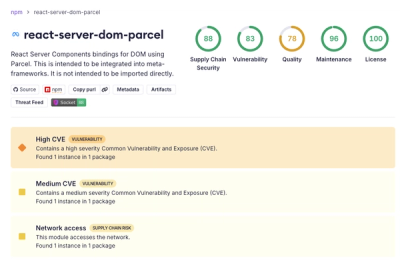
New DoS and source code exposure bugs in React Server Components and Next.js: what’s affected and how to update safely.

Security News
Socket CEO Feross Aboukhadijeh joins Software Engineering Daily to discuss modern software supply chain attacks and rising AI-driven security risks.