

Security News
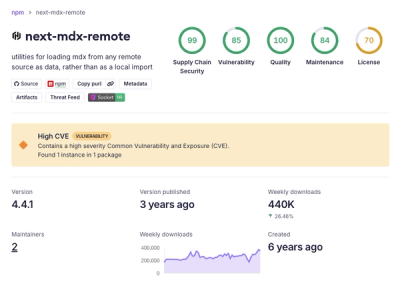
High-Severity RCE Vulnerability Disclosed in next-mdx-remote
HashiCorp disclosed a high-severity RCE in next-mdx-remote affecting versions 4.3.0 to 5.x when compiling untrusted MDX on the server.
By Sarah Gooding - Feb 12, 2026
grunt-source
Advanced tools
Reuse multiple Grunt environments across multiple projects
The Problem - Grunt environments can quickly become quite complicated and whenever we need to reuse a Grunt environment, it requires us to copy the current project and remove the source leaving just the Grunt related files.
A static solution - The Grunt team has made grunt-init which gives you a static copy of a predefined template. Note, grunt-init does provides a way to template in new values for each copy however, this is can still be improved.
A dynamic solution - Enter Grunt Source, instead of making numerous static copies of a given Grunt environment, you can actually use one Grunt environment for multiple projects. Also, having a directory separation between the Grunt environment and the actual source will help to reduce the complexity of your project.
When using Grunt Source, projects will now contain only a Gruntsource.json, thereby abstracting the magic of Grunt outside of the project. This will help those who don't need to know the complexities of the build, yet still want to modify the source.
Install Grunt Source
npm install -g grunt-source
Create a Gruntsource.json configuration in your project's root
{
  "source": "~/.grunt-sources/ghpages",
  "repo": "https://github.com/jpillora/grunt-source-ghpages.git"
}
Note: The "source" path represents the source Grunt environment, if it's missing it'll clone "repo" there.
Then simply run grunt-source
grunt-source
Note: On first run, it will also run the init task - registered by Grunt Source - which copies the missing files from "source"/init directory into the current directory, essentially initialising your project.
You can use grunt-source just as you would normally use grunt, command line arguments and options work all function
Instead of creating a Gruntsource.json, you can add a gruntSource field to your package.json file:
{
  "name": "my-module",
  "version": "0.1.3",
  "gruntSource": {
    "source": "~/.grunt-sources/node",
    "repo": "https://github.com/jpillora/grunt-source-node.git"
  }
}
source - required - the directory where the source Grunt environment residesrepo - the Git repository whichconfig - an object which will get merged when you call grunt.initConfig(), allowing you to override the source Gruntfile.In your Gruntfile wrapper function, a source object is added to the grunt object
grunt.source.loadAllTasks() (function)This function is very important, first it loads all of the tasks (npm tasks and local tasks) in the "source" directory (or the Grunt project directory), then it changes the working directory back to the current directory and loads all local tasks there.
grunt.source.dir (string)The absolute path to the source directory
grunt.source.<config-prop>All properties defined in your configuration object will also be set on the grunt.source object
The grunt-source runs in the same was as grunt-clie, so commands like grunt-source task2:target4 task3:target1 will work as you expect.
See grunt-source-ghpages for another example grunt source
See notifyjs-com for an example project using grunt-source-ghpages
Copyright © 2013 Jaime Pillora <dev@jpillora.com>
Permission is hereby granted, free of charge, to any person obtaining a copy of this software and associated documentation files (the 'Software'), to deal in the Software without restriction, including without limitation the rights to use, copy, modify, merge, publish, distribute, sublicense, and/or sell copies of the Software, and to permit persons to whom the Software is furnished to do so, subject to the following conditions:
The above copyright notice and this permission notice shall be included in all copies or substantial portions of the Software.
THE SOFTWARE IS PROVIDED 'AS IS', WITHOUT WARRANTY OF ANY KIND, EXPRESS OR IMPLIED, INCLUDING BUT NOT LIMITED TO THE WARRANTIES OF MERCHANTABILITY, FITNESS FOR A PARTICULAR PURPOSE AND NONINFRINGEMENT. IN NO EVENT SHALL THE AUTHORS OR COPYRIGHT HOLDERS BE LIABLE FOR ANY CLAIM, DAMAGES OR OTHER LIABILITY, WHETHER IN AN ACTION OF CONTRACT, TORT OR OTHERWISE, ARISING FROM, OUT OF OR IN CONNECTION WITH THE SOFTWARE OR THE USE OR OTHER DEALINGS IN THE SOFTWARE.
FAQs
Reuse multiple Grunt environments across multiple projects
The npm package grunt-source receives a total of 45 weekly downloads. As such, grunt-source popularity was classified as not popular.
We found that grunt-source demonstrated a not healthy version release cadence and project activity because the last version was released a year ago. It has 1 open source maintainer collaborating on the project.
Did you know?

Socket for GitHub automatically highlights issues in each pull request and monitors the health of all your open source dependencies. Discover the contents of your packages and block harmful activity before you install or update your dependencies.
Security News
HashiCorp disclosed a high-severity RCE in next-mdx-remote affecting versions 4.3.0 to 5.x when compiling untrusted MDX on the server.

Security News
Security researchers report widespread abuse of OpenClaw skills to deliver info-stealing malware, exposing a new supply chain risk as agent ecosystems scale.

Security News
Claude Opus 4.6 has uncovered more than 500 open source vulnerabilities, raising new considerations for disclosure, triage, and patching at scale.