

Product
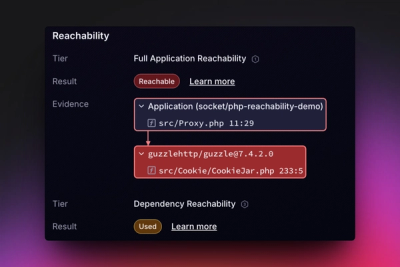
Introducing Reachability for PHP
Reachability analysis for PHP is now available in experimental, helping teams identify which vulnerabilities are actually exploitable.
By Benjamin Barslev - Apr 24, 2026





Logger for gulp and gulp plugins
var logger = require('gulplog');
// logs strings
logger.debug('The MOST verbose!');
logger.info('Some important info');
logger.warn('All the warnings to you');
logger.error('OH NO! SOMETHING HAPPENED!');
// supports util.format!
logger.info('%s style!', 'printf');
// log anything
logger.debug({ my: 'obj' });
logger.info([1, 2, 3]);
Logging (and level of logging) is controlled by gulp-cli
Highest log level. Typically used for debugging purposes.
If the first argument is a string, all arguments are passed to node's
util.format() before being emitted.
Standard log level. Typically used for user information.
If the first argument is a string, all arguments are passed to node's
util.format() before being emitted.
Warning log level. Typically used for warnings.
If the first argument is a string, all arguments are passed to node's
util.format() before being emitted.
Error log level. Typically used when things went horribly wrong.
If the first argument is a string, all arguments are passed to node's
util.format() before being emitted.
MIT
Winston is a versatile logging library for Node.js that supports multiple transports (e.g., console, file, HTTP). It is more feature-rich compared to gulplog, offering advanced logging capabilities such as log levels, custom formats, and more.
Bunyan is a simple and fast JSON logging library for Node.js services. It provides structured logging and is designed for high-performance logging in production environments. Compared to gulplog, Bunyan offers more advanced features like log streams and serializers.
Pino is a low-overhead logging library for Node.js that focuses on performance. It is designed to be extremely fast and efficient, making it suitable for high-throughput applications. Pino offers more advanced features and better performance compared to gulplog.
FAQs
Logger for gulp and gulp plugins
The npm package gulplog receives a total of 1,784,884 weekly downloads. As such, gulplog popularity was classified as popular.
We found that gulplog demonstrated a not healthy version release cadence and project activity because the last version was released a year ago. It has 2 open source maintainers collaborating on the project.
Did you know?

Socket for GitHub automatically highlights issues in each pull request and monitors the health of all your open source dependencies. Discover the contents of your packages and block harmful activity before you install or update your dependencies.
Product
Reachability analysis for PHP is now available in experimental, helping teams identify which vulnerabilities are actually exploitable.
Product
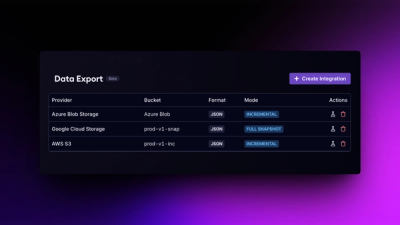
Export Socket alert data to your own cloud storage in JSON, CSV, or Parquet, with flexible snapshot or incremental delivery.
Research
/Security News
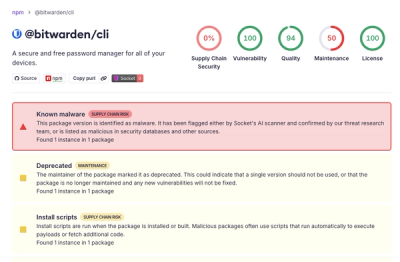
Bitwarden CLI 2026.4.0 was compromised in the Checkmarx supply chain campaign after attackers abused a GitHub Action in Bitwarden’s CI/CD pipeline.