

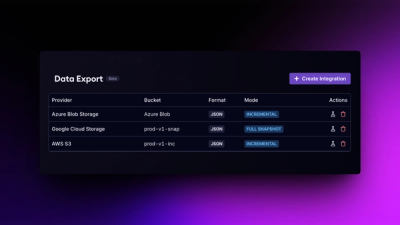
Product
Introducing Data Exports
Export Socket alert data to your own cloud storage in JSON, CSV, or Parquet, with flexible snapshot or incremental delivery.
By Ola Adekola - Apr 23, 2026

While many consider inline styles to be, in essence, more maintainable than external stylesheets, the limited capabilities of vanilla inline styles (e. g. no media queries or pseudo-selectors) often force a project to use external stylesheets or to resort to JavaScript for even trivial state changes (like changing the color of a button on hover) or responsive designs. Moreover, JavaScript cannot replace stylesheets completely, as it offers no direct way to style pseudo-elements such as input placeholders.
Hacss combines the maintainability benefits of inline styles with the
capabilities of external stylesheets by embedding its own styling DSL within
HTML class attributes. At build time, Hacss automatically generates a
stylesheet from the CSS classes used throughout the project:
<h1 class="C(red)">Hello World</h1>, for example, yields a CSS block
.C\(red\) { color: red; }.
Hacss is a drop-in replacement for acss.io's Atomizer tool for the majority of use cases. In general, the "Atomic" and "Helper" classes listed on the acss.io Reference page are applicable to Hacss as well. Hacss may be a better option than Atomizer for non-basic use cases for a few reasons:
O (outline)
using box-shadow as described
here.globalMapArg to allow global
variable lookups as well as other transformations.For more, see the guides.
FAQs
Hackable inline style language embedded in HTML classes
We found that hacss demonstrated a not healthy version release cadence and project activity because the last version was released a year ago. It has 1 open source maintainer collaborating on the project.
Did you know?

Socket for GitHub automatically highlights issues in each pull request and monitors the health of all your open source dependencies. Discover the contents of your packages and block harmful activity before you install or update your dependencies.
Product
Export Socket alert data to your own cloud storage in JSON, CSV, or Parquet, with flexible snapshot or incremental delivery.
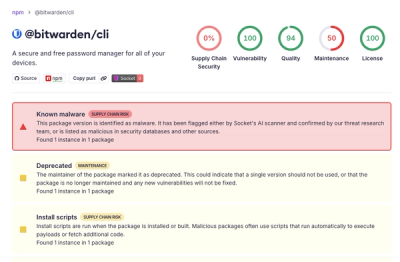
Research
/Security News
Bitwarden CLI 2026.4.0 was compromised in the Checkmarx supply chain campaign after attackers abused a GitHub Action in Bitwarden’s CI/CD pipeline.
Research
/Security News
Docker and Socket have uncovered malicious Checkmarx KICS images and suspicious code extension releases in a broader supply chain compromise.