


Company News
Socket Has Acquired Secure Annex
Socket has acquired Secure Annex to expand extension security across browsers, IDEs, and AI tools.
By Feross Aboukhadijeh - Apr 28, 2026
happo-olivier-target-firefox
Advanced tools
Firefox target for the happo visual diffing library
If you haven't already installed happo you will need to do that:
npm install --save-dev happo
To get the Firefox target, you will install from npm:
npm install --save-dev happo-target-firefox
You'll also need Firefox installed on the machine. Happo uses selenium-webdriver under the hood, and will support the same version of Firefox as Selenium supports. Happo currently works best with Firefox > 50. It uses geckodriver to control Firefox.
You define your examples in a JavaScript file and include it in the
sourceFiles configuration option.
Here's an example of a button component being added to a Happo suite:
happo.define('button', () => {
  var elem = document.createElement('button');
  elem.setAttribute('class', 'button');
  elem.innerHTML = 'Submit';
  document.body.appendChild(elem);
});
Here's an example using React):
happo.define('<MyReactComponent>', () => {
  const div = document.createElement('div');
  document.body.appendChild(div);
  const component = (
    <MyReactComponent
      foo={1}
      bar='baz'
    />
  );
  ReactDOM.render(component, div);
});
Examples are responsible for rendering the element into the DOM. This is because a lot of frameworks (e.g. React) like to maintain control over the DOM. A helper method to reduce some of the boilerplate is probably a good idea in your project.
By default, Happo renders examples in a 1024px-wide window. If you have
components that render differently depending on available screen size you can
use the viewports option in the object passed in as the second argument to
happo.define. These need to correspond to configured viewports in the
.happo.js file. Happo comes pre-configured with three default sizes:
large (1024x768), medium (640x888), and small (320x444).
happo.define('responsive component', () => {
  var elem = document.createElement('div');
  elem.setAttribute('class', 'responsive-component');
  document.body.appendChild(elem);
}, { viewports: ['large', 'small'] });
If your examples need to do something asynchronous before they finish rendering,
you can return a Promise from your define method. Happo will wait for the
Promise to resolve before taking a screenshot.
happo.define('async component', () => {
  return new Promise(function(resolve) {
    var elem = document.createElement('div');
    document.body.appendChild(elem);
    setTimeout(function() {
      elem.innerHTML = 'Async content loaded';
      resolve();
    }, 100);
  });
});
Alternatively, use the done callback passed in to the define method.
happo.define('async component', (done) => {
  var elem = document.createElement('div');
  document.body.appendChild(elem);
  setTimeout(() => {
    elem.innerHTML = 'Async content loaded';
    done();
  }, 100);
});
During development, you might want to focus on a single example. In those
situations, you can use the happo.fdefine function instead of happo.define.
Using fdefine will cause happo to only run for the examples that are using
fdefine and skip all examples using define.
// This example will be skipped because it is not being "focused".
happo.define('button', () => {
  var elem = document.createElement('button');
  elem.setAttribute('class', 'button');
  elem.innerHTML = 'Submit';
  document.body.appendChild(elem);
});

// This example will not be skipped because it is being "focused".
happo.fdefine('different button', () => {
  var elem = document.createElement('button');
  elem.setAttribute('class', 'button button--send');
  elem.innerHTML = 'Send';
  document.body.appendChild(elem);
});
Happo will clean up the DOM between rendered examples. If you need more control
over the clean-up process you can override happo.cleanOutElement with your own
implementation. This is useful if you need to clean up event listeners for
instance, or if you use React and need to
unmount components.
happo.cleanOutElement = function(element) {
  React.unmountComponentAtNode(element);
};
By default, Happo will compute a bounding rectangle used when snapshotting
based on the dimensions of all root DOM nodes found in the <body> element and
their descendant nodes. You can override this default by implementing a
happo.getRootNodes function. If you use
React you might want to use this to better
control the size of the snapshot.
happo.getRootNodes = function() {
  return document.querySelectorAll('[data-reactroot]');
};
// .happo.js
// =========

var FirefoxTarget = require('happo-target-firefox');

module.exports = {
  // ...

  targets: [
    // ...
    new FirefoxTarget({
      // an overridable name to identify the target
      // (useful for running a specific target from the CLI.)
      // (default: 'firefox')
      name: 'firefox',

      // Control the interface on which the local server listens (defaults to 'localhost')
      // (default: 'localhost')
      bind: '0.0.0.0',

      // Control the port used for the local server
      // (default: 4567)
      port: 7777,

      // List javascript source files. These can be files or raw URLs.
      // (default: [])
      sourceFiles: [
        'https://unpkg.com/jquery@3.1.1',
        'application.js',
        'happo-examples.js',
      ],

      // List css source files. These can also be files or raw URLs.
      // (default: [])
      stylesheets: [
        'application.css',
      ],

      // List directories where public files are accessible (useful for e.g. font files)
      // (default: [])
      publicDirectories: [
        'public',
      ],

      // Configure the window size when taking snapshots
      // (defaults shown below)
      viewports: {
        large: {
          width: 1024,
          height: 768,
        },
        medium: {
          width: 640,
          height: 888,
        },
        small: {
          width: 320,
          height: 444,
        },
      },
    }),
  ],
};
Since Happo uses Firefox to generate its snapshots, you need a display. If
you are on a build server, you usually don't have a screen. To run happo
then, you can use a virtual display server such as
xvfb. The
example CI script as well as the internal Travis test
run for Happo uses xvfb-run in order to obtain a virtual display.
FAQs
Firefox target for the happo visual diffing library
The npm package happo-olivier-target-firefox receives a total of 0 weekly downloads. As such, happo-olivier-target-firefox popularity was classified as not popular.
We found that happo-olivier-target-firefox demonstrated a not healthy version release cadence and project activity because the last version was released a year ago. It has 1 open source maintainer collaborating on the project.
Did you know?

Socket for GitHub automatically highlights issues in each pull request and monitors the health of all your open source dependencies. Discover the contents of your packages and block harmful activity before you install or update your dependencies.
Company News
Socket has acquired Secure Annex to expand extension security across browsers, IDEs, and AI tools.

Research
/Security News
Socket is tracking cloned Open VSX extensions tied to GlassWorm, with several updated from benign-looking sleepers into malware delivery vehicles.
Product
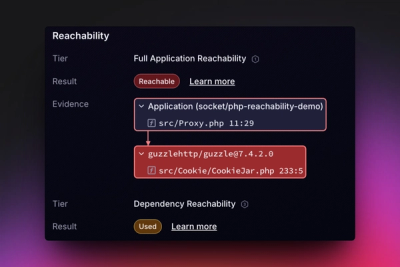
Reachability analysis for PHP is now available in experimental, helping teams identify which vulnerabilities are actually exploitable.