

Product
Introducing Data Exports
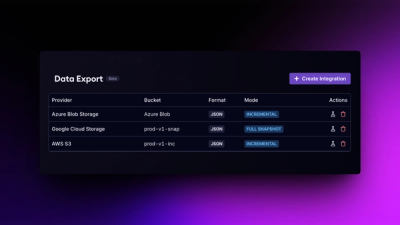
Export Socket alert data to your own cloud storage in JSON, CSV, or Parquet, with flexible snapshot or incremental delivery.
By Ola Adekola - Apr 23, 2026




The Heroku CLI is used to manage Heroku apps from the command line. It is built using oclif.
For more about Heroku see https://www.heroku.com/home
To get started see https://devcenter.heroku.com/start
The Heroku CLI is a command-line interface for managing Heroku applications and services. Built with Node.js and oclif, it provides an extensible architecture for interacting with the Heroku platform.
Key features include:
For more on developing plugins, read Developing CLI Plugins
For problems directly related to the CLI, add an issue on GitHub.
For other issues, submit a support ticket.
heroku access - manage user access to appsheroku accounts - list the Heroku accounts in your cacheheroku addons - tools and services for developing, extending, and operating your appheroku apps - manage apps on Herokuheroku auth - manage authentication for your Heroku accountheroku authorizations - OAuth authorizationsheroku autocomplete - display autocomplete installation instructionsheroku buildpacks - scripts used to compile appsheroku certs - SSL certificatesheroku ci - test runner for Heroku Pipelinesheroku clients - OAuth clients on the platformheroku config - environment variables of appsheroku container - deploy your Docker-based app to Herokuheroku data - display details of the most recent maintenance for an addonheroku domains - custom domains for appsheroku drains - forward logs to syslog or HTTPSheroku features - add/remove app featuresheroku git - set git remote and clone Heroku repositoryheroku help - Display help for heroku.heroku keys - add/remove account ssh keysheroku labs - add/remove experimental featuresheroku local - run Heroku app locallyheroku logs - display recent log outputheroku maintenance - enable/disable access to appheroku mcp - starts the Heroku platform MCP server in stdio modeheroku members - manage organization membersheroku notifications - display notificationsheroku orgs - manage organizationsheroku pg - manage postgresql databasesheroku pipelines - manage pipelinesheroku plugins - List installed plugins.heroku ps - Client tools for Heroku Execheroku redis - manage heroku redis instancesheroku regions - list available regions for deploymentheroku releases - display the releases for an appheroku repl - enter an interactive REPL session to run Heroku CLI commandsheroku reviewapps - manage reviewapps in pipelinesheroku run - run a one-off process inside a Heroku dynoheroku search - Search for a command.heroku sessions - OAuth sessionsheroku spaces - list available spacesheroku status - display current status of the Heroku platformheroku teams - manage teamsheroku telemetry - list telemetry drainsheroku update - update the Heroku CLIheroku usage - list usage for metered add-ons attached to an app or apps within a teamheroku versionheroku webhooks - list webhooks on an appAfter cloning the repo
npm install to install dependenciesnpm run build to build the CLI. This will need to be re-run any time you make changes and want to test them locally.To execute Heroku CLI commands locally, use ./bin/run <command>. For example, to run the heroku apps command with your local code, run ./bin/run apps from the root directory.
Run all tests with npm test.
Using WebStorm (from JetBrains / IntelliJ), you can run/debug an individual test case.
See the Heroku CLI Release Steps.
Review our PR guidelines.
FAQs
CLI to interact with Heroku
The npm package heroku receives a total of 9,223 weekly downloads. As such, heroku popularity was classified as popular.
We found that heroku demonstrated a healthy version release cadence and project activity because the last version was released less than a year ago. It has 52 open source maintainers collaborating on the project.
Did you know?

Socket for GitHub automatically highlights issues in each pull request and monitors the health of all your open source dependencies. Discover the contents of your packages and block harmful activity before you install or update your dependencies.
Product
Export Socket alert data to your own cloud storage in JSON, CSV, or Parquet, with flexible snapshot or incremental delivery.
Research
/Security News
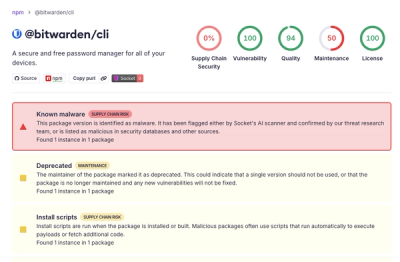
Bitwarden CLI 2026.4.0 was compromised in the Checkmarx supply chain campaign after attackers abused a GitHub Action in Bitwarden’s CI/CD pipeline.
Research
/Security News
Docker and Socket have uncovered malicious Checkmarx KICS images and suspicious code extension releases in a broader supply chain compromise.