Security News
curl Shuts Down Bug Bounty Program After Flood of AI Slop Reports
A surge of AI-generated vulnerability reports has pushed open source maintainers to rethink bug bounties and tighten security disclosure processes.
Node.js library for ed25519 keys management.
npm i hyperkeys
By default it saves the files in ~/.hyperkeys.
const Hyperkeys = require('hyperkeys')
const hyperkeys = new Hyperkeys()
const seed = hyperkeys.create(name)
const { publicKey, secretKey, seedKey } = hyperkeys.get(name)
hyperkeys.set(name, { publicKey, secretKey, seedKey })
const paths = hyperkeys.exists(name)
hyperkeys.remove(name)
const { keyPairs, knownKeys } = hyperkeys.list()
Hyperkeys.keyTriad() // => { publicKey, secretKey, seedKey }
const hyperkeys = new Hyperkeys({ dir: '/home/user/.another-folder' })
Hyperkeys.dir = '/home/user/.global-folder'
// Now all instances uses that global directory
const hyperkeys1 = new Hyperkeys()
// Setting a specific dir overrides the global
const hyperkeys2 = new Hyperkeys({ dir: '/home/user/.override-folder' })
// Writes the file to disk: ~/.hyperkeys/crst
const seedKey = hyperkeys.create('crst')
If you try to create twice with the same name it will throw an error.
If you have the seedKey then it will return all the keys.
That's because you can derivate the public and secret keys from the seed.
const keys = hyperkeys.get('crst')
// => { publicKey, secretKey, seedKey }
If you only have the publicKey then that's what you'll get.
const keys = hyperkeys.get('friend')
// => { publicKey, secretKey: null, seedKey: null }
You can force to save any key to a specific name.
hyperkeys.set('friend', { publicKey: Buffer<newer public key> })
Another example:
// As previously said, this will save only the seedKey to disk
hyperkeys.create('vm1')
// You can use "get" to retrieve and generate all the corresponding keys
const keys = hyperkeys.get('vm1')
// And force save them
hyperkeys.set('vm1', keys)
// Now you have those files saved:
// publicKey: ~/.hyperkeys/vm1.pub
// secretKey: ~/.hyperkeys/vm1.sec
// seedKey: ~/.hyperkeys/vm1
It will return the keys filepath linked to the name.
hyperkeys.create('vm2')
const exists = hyperkeys.exists('vm2')
// => { publicKey: null, secretKey: null, seedKey: '/home/user/...' }
// Again, with this we have explicitly all the keys in disk
hyperkeys.create('vm3')
hyperkeys.set('vm3', hyperkeys.get('vm3'))
const exists = hyperkeys.exists('vm3')
// => { publicKey: '/home/user/...', secretKey: '/home/user/...', seedKey: '/home/user/...' }
const exists = hyperkeys.exists('non-existent')
// => { publicKey: null, secretKey: null, seedKey: null }
It will remove all the keys, be it publicKey, secretKey and/or seedKey.
hyperkeys.remove('vm1')
keyPairs are the keys where you have the seedKey or the combination of publicKey and secretKey.
knownKeys are the keys where you don't have either the secretKey and seedKey.\
const { keyPairs, knownKeys } = hyperkeys.list()
// keyPairs => [{ name, publicKey, secretKey, seedKey }, ...]
// knownKeys => [{ name, publicKey, secretKey: null, seedKey: null }, ...]
Note: If you only have the secretKey file (.sec) it will not show up on the list.
It may be possible to derive the publicKey from the secretKey but not done for now.
const keyTriad = Hyperkeys.keyTriad()
// => { publicKey, secretKey, seedKey }
const keyPair = Hyperkeys.keyPair()
// => { publicKey, secretKey }
const seed = Hyperkeys.seed()
// => Buffer<32 random bytes>
MIT
FAQs
Keychain that derives deterministic keypairs
The npm package hyperkeys receives a total of 0 weekly downloads. As such, hyperkeys popularity was classified as not popular.
We found that hyperkeys demonstrated a not healthy version release cadence and project activity because the last version was released a year ago. It has 1 open source maintainer collaborating on the project.
Did you know?

Socket for GitHub automatically highlights issues in each pull request and monitors the health of all your open source dependencies. Discover the contents of your packages and block harmful activity before you install or update your dependencies.

Security News
A surge of AI-generated vulnerability reports has pushed open source maintainers to rethink bug bounties and tighten security disclosure processes.

Product
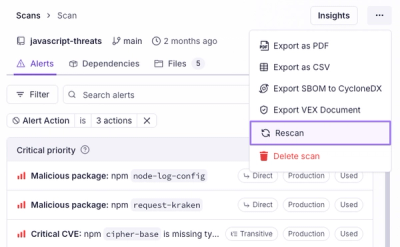
Scan results now load faster and remain consistent over time, with stable URLs and on-demand rescans for fresh security data.

Product
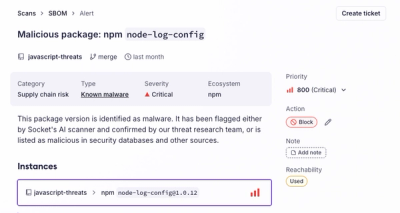
Socket's new Alert Details page is designed to surface more context, with a clearer layout, reachability dependency chains, and structured review.