


Company News
Socket Has Acquired Secure Annex
Socket has acquired Secure Annex to expand extension security across browsers, IDEs, and AI tools.
By Feross Aboukhadijeh - Apr 28, 2026
json-immutability-helper
Advanced tools
JSON-serialisable mutability helpers.
Originally based on
immutability-helper,
with list, string and mathematical commands added, but now uses an
alternative syntax.
npm install --save json-immutability-helper
When working with collaborative state shared over a network, it can be desirable to share state deltas rather than full state objects. This allows parallel editing from different editors, and reduces bandwidth requirements.
Sharing functions between browsers and servers is not desirable, as it introduces security concerns. Instead, this package provides a foundational set of primitive operations which cover typical mutations.
Because the operations are intended to be shared, all inputs are assumed to be potentially malicious, with necessary mitigations applied.
The core function update takes an object and a spec, and returns an
updated object. The input object and spec are unchanged (considered
immutable).
Optimisations ensure that if any properties within the object are unchanged, they will be returned exactly (not a copy). This helps when detecting changes using shallow comparison.
Simple usage:
const { update } = require('json-immutability-helper');

const initialState = { foo: 3 };

const updatedState = update(initialState, { foo: ['add', 1] });
// updatedState = { foo: 4 }
// initialState is unchanged
You can define arbitrary hierarchies:
const { update } = require('json-immutability-helper');

const initialState = { foo: { bar: { baz: 1 } } };

const updatedState = update(initialState, {
  foo: {
    bar: {
      baz: ['set', 7],
    },
    extra: ['set', 1]
  },
});
// updatedState = { foo: { bar: { baz: 7 }, extra: 1 } }
Note that arrays in the spec define commands. To navigate to a particular item in an array, use a number as an object key:
const { update } = require('json-immutability-helper');

const initialState = { foo: [2, 8] };

const updatedState = update(initialState, {
  foo: {
    0: ['set', 5],
  },
});
// updatedState = { foo: [5, 8] }

// To serialise as JSON, you can quote the index:

const spec = `
{
  "foo": {
    "0": ["set", 5]
  }
}
`;
With list commands:
const { update } = require('json-immutability-helper');

const initialState = {
  items: [
    { myId: 3, myThing: 'this' },
    { myId: 28, myThing: 'that' },
  ],
};

// Change the property 'myThing' of the item with myId=3
const updatedState = update(initialState, {
  items: [
    'updateWhere',
    ['myId', 3],
    { myThing: ['set', 'updated this'] },
  ],
});

// Note that the spec is fully JSON-serialisable:

const spec = `
{
  "items": [
    "updateWhere",
    ["myId", 3],
    { "myThing": ["set", "updated this"] }
  ]
}
`;
const updatedJsonState = update(initialState, JSON.parse(spec));
The main concept introduced in this project is conditions. Several
commands use conditions to decide which items to update, such as
updateIf, updateWhere and deleteFirstWhere, among others.
const items = [1, 2, 3, 4];

// Set items to 5 using the condition {equals: 3}
const updatedItems = update(items, [
  'updateWhere',
  { equals: 3 },
  ['set', 5],
]);

// The output is:
const expectedItems = [1, 2, 5, 4];
equals checks for a specific value. Other conditions are available,
for example:
const items = [1, 2, 3, 4];

const updatedItems = update(items, [
  'updateWhere',
  { greaterThanOrEqual: 3 },
  ['set', 5],
]);

// The output is:
const expectedItems = [1, 2, 5, 5];
Conditions can also be combined, for example to make a range:
const items = [1, 2, 3, 4];

const updatedItems = update(items, [
  'updateWhere',
  { greaterThan: 1, lessThan: 4 },
  ['set', 5],
]);

// The output is:
const expectedItems = [1, 5, 5, 4];
A common use-case is working with lists of objects. In this situation,
you can provide a key to test a particular property of the object:
const items = [
  { myId: 3, myThing: 'this' },
  { myId: 28, myThing: 'that' },
];

const updatedItems = update(items, [
  'updateWhere',
  { key: 'myId', equals: 3 },
  { myThing: ['set': 'updated this'] },
]);

// The output is:
const expectedItems = [
  { myId: 3, myThing: 'updated this' }, // <-- this item has changed
  { myId: 28, myThing: 'that' },
];
Because this is a common use-case, a shorthand is available:
['myProperty', myValue]

// Same as:
{key: 'myProperty', equals: myValue}
In both cases, this will look at the value of myProperty in the
current object, and check if it is equal to myValue.
Conditions can check multiple properties by wrapping them in an array (these only match if all conditions are met):
[
  {key: 'myProperty', greaterThanOrEqual: 2},
  {key: 'myOtherProperty', equals: 'something'},
]

// or, using the shorthand:
[
  {key: 'myProperty', greaterThanOrEqual: 2},
  ['myOtherProperty', 'something'],
]
equals: checks for an exact match. Note that this uses ===
matching, so null and undefined are distinct, and objects /
arrays will never compare equal (only test primitive types).not: negated form of equals.greaterThan: checks for strictly-greater-than.greaterThanOrEqual: checks for greater-than-or-equal.lessThan: checks for strictly-less-than.lessThanOrEqual: checks for less-than-or-equal.You can add new conditions with:
update.extendCondition(
  'conditionName',
  (parameter) => (actualValue) => {
    // parameter is the value assigned to the condition
    // actualValue is the value of the object being tested

    // example: greaterThan
    return actualValue > parameter;
  }
);
['set', value] alias ['=', value]
sets the value to the literal value given.
['unset']
deletes the value. If the parent is an object, the property is
removed. If the parent is an array, the element is removed and
subsequent items re-packed. If used on the root, update will
return undefined (unless allowUnset is specified).
['init', value]
if undefined, sets the value to the literal value given.
Otherwise leaves the value unchanged.
['updateIf', condition, spec, elseSpec?]
applies the given spec if the condition matches, otherwise
applies the elseSpec (if provided) or does nothing.
['seq', specs...]
applies the given specs sequentially. This can be used to create
complex updates out of simple operations.
// Computes (value + 2 - 10)
const updated = update(state, [
  'seq',
  ['add', 2],
  ['subtract', 10],
]);
(note that for mathematical operations it is usually better to
use rpn, described below).
['push', items...]
inserts one or more items at the end of the array.
['unshift', items...]
inserts one or more items at the start of the array.
['splice', arguments...]
invokes splice on the array repeatedly. Each argument should
be an array of parameters to send the splice function;
[offset, length, items...]. Note that offset can be negative
to count from the end of the array.
['insertBeforeFirstWhere', condition, items...]
inserts one or more items before the first item which matches the
condition (or at the end of the array if no items match).
['insertAfterFirstWhere', condition, items...]
inserts one or more items after the first item which matches the
condition (or at the end of the array if no items match).
['insertBeforeLastWhere', condition, items...]
inserts one or more items before the last item which matches the
condition (or at the start of the array if no items match).
['insertAfterLastWhere', condition, items...]
inserts one or more items after the last item which matches the
condition (or at the start of the array if no items match).
['updateAll', spec]
applies the given spec to all items in the array individually.
['updateWhere', condition, spec]
applies the given spec to all items in the array which match the
condition. If no item matches, does nothing. Same as
['updateAll', ['updateIf', condition, spec]].
['updateFirstWhere', condition, spec]
applies the given spec to the first item in the array which matches
the condition. If no item matches, does nothing.
['updateLastWhere', condition, spec]
applies the given spec to the last item in the array which matches
the condition. If no item matches, does nothing.
['deleteWhere', condition]
deletes all items in the array which match the condition. If no
items match, does nothing. Same as
['updateWhere', condition, ['unset']].
['deleteFirstWhere', condition]
deletes the first item in the array which match the condition. If
no item matches, does nothing. Same as
['updateFirstWhere', condition, ['unset']].
['deleteLastWhere', condition]
deletes the last item in the array which match the condition. If
no item matches, does nothing. Same as
['updateLastWhere', condition, ['unset']].
['merge', object, initial?]
Merges the keys of object into the current target. Similar to
calling Object.assign. If initial is provided and the target
value is undefined, it will be assigned the value of initial
before merging
(equivalent to ['seq', ['init', initial], ['merge', object]]).['replaceAll', search, replace]
replaces all occurrences of search in the string with replace.
Note that the search is used as a literal, not as a regular
expression.
Note that use of replaceAll is disabled unless .enableRiskyStringOps()
has been called.
['rpn', operations...]
reverse Polish notation command; see below for details.
Note that this usage of rpn is disabled unless .enableRiskyStringOps()
has been called.
['add', value] alias ['+', value]
adds the given value to the current value.
['subtract', value] alias ['-', value]
subtracts the given value from the current value.
['rpn', operations...]
reverse Polish notation command; see below for details.
['toggle'] alias ['~']
toggles the current value
(true → false; false → true).rpnThe rpn command lets you specify updates in reverse Polish notation.
This is especially useful for applying complex mathematical operations or
string manipulations.
Some examples:
// compute x * 2
update(5, ['rpn', 'x', 2, '*']); // = 10

// compute x * 2 + 10
update(5, ['rpn', 'x', 2, '*', 10, '+']); // = 20

// compute sin(x) + 2 * cos(x)
update(5, ['rpn', 'x', 'sin', 2, 'x', 'cos', '*', '+']); // ~= -0.3916
String manipulation is also supported, but disabled by default due to its
ability to construct large strings, which could be used by malicious clients
to launch memory exhaustion attacks against a server. To enable string
manipulation, call .enableRiskyStringOps() on the context:
const defaultContext = require('json-immutability-helper');

defaultContext.enableRiskyStringOps();
const update = defaultContext.update;

// compute x.substr(4, 3)
update('foo bar baz', ['rpn', 'x', 4, 3, 'substr']); // = bar

// compute x.leftPad(2)
update('3', ['rpn', 'x', 2, 'leftPad']); // = 03
Some functions accept optional parameters or are variadic. By default it
is assumed that the minimum number of parameters are passed to each function.
To specify a different number, add :<num> to the end of the function name:
// compute max(x, -x, 2)
update(4, ['rpn', 'x', 'x', 'neg', 2, 'max:3']); // = 4

// compute log_2(x)
update(8, ['rpn', 'x', 2, 'log:2']); // = 3
String literals can be specified as JSON-encoded strings (this means that for
transport, strings may be double-encoded). For example: '"foo"'.
Available constants:
x: the old valuepi: the mathematical constant π (3.141…)e: the mathematical constant e (2.718…)Inf: positive infinityNaN: not-a-numberAvailable functions/operators:
value 'String': converts the value to a string
value dp 'String:2': converts the value to a rounded string (decimal places
can be a positive or negative integer)
value 'Number': converts the value to a number
a b '+': adds two numbers or concatenates two strings (mixed values are
concatenated as strings)
a b '-': subtracts b from a
a b '*': multiplies two numbers
a b '/': divides a by b
a b '//': divides a by b, returning the truncated integer result
a b '^': raises a to the power of b, or if a is a string: repeats the
string b times
a b '%': returns the remainder of a / b (can be negative)
a b 'mod': returns the positive remainder of a / b
a 'neg': negates a
a 'abs': returns the absolute value of a
value 'log': returns the natural logarithm of value
value base 'log:2': returns the logarithm of value in base base
value 'log2': returns the logarithm of value in base 2
(same as value 2 'log:2')
value 'log10': returns the logarithm of value in base 10
(same as value 10 'log:2')
value 'exp': returns the exponent of value (i.e. e^value)
value base 'exp:2': returns base^value
v1 v2 v3 ... 'max:n': returns the largest value (the default arity is 2)
v1 v2 v3 ... 'min:n': returns the smallest value (the default arity is 2)
a b 'bitor': returns the bitwise-or of a and b
a b 'bitand': returns the bitwise-and of a and b
a b 'bitxor': returns the bitwise-xor of a and b
a 'bitneg': returns the bitwise negation of a
x 'sin': returns sin(x) in radians
x 'cos': returns cos(x) in radians
x 'tan': returns tan(x) in radians
x 'asin': returns asin(x) in radians
x 'acos': returns acos(x) in radians
x 'atan': returns atan(x) in radians
x 'sinh': returns sinh(x)
x 'cosh': returns cosh(x)
x 'tanh': returns tanh(x)
x 'asinh': returns asinh(x)
x 'acosh': returns acosh(x)
x 'atanh': returns atanh(x)
x 'round': rounds x to the nearest integer ("round halves-up")
(for control over the number of decimal places, see 'String')
x 'floor': returns the highest integer which is less than or equal to x
("round down")
x 'ceil': returns the lowest integer which is greater than or equal to x
("round up")
x 'trunc': returns the largest integer with absolute value less than or
equal to abs(x) ("round towards zero")
string 'length': returns the length of string in characters
string search 'indexOf': returns the index of the first occurrence of
search in string (0-based), or -1 if it is not found
string search start 'indexOf:3': returns the index of the first occurrence
of search in string, skipping the first start characters
string search 'lastIndexOf': returns the index of the last occurrence of
search in string (0-based), or -1 if it is not found
string search end 'lastIndexOf:3': returns the index of the last occurrence
of search in string within the range up to end
string length 'padStart': pads the start of string with spaces until it
is at least length characters long
string length padding 'padStart:3': pads the start of string with
padding until it is at least length characters long (fragments of the
padding string may be used)
string length 'padEnd': pads the end of string with spaces until it
is at least length characters long
string length padding 'padEnd:3': pads the end of string with
padding until it is at least length characters long (fragments of the
padding string may be used)
string from 'slice': returns a substring of string from from to the
end of the string. If from is negative, it counts from the end of the
string.
string from to 'slice:3': returns a substring of string from from to
to (exclusive). If from or to are negative, they cound from the end
of the string.
string from length 'substr': returns a substring of string from from
of length length. If from is negative it counts from the end of the
string.
As a basic protection against memory exhaution attacks, the generated string
length for the ^, padStart and padEnd operations is capped to 1024
characters, and String only accepts decimal places within the range -20
– 20. These restrictions ensure that memory usage can only be linear in
the number of operations, but could still become very high. As the risk
cannot be fully mitigated, string operations are disabled by default and must
be explicitly enabled by calling enableRiskyStringOps.
You can access the default context, or create your own scoped context:
const defaultContext = require('json-immutability-helper');
const { Context } = require('json-immutability-helper');
const myContext = new Context();
.extend(name, (object, args, context) => newValue)
adds a new command which can be used in the same places as built-in
commands. object is the previous value for the current position.
args is an array of parameters (excluding the command name).
context is an object which contains the methods listed here, as
well as update.
.extendAll(object)
same as calling extend for all key/value pairs in the given object.
.enableRiskyStringOps()
enables replaceAll and the string manipulation operators in the rpn
command, which are disabled by default due to their potential to amplify
memory exhaustion attacks.
.extendCondition(name, (param) => (actual) => boolean)
adds a new condition which can be used in the same places as built-in
conditions.
.extendConditionAll(object)
same as calling extendCondition for all key/value pairs in the
given object.
.combine(specs)
generates a single spec which is equivalent to applying all the given
specs sequentially. Conceptually this is identical to using
['seq', ...specs], but combine optimises common paths where
possible.
Note that the specs must be provided in an array, not as variadic
parameters.
.makeConditionPredicate(condition)
generates a predicate for the provided condition. This should be
used by custom commands when filtering based on a provided
condition is required.
.invariant(check, message?)
throws an exception if check is false. Includes the message if
specified (can be a string or a function which returns a string).
The default context's update, combine and invariant are also
available as direct imports:
const { update, combine, invariant } = require('json-immutability-helper');
FAQs
json-serialisable general-purpose reducer
We found that json-immutability-helper demonstrated a healthy version release cadence and project activity because the last version was released less than a year ago. It has 1 open source maintainer collaborating on the project.
Did you know?

Socket for GitHub automatically highlights issues in each pull request and monitors the health of all your open source dependencies. Discover the contents of your packages and block harmful activity before you install or update your dependencies.
Company News
Socket has acquired Secure Annex to expand extension security across browsers, IDEs, and AI tools.

Research
/Security News
Socket is tracking cloned Open VSX extensions tied to GlassWorm, with several updated from benign-looking sleepers into malware delivery vehicles.
Product
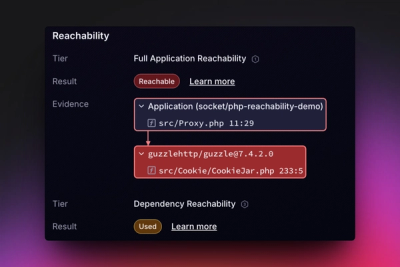
Reachability analysis for PHP is now available in experimental, helping teams identify which vulnerabilities are actually exploitable.