

Security News
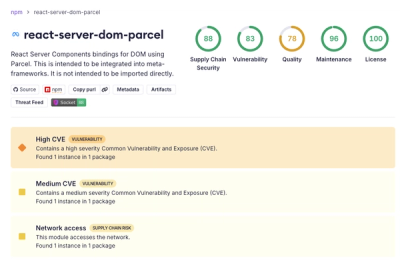
New React Server Components Vulnerabilities: DoS and Source Code Exposure
New DoS and source code exposure bugs in React Server Components and Next.js: what’s affected and how to update safely.
By Sarah Gooding - Dec 12, 2025
A TypeScript framework for building MCP (Model Context Protocol) servers elegantly
npm install litemcp zod
import { LiteMCP } from "litemcp";
import { z } from "zod";

const server = new LiteMCP("demo", "1.0.0");

server.addTool({
  name: "add",
  description: "Add two numbers",
  parameters: z.object({
    a: z.number(),
    b: z.number(),
  }),
  execute: async (args) => {
    return args.a + args.b;
  },
});

server.addResource({
  uri: "file:///logs/app.log",
  name: "Application Logs",
  mimeType: "text/plain",
  async load() {
    return {
      text: "Example log content",
    };
  },
});

server.start();
You can test the server in terminal with:
npx litemcp dev server.js
Tools in MCP allow servers to expose executable functions that can be invoked by clients and used by LLMs to perform actions.
server.addTool({
  name: "fetch",
  description: "Fetch the content of a url",
  parameters: z.object({
    url: z.string(),
  }),
  execute: async (args) => {
    const content = await fetchWebpageContent(args.url);
    return content;
  },
});
Resources represent any kind of data that an MCP server wants to make available to clients. This can include:
Each resource is identified by a unique URI and can contain either text or binary data.
server.addResource({
  uri: "file:///logs/app.log",
  name: "Application Logs",
  mimeType: "text/plain",
  async load() {
    return {
      text: await readLogFile(),
    };
  },
});
You can also return binary contents in load:
async load() {
  return {
    blob: 'base64-encoded-data'
  }
}
Prompts enable servers to define reusable prompt templates and workflows that clients can easily surface to users and LLMs. They provide a powerful way to standardize and share common LLM interactions.
server.addPrompt({
  name: "git-commit",
  description: "Generate a Git commit message",
  arguments: [
    {
      name: "changes",
      description: "Git diff or description of changes",
      required: true,
    },
  ],
  load: async (args) => {
    return `Generate a concise but descriptive commit message for these changes:\n\n${args.changes}`;
  },
});
You can send log messages to the client with server.logger
server.addTool({
  name: "download",
  description: "Download a file from a url",
  parameters: z.object({
    url: z.string(),
  }),
  execute: async (args) => {
    server.logger.info("Downloading file", { url: args.url });
    // ...
    server.logger.info("Downloaded file", { url: args.url });
    return response;
  },
});
The logger object has the following methods:
debug(message: string, context?: JsonValue)info(message: string, context?: JsonValue)warn(message: string, context?: JsonValue)error(message: string, context?: JsonValue)mcp-cliThe fastest way to test and debug your server is with mcp-cli:
npx litemcp dev server.js
npx litemcp dev server.ts // ts files are also supported
This will run your server with mcp-cli for testing and debugging your MCP server in the terminal.
MCP InspectorAnother way is to use the official MCP Inspector to inspect your server with a Web UI:
npx litemcp inspect server.js
The servers are running with stdio transport by default. You can also run the server with SSE mode:
server.start({
  transportType: "sse",
  sse: {
    endpoint: "/sse",
    port: 8080,
  },
});
This will start the server and listen for SSE connections on http://localhost:8080/sse.
You can then connect to the server with SSE transport in the client.
If you've developed a server using LiteMCP, please submit a PR to showcase it here!
FAQs
A TypeScript library that simplifies MCP server development
We found that litemcp demonstrated a healthy version release cadence and project activity because the last version was released less than a year ago. It has 1 open source maintainer collaborating on the project.
Did you know?

Socket for GitHub automatically highlights issues in each pull request and monitors the health of all your open source dependencies. Discover the contents of your packages and block harmful activity before you install or update your dependencies.
Security News
New DoS and source code exposure bugs in React Server Components and Next.js: what’s affected and how to update safely.

Security News
Socket CEO Feross Aboukhadijeh joins Software Engineering Daily to discuss modern software supply chain attacks and rising AI-driven security risks.
Security News
GitHub has revoked npm classic tokens for publishing; maintainers must migrate, but OpenJS warns OIDC trusted publishing still has risky gaps for critical projects.