


Company News
Socket Has Acquired Secure Annex
Socket has acquired Secure Annex to expand extension security across browsers, IDEs, and AI tools.
By Feross Aboukhadijeh - Apr 28, 2026
mongoose-plugins-trashable
Advanced tools
A mongoose plugin that adds ablity to trash/untrash (soft deletes) model instances.


This mongoose plugin adds the ability to soft-delete model instances, optionally records the id of a model (usually a User) responsible for the action.
Also, the Model.count(), Model.find(), Model.findOne(),
Model.findById() and other static methods is augmented to show only
non-trashed instances by default. You can still retrieve trashed instances by
using new static methods Model.findTrashed(), Model.findWithTrashed etc.
Refer to the test cases for their usage.
Use with Caution
This plugin internally overriden the model's count(), find() and many
static methods to retrieve only trashed instances. It also adds a by() to
mongoose.Query to enable a sweet syntax to record Users responsible for the
delete action.
If you don't feel right about modifying/extending native APIs, please don't use this plugin.
This plugin is inspired by yi's plugin.
Install the module with:
npm install mongoose-plugins-trashable
var Schema    = require('mongoose').Schema;
var trashable = require('mongoose-plugins-trashable');
var should    = require('should');

var TrashableSchema = new Schema({});
TrashableSchema.plugin(trachsable);
Trashable = mongoose.model('Trashable', TrashableSchema);

var trashable = new TrashableModel(); // assume async

// the attributes are created with null values
trashable.should.have.property('trashedAt').that.is.null;
trashable.should.have.property('trashedBy').that.is.null;


//
// promise style
//

// trash an object
trashable.trash.exec().then(function(trashable) {
    trashable.should.have.property('trashedAt').that.is.a('Date');
    trashable.should.have.property('trashedBy').that.is.null;
}).done();

// trash an object, and mark the User responsible
var User = mongoose.model('User');
var user = new User({}); // assume async
trashable.trash().by(user).exec().then(function(trashable) {
    trashable.should.have.property('trashedAt').that.is.a('Date');
    trashable.should.have.property('trashedBy');
    trashable.trashedBy.toString().should.equals(user.id);
}).done();

// restore a trashed object
trashable.restore().exec().then(function(trashable) {
    trashable.should.have.property('trashedAt').that.is.null;
    trashable.should.have.property('trashedBy').that.is.null;
}).done();


//
// callback style
//

// trash an object
trashable.trash(function(err, trashable) {
    trashable.should.have.property('trashedAt').that.is.a('Date');
    trashable.should.have.property('trashedBy').that.is.null;
});

// trash an object, and mark the User responsible
var User = mongoose.model('User');
var user = new User({}); // assume async
trashable.trash().by(user, function(err, trashable) {
    trashable.should.have.property('trashedAt').that.is.a('Date');
    trashable.should.have.property('trashedBy');
    trashable.trashedBy.toString().should.equals(user.id);
});

// restore a trashed object
trashable.restore(function(err, trashable) {
    trashable.should.have.property('trashedAt').that.is.null;
    trashable.should.have.property('trashedBy').that.is.null;
});
Copyright (c) 2014 Justin Lau justin@tclau.com
Licensed under the MIT license.
FAQs
A mongoose plugin that adds ablity to trash/untrash (soft deletes) model instances.
The npm package mongoose-plugins-trashable receives a total of 0 weekly downloads. As such, mongoose-plugins-trashable popularity was classified as not popular.
We found that mongoose-plugins-trashable demonstrated a not healthy version release cadence and project activity because the last version was released a year ago. It has 1 open source maintainer collaborating on the project.
Did you know?

Socket for GitHub automatically highlights issues in each pull request and monitors the health of all your open source dependencies. Discover the contents of your packages and block harmful activity before you install or update your dependencies.
Company News
Socket has acquired Secure Annex to expand extension security across browsers, IDEs, and AI tools.

Research
/Security News
Socket is tracking cloned Open VSX extensions tied to GlassWorm, with several updated from benign-looking sleepers into malware delivery vehicles.
Product
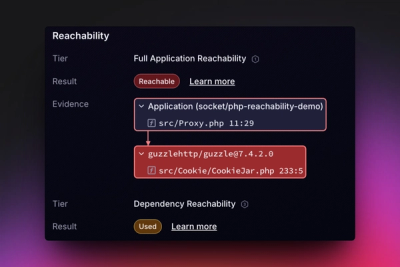
Reachability analysis for PHP is now available in experimental, helping teams identify which vulnerabilities are actually exploitable.