


Security News
Deno 2.6 + Socket: Supply Chain Defense In Your CLI
Deno 2.6 introduces deno audit with a new --socket flag that plugs directly into Socket to bring supply chain security checks into the Deno CLI.
By Sarah Gooding - Dec 12, 2025
Efficient, tiny object pool
import nage from 'nage';
// create your pool
const pool = nage();
// reserve an object from the pool
const object = pool.reserve();
// do your logic
// release object back to the pool
pool.release(object);
All typings for the internals are under the Nage namespace. The available types:
type Entry = {
  [key: string]: any;
  [index: number]: any;
};

type Creator<Pooled> = () => Pooled;

type Handler<Pooled> = (entry: Pooled) => void;

type ResetHandler<Pooled> = (stack: Pooled[]) => void;

type Options<Pooled extends {} = Entry> = {
  create?: Creator<Pooled>;
  initialSize?: number;
  name?: number | string | symbol;
  onRelease?: Handler<Pooled>;
  onReserve?: Handler<Pooled>;
  onReset?: ResetHandler<Pooled>;
};
The pool itself is not namespaced, it should be available directly as NagePool:
defaults to () => ({})
The method used to create a new object in the pool. The default returns an empty object, but if you have objects with a consistent structure it is more memory efficient to return an object with that structure to reduce the number of hidden classes created under-the-hood.
type Obj = {
  name: string | null;
  target: any;
}

const pool = nage<Obj>({
  create() {
    return {
      name: null,
      target: null,
    };
  },
});
NOTE: This function does not receive any arguments, and must return an object of some kind. This can be a standard POJO, array, Map, Set, etc., but it cannot be a primitive or null.
defaults to 1
const pool = nage<Obj>({ initialSize: 10 });
The number of objects to prepopulate the pool with. If you expect a number of objects to be used in parallel, it is advised to prepopulate the pool with the number appropriate for the use-case.
defaults to Infinity
const pool = nage<Obj>({ maxSize: 10 });
The maximum number of objects that will live in the pool. If you have reserved an object from the pool and try to release it back to the pool, it will allow the object to be garbage collected.
NOTE: If you provide an initialSize that is larger than the maxSize, the maxSize will be used as the initialSize.
const pool = nage<Obj>({ name: 'custom-name' });
The name for the given pool. This doesn't impact anything at runtime, but can help with debugging as an identifier.
type Obj = { [key: string]: any };

const pool = nage<Obj>({
  onReserve(object) {
    object.reservedAt = Date.now();
  },
});
Handler called for a newly-reserved item from the pool, called with the object prior to being returned. This method is handy if you want to prepopulate the object with some data.
type Obj = { [key: string]: any };

const pool = nage<Obj>({
  onRelease(object) {
    for (const key in object) {
      object[key] = null;
    }
  },
});
Handler called for a newly-released item back into the pool, called with the object just prior to being added to the stack. This method is handy to perform cleanup of the object in preparation for future use.
const pool = nage<Obj>({
  onReset(stack) {
    stack.forEach((entry) => {
      console.log(entry);
    });
  },
});
Handler called just prior to the stack being reset. This method is handy if you need to take a snapshot of the existing pool prior to it being purged and repopulated.
Reserves an object from the pool. If no objects remain to be reserved, it will create a new one for you based on the create method from options.
const object = pool.reserve();
Releases an object back to the pool from where it came from.
pool.release(object);
Reserves multiple objects from the pool. If no objects remain to be reserved, it will create new ones for you based on the create method from options.
const object = pool.reserveN(10);
Releases multiple objects back to the pool from where it came from.
pool.releaseN([object, anotherObject]);
Resets the pool to its initial state, which is based on the initialSize value from options.
pool.reset();
The number of objects in the pool available for reservation.
The number of objects in the pool unavailable because they are reserved.
The total number of objects in the pool, regardless of reservation status.
Standard stuff, clone the repo and npm install dependencies. The npm scripts available:
benchmark => run the benchmark suite pitting moize against other libraries in common use-casesbuild => run rollup to build the distributed files in distclean => run rimraf on the dist folderdev => run webpack dev server to run example app (playground!)dist => runs clean and buildlint => runs ESLint against all files in the src folderlint:fix => runs `lint``, fixing any errors if possibleprepublish => runs compile-for-publishprepublish:compile => run lint, test:coverage, and disttest => run test functions with NODE_ENV=testtest:coverage => run test but with nyc for coverage checkertest:watch => run test, but with persistent watcherFAQs
Efficient, tiny object pool
We found that nage demonstrated a not healthy version release cadence and project activity because the last version was released a year ago. It has 1 open source maintainer collaborating on the project.
Did you know?

Socket for GitHub automatically highlights issues in each pull request and monitors the health of all your open source dependencies. Discover the contents of your packages and block harmful activity before you install or update your dependencies.
Security News
Deno 2.6 introduces deno audit with a new --socket flag that plugs directly into Socket to bring supply chain security checks into the Deno CLI.
Security News
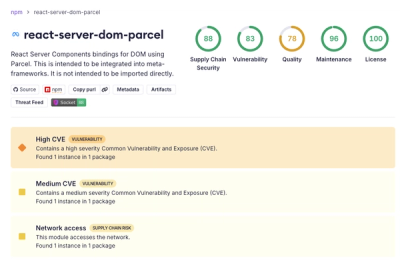
New DoS and source code exposure bugs in React Server Components and Next.js: what’s affected and how to update safely.

Security News
Socket CEO Feross Aboukhadijeh joins Software Engineering Daily to discuss modern software supply chain attacks and rising AI-driven security risks.