

Product
Socket for Jira Is Now Available
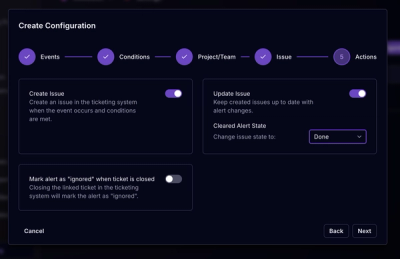
Socket for Jira lets teams turn alerts into Jira tickets with manual creation, automated ticketing rules, and two-way sync.
By Jeppe Hasseriis - Apr 20, 2026






Small middleware stack library. Analogous to co but without relying on
fancy language features. Weighs ~0.4kb gzipped.
var nanostack = require('nanostack')
var stack = nanostack()

stack.push(function timeElapsed (ctx, next) {
  var start = Date.now()

  next(null, function (err, ctx, next) {
    if (err) return next(err)
    var now = Date.now()
    var elapsed = start - now
    console.log('time elapsed: ' + elapsed + 'ms')
    next()
  })
})

var ctx = {}
stack.walk(ctx, function (err, data, next) {
  if (err) throw err
})
A stack is a "last-in, first-out" type structure. The last thing that's added is also the first thing that's taken off when you "unwind the stack".
In nanostack we push middleware onto the stack. This means that middleware is
first executed upwards (e.g. next function in sequence) until next() is
called without a callback. When that happens the stack starts to unwind, and
middleware is executed downwards. You can think of the execution order like
this:
  Nanostack
1.          7.  Middleware 1
==============
2.          6.  Middleware 2
==============
3.          5.  Middleware 3
==============
      4.        Middleware 4
Sequence: middleware 1, middleware 2, middleware 3
          middleware 4, middleware 3, middleware 2
          middleware 1
A keyd thing to note here is that any part of middleware can cause the stack to
unwind. This is done by not passing a callback into the next() function. This
is for example useful to handle create generic error handlers for the whole
stack of middleware.
stack = nanostackCreate a new nanostack instance.
stack.push(cb(ctx, next))Push a new handler onto the middleware stack.
stack.walk(ctx, next)Call the functions on the middleware stack. Takes an initial context object and a callback.
next([err], [value], [handler])Call the next function in the stack. If handler is not passed (e.g. last
argument is not a function) the stack unwinds, calling all previous handler
functions in reverse order (e.g. as a stack).
I realized that most frontend and backend plugin systems / middleware is often best expressed as a stack that can execute some code at the start, handing off control to a function up the stack and then execute some more code when it regains control (before handing control off again down the stack).
co figured this out a while ago, but relying on newer language features
prevented it from being generally applicable (for me). This package takes the
same ideas and allows them to run in more environments.
This package is probably best left for frameworks to consume / when doing more complex-ish architecture things. Generally the last handler on the stack would be a message bus / router that enables multiple handlers to resolve. If you're building something simple that might be all you need actually. Or if you want to get fancy you might want to consider using a package that consumes this one and exposes a neato pattern on top.
FAQs
Small middleware stack library
We found that nanostack demonstrated a not healthy version release cadence and project activity because the last version was released a year ago. It has 1 open source maintainer collaborating on the project.
Did you know?

Socket for GitHub automatically highlights issues in each pull request and monitors the health of all your open source dependencies. Discover the contents of your packages and block harmful activity before you install or update your dependencies.
Product
Socket for Jira lets teams turn alerts into Jira tickets with manual creation, automated ticketing rules, and two-way sync.
Company News
Socket won two 2026 Reppy Awards from RepVue, ranking in the top 5% of all sales orgs. AE Alexandra Lister shares what it's like to grow a sales career here.

Security News
NIST will stop enriching most CVEs under a new risk-based model, narrowing the NVD's scope as vulnerability submissions continue to surge.