

Product
Introducing Immutable Scans
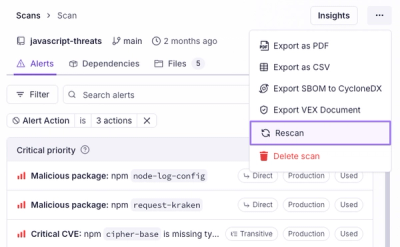
Scan results now load faster and remain consistent over time, with stable URLs and on-demand rescans for fresh security data.
By Nolan Lawson - Jan 23, 2026
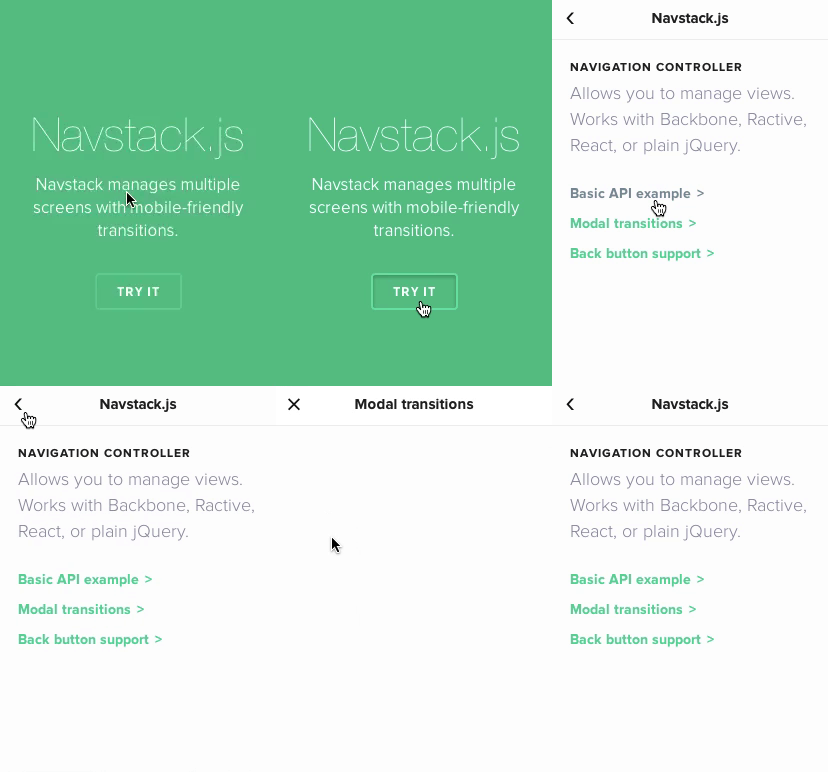
Manage a stack of multiple views. Perfect for tabs, navigation stacks, and similar. Inspired by iOS's UINavigationController.
Framework-agnostic: made to play fair with Backbone, Ractive, React.js and more. Can even work with plain old jQuery.
Router-friendly: made to be able to work with pushstate routers (like page.js), giving you back/forward button support.
Mobile-like transitions: buttery-smooth transitions are available out of the box, modeled after iOS7.
Requires jQuery 1.7+.

Status: very usable - just need to add documentation and examples.
Navstack is a JS + CSS bundle.
Or get it via Bower:
bower install navstack
Then use it:
<script src="jquery.js"></script>
<script src="navstack.js"></script>
<link rel="stylesheet" href="navstack.css">
Create your stack. You may pass a selector to el, or a jQuery object (eg,
$('#stage')), or a DOM node.
stage = new Navstack({ el: '#stage' });
Use .push() to create your panes. It takes 2 arguments:
name (string): the ID of the pane. This allows you to go back to previous panes.callback (function): a callback to return the pane's contents.// Navigate to new pages using push.
stage.push('home', function() {
return $("<div class='full-screen'>This is the home screen</div>");
});
// The first parameter is an ID for the pane to be pushed.
stage.push('task:1', function() {
return $("<div class='full-screen'>Task #1 details: ...</div>");
});
You may use Backbone views, Ractive instances, or React.js components as well.
stage.push('task:1', function() {
  /* Backbone: */
  return new Backbone.View({ ... });

  /* Ractive: */
  return new Ractive({ template: '...' });

  /* React.js: */
  var MyComponent = React.createClass({ ... });
  return new MyComponent({ name: "John" });
});
To switch back to previously-defined panes, use .push(name).
If the pane is recent (ie, last 5 panes used or so), the pane's DOM element is
previously hidden and will be made visible. If it's an old pane, it will be
recreated based on the initializer first passed onto .push().
stage.push('home');
Include the navstack.css file and use:
stage = new Navstack({
  el: '#hello',
  transition: 'slide'
})
Available transitions are slide and modal.
You can listen to events.
stage = new Navstack().
stage.on('push', function (e) {
  e.direction  // 'forward' or 'backward'
  e.current    // current pane
  e.previous   // previous pane
});

stage.on('push:yourpanenamehere', function (e) { ... });
Allows you to do modal dialogs.
(TODO: explain this.)
stage = new Navstack({
  transition: 'slide',
  groupTransition: 'modal',
});

stage.push('root!hello', function () { ... });
stage.push('modal!login', function () { ... });
stage.push('modal!confirm-email', function () { ... });
When a view is about to be hidden, a navstack:sleep event is called.
When a view is about to be shown, a navstack:wake event is called.
var $box = $("<div>hello</div>");
$box.on('navstack:sleep', function () { ... });
$box.on('navstack:wake', function () { ... });

stage.push('home', function () {
  return $box;
});

### Use with routers

To take full advantage of Navstack, it's recommended to use it with a router to
manage browser history states (read: makes the browser "Back" button work).

An example usage of Navstack with [page.js]:

``` js
var stack = new Navstack();

page('/home', function () {
  stack.push('home', function () {
    return $("<div>...</div>");
  });
});

page('/book/:id', function (ctx) {
  var id = ['book', ctx.params.id].join(':');
  stack.push(id, function () {
    return $("<div>...</div>");
  });
});

$(function () {
  $(stack.el).appendTo('body');
});
Or with Backbone.Router:
var stack = new Navstack();

App.Router = Backbone.Router.extend({
  routes: {
    '': 'home',
    'book/:id': 'showBook'
  },

  home: function () {
    stack.push('home', function () {
      return new HomeView(...);
    });
  },

  showBook: function (id) {
    stack.push('book:' + id, function () {
      var book = new Book(id: id);
      return new BookView(book);
    });
  }
});

$(function () {
  $(stack.el).appendTo('body');
  Backbone.history.start();
});
Rather than repetitively defining your constructor parameters across different
instances, you can subclass Navstack using Navstack.extend. This allows you
to set preset parameters, as well as define your own methods.
Stage = Navstack.extend({
  /* options go here */
});

stage = new Stage({ el: '#stage' });
stage.go('home');
// Basic usage
stage = new Navstack();

// All options are optional
stage = new Navstack({
  el: 'body', /* selector, or jQuery object */

  adapt: ['backbone'],
  adaptors: { backbone: ... },

  transition: 'slide' | 'modal',
  transitions: { slide: ... }, /* custom transitions */
});

stage.push('pane_id', function () {
  return $("<div>...</div>");
  return new Ractive(...);
  return new ReactComponent(...);
});

// Return to old pane
stage.push('pane_id');


// The main element
stage.el;           //=> <div>

// Access the active pane
stage.active;
stage.active.el;    //=> <div>
stage.active.view;  //=> whatever's returned in the initializer
stage.active.name;  //=> "home"

// Access the stack
stage.stack;
stage.stack['pane_id'].view;
stage.stack.length;

// Global repositories
Navstack.adaptors = {...};
Navstack.transitions = {...};
Public API is stable, and is okay for public consumption. The internal API is not stable yet (eg, transitions are due for a refactor).
Navstack © 2014, Rico Sta. Cruz. Released under the MIT License.
Authored and maintained by Rico Sta. Cruz with help from contributors.
ricostacruz.com · GitHub @rstacruz · Twitter @rstacruz
FAQs
Did you know?

Socket for GitHub automatically highlights issues in each pull request and monitors the health of all your open source dependencies. Discover the contents of your packages and block harmful activity before you install or update your dependencies.
Product
Scan results now load faster and remain consistent over time, with stable URLs and on-demand rescans for fresh security data.
Product
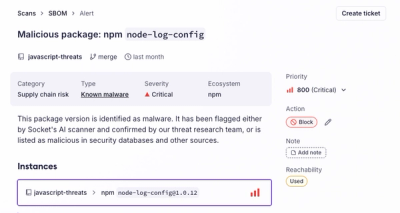
Socket's new Alert Details page is designed to surface more context, with a clearer layout, reachability dependency chains, and structured review.
Product
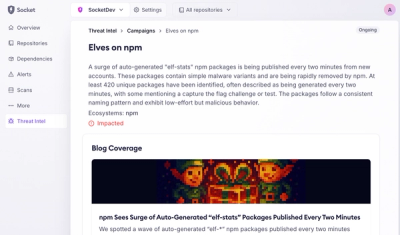
Campaign-level threat intelligence in Socket now shows when active supply chain attacks affect your repositories and packages.