

Product
Introducing Custom Tabs for Org Alerts
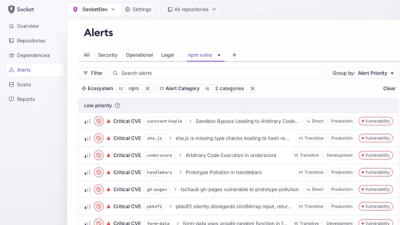
Create and share saved alert views with custom tabs on the org alerts page, making it easier for teams to return to consistent, named filter sets.
By André Staltz - Jan 20, 2026

ndm makes it easy to deploy a complex service-oriented-architecture by allowing you to deploy OS-specific service-wrappers directly from an npm package.
ndm currently supports Centos, OS X, and Ubuntu.
Table of Contents:
npm install ndm -gYou might need to run that as root with sudo.
How to build an ndm-ready package:
sudo npm install ndm -gnpm initnpm install my-service-module --savendm init.args and envs for your server.ndm install.ndm start.ndm can run a single services or a collection of services. It's structured like an npm package, with a package.json file listing its dependencies. Each service you want to run with ndm should be packaged as its own separate npm module that the ndm wrapper depends on. Then a service.json file describes how to run each service.
An ndm wrapper package looks like this:
wrapper/
  package.json
  service.json
  logs/
  node_modules/
A node-packaged service built for ndm can provide some hints in its package.json about how to run itself. Here's an example ndm-ready package.json:
{
  "name": "be-awesome",
  "version": "0.0.0",
  "description": "a service designed to be run with ndm.",
  "main": "index.js",
  "author": "",
  "license": "ISC",
  "dependencies": {
    "ssh2": "^0.2.25"
  },
  "devDependencies": {
    "mocha": "^1.20.0"
  },
  "script": {
    "start": "node ./bin/awesome.js"
  },
  "service": {
    "args": {
      "--verbose": "false"
    },
    "env": {
      "PORT": "5000"
    }
  },
}
Note the environment field and its subfields. environment.args is a map of arguments that should be passed to the ndm service. ndm.env is a map of environment variables that should be passed to your ndm service.
service.json file The ndm wrapper must also have a service.json file, which describes how to run the services. Run ndm init to generate service.json from your installed npm dependencies. The init script will copy default values from the environment stanza in each service's package.json. You can then edit the defaults if you need to change anything.
Here's an example:
{
  "baby-animals": {
    "description": "baby animal thumbnailing service",
    "scripts": {
      "start": "./baby-animal.js"
    },
    "env": {
      "PORT": "8000",
      "USER": "bcoe"
    },
    "args": {
      "--kitten": "cute"
    }
  },
  "ndm-test2": {
    "description": "the awesome service",
    "processes": 3,
    "module": "be-awesome",
    "scripts": {
      "start": "./bin/foo.js"
    },
    "env": {
      "PORT": "5000"
    },
    "args": {
      "--verbose": "false"
    }
  },
  "env": {
    "APP": "my-test-app-%i",
    "NODE_ENV": "production"
  },
  "args": {
    "--batman": "greatest-detective"
  }
}
start script is used.%i: %i is a place-holder for the process # if you're running multiple processes.
800%i.Defaults for all services are in the top-level env and args fields. Each services can override and extend the defaults in its own options stanza.
To add new dependencies:
npm install <new-service> --savendm update.To install your ndm-wrapped services, copy the package directory to your host system using whatever means you prefer. Then from inside the directory, run ndm install.
On systems like Ubuntu, you'll need to run this as root so ndm has permission to add the upstart config file to /etc/init. On OS X, you can run it as any user to create a local launch control script.
Command line arguments can be passed to the service wrapper at generation time, by appending them after --:
ndm install -- --verbose true
You can start and stop the services manually using your host's native daemon control: upstart, launchctl, or initctl. Or you can use ndm start and ndm stop from inside an ndm wrapper directory to start & stop all the wrapped services.
All console.log and console.error output is recorded in the logs/ directory, in files named <service-name>.log. This is separate from whatever internally-managed logging the service might do.
Rather than providing set-in-stone default values, you can opt to interview your user. To interview a user for important variables, write your default values in this form:
"env": {
  "HOST": {
    "default": "localhost",
    "description": "what host should I bind to?"
  }
}
By running ndm interview, a user will then be asked to fill in these values in an interactive manner:
Benjamins-MacBook-Air:ndm benjamincoe$ node ./bin/ndm.js interview
starting interview:
[?] url of front facing server: www.example.com
[?] what environment should we run the app in: test
[?] what do you think of dogs? I like 'em.
Add an .ndmrc file to your home directory, to override ndm's default settings.
Variable names should be camel-case. As an example, the following .ndmrc would change the default logging location:
; override ndm CLI variables by adding
; them to a .ndmrc file. Variables should be
; cammel case.
logsDirectory=/foo/bar/logs
Rather than using the ndm bin to manage services, you can use the ndm API to create a self-installable service:
start script, which is what ndm will run by default.runScript.service.json example:
{
  "ndm-test": {
    "description": "ndm test service",
    "scripts": {
      "start": "node ./test.js",
      "echo": "echo hello",
      "node-echo": "node ./test2.js"
    },
    "env": {
      "PORT": 8000,
      "USER": {
  "description": "enter a username."
      }
    }
  }
}
#!/usr/bin/env node

var argv = require('yargs').argv,
  ndm = require('ndm')('ndm-test');

switch(argv._[0]) {
  case 'install':
    ndm.install();
    break;
  case 'remove':
    ndm.remove();
    break;
  case 'start':
    ndm.start();
    break;
  case 'restart':
    ndm.restart();
    break;
  case 'stop':
    ndm.stop();
    break;
  case 'list-scripts':
    ndm.listScripts();
    break;
  case 'run-script':
    ndm.runScript();
    break;
}
ndm-test is published to npm, try it out:
npm install ndm-test -g
ndm-test install
ndm-test start
ndm is an experiment, based on ops challenges we've been facing at npm. This is a dot release. I'll be moving things around a lot in this library, as we use it for our own deployments.
The ndm stanza is not officially supported by npm.
ISC
FAQs
ndm allows you to deploy OS-specific service-wrappers directly from npm-packages.
The npm package ndm receives a total of 57 weekly downloads. As such, ndm popularity was classified as not popular.
We found that ndm demonstrated a not healthy version release cadence and project activity because the last version was released a year ago. It has 1 open source maintainer collaborating on the project.
Did you know?

Socket for GitHub automatically highlights issues in each pull request and monitors the health of all your open source dependencies. Discover the contents of your packages and block harmful activity before you install or update your dependencies.
Product
Create and share saved alert views with custom tabs on the org alerts page, making it easier for teams to return to consistent, named filter sets.
Product
Socket’s Rust and Cargo support is now generally available, providing dependency analysis and supply chain visibility for Rust projects.

Security News
Chrome 144 introduces the Temporal API, a modern approach to date and time handling designed to fix long-standing issues with JavaScript’s Date object.