


Security News
Deno 2.6 + Socket: Supply Chain Defense In Your CLI
Deno 2.6 introduces deno audit with a new --socket flag that plugs directly into Socket to bring supply chain security checks into the Deno CLI.
By Sarah Gooding - Dec 12, 2025
nestjs-param-store
Advanced tools
This package allows you to configure your NestJS application by loading the configuration from AWS SSM Parameter Store.
npm install nestjs-param-store @aws-sdk/client-ssm
import { Module } from '@nestjs/common';
import { PSConfigModule } from 'nestjs-param-store';

@Module({
  imports: [
    PSConfigModule.register({
      ssmParamStorePath: '/production/services/my-service',
      ssmDecryptParams: true,
      ssmRecursive: false,
      ssmClientOptions: {
        region: 'us-east-1',
      },
    }),
  ],
})
export class AppModule {}
By calling PSConfigModule.register, you configure the module to load all the parameters under the path ssmParamStorePath.
The following example shows how to retrieve the configuration before registering the module.
import { Module } from '@nestjs/common';
import { ConfigModule, ConfigService } from '@nestjs/config';
import { PSConfigModule } from 'nestjs-param-store';

@Module({
  imports: [
    PSConfigModule.registerAsync({
      imports: [ConfigModule],
      useFactory: async (config: ConfigService<EnvironmentVariables>) => ({
        ssmParamStorePath: config.get<string>('APP_CONFIG_PATH'),
        ssmDecryptParams: true,
        ssmRecursive: false,
        ssmClientOptions: {
          region: config.get<string>('AWS_REGION'),
        },
      }),
      inject: [ConfigService],
    }),
  ],
})
export class AppModule {}
| Option | Required | Default | Description |
|---|---|---|---|
| ssmParamStorePath | Yes | The hierarchy for the parameter | |
| ssmDecryptParams | No | false | Retrieve all parameters in a hierarchy with their value decrypted |
| ssmRecursive | No | false | Retrieve all parameters within a hierarchy |
| ssmClientOptions | No | undefined | Options to pass to the underlying SSM client |
This module exposes the following services.
The PSConfigService service allows you to access the configuration loaded from Parameter Store. Use its own class name as the injection token.
Let's assume the following parameters were previously registered:
/production/services/my-service/pagination-limit: '25'/production/services/my-service/post-table: 'ProductionPostTable'Configure the module with ssmParamStorePath pointing to /production/services/my-service to access all the parameters register for the service in production.
Then, access the configuration as follows:
import { Injectable } from '@nestjs/common';
import { PSConfigService } from 'nestjs-param-store';
import { DynamoDBClient, QueryCommand, GetItemCommand } from '@aws-sdk/client-dynamodb';

@Injectable()
export class PostRepository {
  // Some common initialization.
  public constructor(
    private readonly dynamodbClient: DynamoDBClient,
    private readonly psConfigService: PSConfigService,
  ) {}

  public getPostsByUser(userId: string) {
    // Here: Note how to retrieve the configuration.
    const table = await this.psConfigService.get<string>('post-table');
    const limit = await this.psConfigService.get<number>('pagination-limit');

    const queryCommand = new QueryCommand({
      TableName: table, // <- use
      KeyConditionExpression: 'PK = :pk',
      ExpressionAttributeValues: {
        ':pk': { S: `USER#${userId}` },
      },
      Limit: limit,  // <- use
    });

    const { Items = [] } = await this.dynamodbClient.send(queryCommand);
    // .... snip ....
  }
}
The PSConfigService service exposes the following methods:
get(name, defaultValue): To retrieve a string configuration.getBool(name, defaultValue): To retrieve a boolean configuration. The following values as considered truly: true, True, 1, y, yes, and Yes.getNumber(name, defaultValue): To retrieve a numeric configuration.When calling get, getBool, or getNumber, the service will look up a parameter whose name ends with the name specified. This means that the match is partial.
Given the following parameter:
/production/services/my-service/pagination-limit: '25'It can be retrieved using one of these alternatives:
get('pagination-limit')get('my-service/pagination-limit')get('services/my-service/pagination-limit')get('production/services/my-service/pagination-limit')You can access the raw parameters loaded from the Parameter Store.
import { Inject, Injectable } from '@nestjs/common';
import { PS_CONFIG_PARAMETERS, PSConfigParameters } from 'nestjs-param-store';

@Injectable()
export class SophisticatedService {
  public constructor(
    @Inject(PS_CONFIG_PARAMETERS) parameters: PSConfigParameters,
  ) {
    console.log(parameters);
  }
}
Example of output:
[
  {
      "Name": "/production/services/my-service/pagination-limit",
      "Type": "String",
      "Value": "25",
      "Version": 1,
      "LastModifiedDate": "2022-09-03T02:55:00.389000-04:00",
      "ARN": "arn:aws:ssm:us-east-1:000000000000:parameter/production/services/my-service/pagination-limit",
      "DataType": "text"
  },
  {
      "Name": "/production/services/my-service/post-table",
      "Type": "String",
      "Value": "ProductionPostTable",
      "Version": 1,
      "LastModifiedDate": "2022-09-03T03:15:15.032000-04:00",
      "ARN": "arn:aws:ssm:us-east-1:000000000000:parameter/production/services/my-service/post-table",
      "DataType": "text"
  }
]
This happens when recursive is false and the specified path does not resolve the final level in the hierarchy.
Reference: GetParametersByPath
import { Module } from '@nestjs/common';
import { PSConfigModule } from 'nestjs-param-store';

@Module({
  imports: [
    PSConfigModule.register({
      ssmParamStorePath: '/production',
      ssmRecursive: true,   // <-- specify recursively
    }),
  ],
})
export class AppModule {}
FAQs
Configure your NestJS application with AWS Parameter Store
The npm package nestjs-param-store receives a total of 902 weekly downloads. As such, nestjs-param-store popularity was classified as not popular.
We found that nestjs-param-store demonstrated a not healthy version release cadence and project activity because the last version was released a year ago. It has 1 open source maintainer collaborating on the project.
Did you know?

Socket for GitHub automatically highlights issues in each pull request and monitors the health of all your open source dependencies. Discover the contents of your packages and block harmful activity before you install or update your dependencies.
Security News
Deno 2.6 introduces deno audit with a new --socket flag that plugs directly into Socket to bring supply chain security checks into the Deno CLI.
Security News
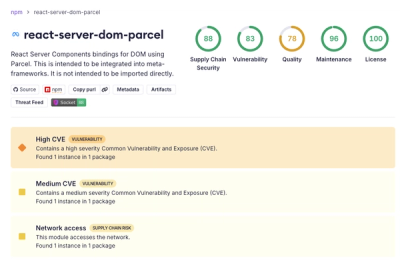
New DoS and source code exposure bugs in React Server Components and Next.js: what’s affected and how to update safely.

Security News
Socket CEO Feross Aboukhadijeh joins Software Engineering Daily to discuss modern software supply chain attacks and rising AI-driven security risks.