

Company News
Socket Has Acquired Secure Annex
Socket has acquired Secure Annex to expand extension security across browsers, IDEs, and AI tools.
By Feross Aboukhadijeh - Apr 28, 2026
oauth2-mock-server
Advanced tools
Configurable OAuth2/OpenID Connect server for automated testing and development purposes
oauth2-mock-server

OAuth 2 mock server. Intended to be used for development or testing purposes.
When developing an application that exposes or consumes APIs that are secured with an OAuth 2 authorization scheme, a mechanism for issuing access tokens is needed. Frequently, a developer needs to create custom code that fakes the creation of tokens for testing purposes, and these tokens cannot be properly verified, since there is no actual entity issuing those tokens.
The purpose of this package is to provide an easily configurable OAuth 2 server, that can be set up and teared down at will, and can be programmatically run while performing automated tests.
Warning: This tool is not intended to be used as an actual production grade OAuth 2 server. It lacks many features that would be required in a proper implementation.
Add it to your Node.js project as a development dependency:
npm install --save-dev oauth2-mock-server
Here is an example for creating and running a server instance with a single random RSA key:
import { OAuth2Server } from 'oauth2-mock-server';
// ...or in CommonJS style:
// const { OAuth2Server } = require('oauth2-mock-server');

let server = new OAuth2Server();

// Generate a new RSA key and add it to the keystore
await server.issuer.keys.generate('RS256');

// Start the server
await server.start(8080, 'localhost');
console.log('Issuer URL:', server.issuer.url); // -> http://localhost:8080

// Do some work with the server
// ...

// Stop the server
await server.stop();
Any number of existing JSON-formatted keys can be added to the keystore.
// Add an existing JWK key to the keystore
await server.issuer.keys.add({
  kid: 'some-key',
  alg: 'RS256',
  kty: 'RSA',
  // ...
});
JSON Web Tokens (JWT) can be built programmatically:
import axios from 'axios';

// Build a new token
let token = await server.issuer.buildToken();

// Call a remote API with the token
axios
  .get('https://server.example.com/api/endpoint', {
    headers: {
      authorization: `Bearer ${token}`,
    },
  })
  .then((response) => {
    /* ... */
  })
  .catch((error) => {
    /* ... */
  });
| Algorithm | kty | alg |
|---|---|---|
| RSASSA-PKCS1-v1_5 | RSA | RS256, RS384, RS512 |
| RSASSA-PSS | RSA | PS256, PS384, PS512 |
| ECDSA | EC | ES256, ES384, ES512 |
| EdDSA | OKP | Ed25519 |
It also provides a convenient way, through event emitters, to programmatically customize the server processing. This is particularly useful when expecting the OIDC service to behave in a specific way on one single test.
Typed signature: (token: MutableToken, req: TokenRequestIncomingMessage) => void
// Modify the expiration time on next produced token
service.once('beforeTokenSigning', (token, req) => {
  const timestamp = Math.floor(Date.now() / 1000);
  token.payload.exp = timestamp + 400;
});
const basicAuth = require('basic-auth');

// Add the client ID to a token
service.once('beforeTokenSigning', (token, req) => {
  const credentials = basicAuth(req);
  const clientId = credentials ? credentials.name : req.body.client_id;
  token.payload.client_id = clientId;
});
Typed signature: (tokenEndpointResponse: MutableResponse, req: TokenRequestIncomingMessage) => void
// Force the oidc service to provide an invalid_grant response
// on next call to the token endpoint
service.once('beforeResponse', (tokenEndpointResponse, req) => {
  tokenEndpointResponse.body = {
    error: 'invalid_grant',
  };
  tokenEndpointResponse.statusCode = 400;
});
Typed signature: (userInfoResponse: MutableResponse, req: IncomingMessage) => void
// Force the oidc service to provide an error
// on next call to userinfo endpoint
service.once('beforeUserinfo', (userInfoResponse, req) => {
  userInfoResponse.body = {
    error: 'invalid_token',
    error_message: 'token is expired',
  };
  userInfoResponse.statusCode = 401;
});
Typed signature: (revokeResponse: StatusCodeMutableResponse, req: IncomingMessage) => void
// Simulates a custom token revocation result code
service.once('beforeRevoke', (revokeResponse, req) => {
  revokeResponse.statusCode = 418;
});
Typed signature: (authorizeRedirectUri: MutableRedirectUri, req: IncomingMessage) => void
// Modify the uri and query parameters
// before the authorization redirect
service.once('beforeAuthorizeRedirect', (authorizeRedirectUri, req) => {
  authorizeRedirectUri.url.searchParams.set('foo', 'bar');
});
Typed signature: (postLogoutRedirectUri: MutableRedirectUri, req: IncomingMessage) => void
// Modify the uri and query parameters
// before the post_logout_redirect_uri redirect
service.once('beforePostLogoutRedirect', (postLogoutRedirectUri, req) => {
  postLogoutRedirectUri.url.searchParams.set('foo', 'bar');
});
Typed signature: (introspectResponse: MutableResponse, req: IncomingMessage) => void
// Simulate a custom token introspection response body
service.once('beforeIntrospect', (introspectResponse, req) => {
  introspectResponse.body = {
    active: true,
    scope: 'read write email',
    client_id: '<client_id>',
    username: 'dummy',
    exp: 1643712575,
  };
});
It also provides basic HTTPS support, an optional cert and key can be supplied to start the server with SSL/TLS using the in-built NodeJS HTTPS module.
We recommend using a package to create a locally trusted certificate, like mkcert.
let server = new OAuth2Server(
  'test-assets/mock-auth/key.pem',
  'test-assets/mock-auth/cert.pem'
);
NOTE: Enabling HTTPS will also update the issuer URL to reflect the current protocol.
/.well-known/openid-configurationReturns the OpenID Provider Configuration Information for the server.
/jwksReturns the JSON Web Key Set (JWKS) of all the keys configured in the server.
/tokenIssues access tokens.
/authorizeSimulates the user authentication. It will automatically redirect to the callback endpoint sent as parameter. It currently supports only 'code' response_type.
/userinfoProvides extra userinfo claims.
/revokeSimulates a token revocation. This endpoint should always return 200 as stated by RFC 7009.
/endsessionSimulates the end session endpoint. It will automatically redirect to the post_logout_redirect_uri sent as parameter.
/introspectSimulates the token introspection endpoint.
The server can be run from the command line.
npx oauth2-mock-server --help
FAQs
Configurable OAuth2/OpenID Connect server for automated testing and development purposes
The npm package oauth2-mock-server receives a total of 72,063 weekly downloads. As such, oauth2-mock-server popularity was classified as popular.
We found that oauth2-mock-server demonstrated a healthy version release cadence and project activity because the last version was released less than a year ago. It has 1 open source maintainer collaborating on the project.
Did you know?

Socket for GitHub automatically highlights issues in each pull request and monitors the health of all your open source dependencies. Discover the contents of your packages and block harmful activity before you install or update your dependencies.
Company News
Socket has acquired Secure Annex to expand extension security across browsers, IDEs, and AI tools.

Research
/Security News
Socket is tracking cloned Open VSX extensions tied to GlassWorm, with several updated from benign-looking sleepers into malware delivery vehicles.
Product
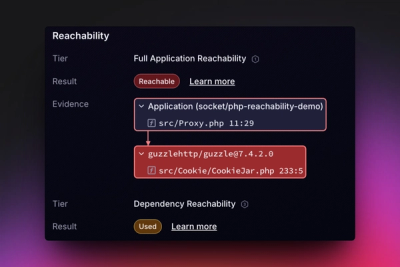
Reachability analysis for PHP is now available in experimental, helping teams identify which vulnerabilities are actually exploitable.