


Company News
Socket Has Acquired Secure Annex
Socket has acquired Secure Annex to expand extension security across browsers, IDEs, and AI tools.
By Feross Aboukhadijeh - Apr 28, 2026
object-property-extractor
Advanced tools
A lightweight (no dependencies) tool to extract deeply nested values from JS Objects (or Arrays), with optional Fallback.
Access deep object properties using a string (e.g. "user.country.name")
A lightweight (no dependencies) tool to extract deeply nested values from JS Objects (or Arrays), with optional Fallback.
Similar to Lodash' get function, but with some additional functionality.
Consider the object
const data = {
  user: {
    name: { first: 'Jango', last: 'Fett' },
    children: ['Boba', 'Clone 1', 'Clone 2', ...etc],
    weapons: [
      { name: 'Blaster', description: 'For shooting stuff' },
      { name: 'Seismic charge', description: '...BWAAAAAANG' },
    ],
  },
  ...otherProperties,
}
In Javascript, you call inner object properties via dot notation:
data.user.name.last // Fett
If you want to access a property dynamically, you can do this:
const key = "user"
return data[key]
However, you can't do this:
const key = "user.name"
return data[key]
This tool allows access to deep properties from a single "property path" string.
yarn add object-property-extractor
// OR
npm install object-property-extractor
extract( dataObject, propertyString, [fallback] )
import extract from "object-property-extractor"

// Using the data object above
extract(data, "user.name.first") // Jango

// With fallback when path not found
extract(data, "user.age", "Unknown") // Unknown

// Arrays can be accessed by index, as per normal indexing syntax
extract(data, "user.children[1]") // Boba
In addition to accessing array by index (above), if an array consists of objects, then it's possible to extract a single property from each object in the returned array.
For example:
extract(data, "user.weapons.name")
// ["Blaster", "Seismic charge"]
Note that this is essentially a shorthand for:
extract(data, "user.weapons").map((weapon) => weapon.name)
If a requested property can't be accessed (e.g. incorrect path), the function will throw an error, unless a fallback is provided. So unless you are catching and handling these errors at a higher level, it is recommended to always provided a fallback (null is an acceptable fallback).
A jest test suite is included in the repo. To run:
yarn test
See /test/test.ts for the test cases.
Please make an issue in the Github repo: https://github.com/CarlosNZ/object-property-extractor
FAQs
A lightweight (no dependencies) tool to extract deeply nested values from JS Objects (or Arrays), with optional Fallback.
We found that object-property-extractor demonstrated a healthy version release cadence and project activity because the last version was released less than a year ago. It has 1 open source maintainer collaborating on the project.
Did you know?

Socket for GitHub automatically highlights issues in each pull request and monitors the health of all your open source dependencies. Discover the contents of your packages and block harmful activity before you install or update your dependencies.
Company News
Socket has acquired Secure Annex to expand extension security across browsers, IDEs, and AI tools.

Research
/Security News
Socket is tracking cloned Open VSX extensions tied to GlassWorm, with several updated from benign-looking sleepers into malware delivery vehicles.
Product
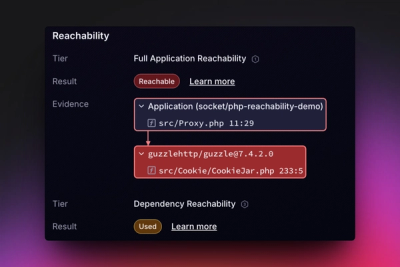
Reachability analysis for PHP is now available in experimental, helping teams identify which vulnerabilities are actually exploitable.