


Security News
Deno 2.6 + Socket: Supply Chain Defense In Your CLI
Deno 2.6 introduces deno audit with a new --socket flag that plugs directly into Socket to bring supply chain security checks into the Deno CLI.
By Sarah Gooding - Dec 12, 2025
The collection of middleware which provides REST API interface for data and schema access, users and security management.




The collection of middleware which provides flexible RESTful API for accessing to application data store and schemas, users and security management. Save your time to bootstrap new web and mobile projects.
Open Parse is open source BaaS (Backend as a Service). On the schema below that is "Data Proccessing / Management":
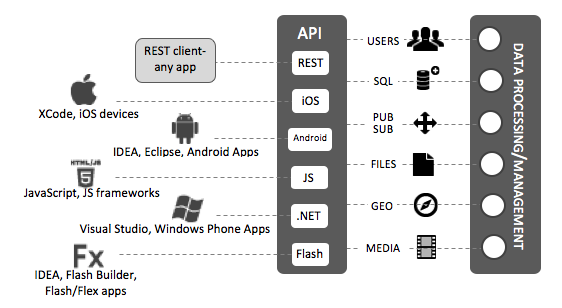
Out of the box Open Parse supports:
bunyan-logger which could be connected to Logentries, Loggly, NewRelic and other cloud log management services just in a 15 seconds.
MongoDB as default data provider. But you could implement custom data providers for any other databases (it takes ~20 min).
Built with love to Functional Principles and.. yes, koa.
Open Parse is incredibly simple. It's just a glue which is connecting 2 pieces:
You can extend any of those points.
npm install --save open-parse
The following example has been written with using promised-mongo and koa-router packages.
import Router from 'koa-router';
import pmongo from 'promised-mongo';

const router = new Router();
const db = new pmongo('localhost/my-app');

const dataRequired = function *(next) {
  if (typeof this.request.body['data'] === 'object') {
    yield next;
  } else {
    this.throw(400, 'Request data is required');
  }
};
const users = {
  dataProvider: new UsersDataProvider({
    collection: db.collection('users')
  })
};
router.post('/users', dataRequired, handleUserSignUp(users));
router.get('/login', handleUserLogin(users));
router.post('/logout', handleUserLogout(users));
router.get('/users/me', handleUserFetch(users));
In this example we're using a local data from JSON file.
const classes = {
  dataProvider: new ObjectsDataProvider({
    collection: db.collection('objects'),
    initialCache: require('./cached-objects.json')
  }),
};
router.post('/classes/:className', dataRequired, handleObjectCreate(classes));
router.get('/classes/:className', handleObjectsList(classes));
router.get('/classes/:className/:objectId', handleObjectFetch(classes));
router.patch('/classes/:className/:objectId', dataRequired, handleObjectUpdate(classes));
router.delete('/classes/:className/:objectId', handleObjectDelete(classes));
For ObjectsDataProvider an initial cache should be specified as a [className][objectId] hash object:
cached-objects.json
{
  "company": {
    "our": {
      "title": "Startup Makers",
      "about": "We are consulting and outsourcing a web-development with cutting-edge JavaScript technologies (ES6, Node.js, React, Redux, koa)"
    }
  }
}
const schemas = {
  dataProvider: new SchemasDataProvider({
    collection: db.collection('schemas')
  })
};
router.get('/schemas/:className', handleSchemaFetch(schemas));
import koa from 'koa';
import cors from 'kcors';
import qs from 'koa-qs';
import bodyParser from 'koa-bodyparser';
import mount from 'koa-mount';

// Create the server instance
const app = koa();
app.use(cors());
qs(app);
app.use(bodyParser());

// ...paste your routes here...

// Connect API router
app.use(mount('/api', router));

// Go LIVE
app.listen(process.env['PORT'] || 3000);
For example how to implement login in your browser scripts when you have connected Open Parse:
const login = (email, password) => {
  const loginURL =
    '/api/login'
    + '?email=' + encodeURIComponent(email)
    + '&password=' + encodeURIComponent(password);
  fetch(loginURL, {
    headers: {
      'Accept': 'application/json',
    },
    credentials: 'same-origin'
  }).then((response) => response.json()).then((body) => {
    if (body['data']) {
      const userId = body['data']['id'];
      const userName = body['data']['attributes']['name'];
      console.log('Logged as user %s (%s)', userName, userId);
    } else {
      body['errors'].forEach(error =>
        console.error('Auth error: %s (%s)', error['title'], error['source']['parameter'])
      );
    }
  });
};
It's really easy. Did you initialize a logger? If you didn't, let's do it right now:
import bunyan from 'bunyan';
import { LogentriesBunyanStream } from 'bunyan-logentries';

const logger = bunyan.createLogger({
  name: 'awesome-app',
  streams: {
    stream: new LogentriesBunyanStream({
      token: process.env['LOGENTRIES_TOKEN']
    }),
    level: 'debug',
    type: 'raw'
  }
});
Add just a one line to your code
const users = {
  dataProvider: new UsersDataProvider({
    collection: db.collection('users')
  }),
  logger // THIS LINE!
};
router.post('/users', dataRequired, handleUserSignUp(users));
router.get('/login', handleUserLogin(users));
router.post('/logout', handleUserLogout(users));
router.get('/users/me', handleUserFetch(users));
That's all. You will get a messages (about login, logout and fetching the data about users) in your Logentries account.
Are you ready to make the world better?
1. Fork this repo
2. Checkout your repo:
git clone git@github.com:YourAccount/open-parse.git
3. Create your feature (or issue) branch:
git checkout -b my-new-feature
4. Commit your changes:
git commit -am 'Add some changes'
5. Push to the branch:
git push origin my-new-feature
Thank you very much. Your support is greatly appreciated.
Version 0.2
Version 0.3
Version 0.4
Version 0.5
FAQs
The collection of middleware which provides REST API interface for data and schema access, users and security management.
The npm package open-parse receives a total of 0 weekly downloads. As such, open-parse popularity was classified as not popular.
We found that open-parse demonstrated a not healthy version release cadence and project activity because the last version was released a year ago. It has 1 open source maintainer collaborating on the project.
Did you know?

Socket for GitHub automatically highlights issues in each pull request and monitors the health of all your open source dependencies. Discover the contents of your packages and block harmful activity before you install or update your dependencies.
Security News
Deno 2.6 introduces deno audit with a new --socket flag that plugs directly into Socket to bring supply chain security checks into the Deno CLI.
Security News
New DoS and source code exposure bugs in React Server Components and Next.js: what’s affected and how to update safely.

Security News
Socket CEO Feross Aboukhadijeh joins Software Engineering Daily to discuss modern software supply chain attacks and rising AI-driven security risks.