

Product
Socket for Jira Is Now Available
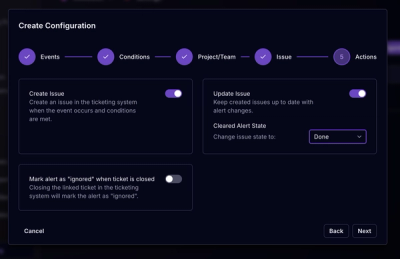
Socket for Jira lets teams turn alerts into Jira tickets with manual creation, automated ticketing rules, and two-way sync.
By Jeppe Hasseriis - Apr 20, 2026

This module provides a transport for pino that forwards messages to a Loki instance.
Pino-loki is based upon the highly performant logging library pino. Loki usually gets the logs through Grafana Agent which reads system logs from files. This setup may not always be possible or require additional infrastructure, especially in situations where logs are gathered application code deployed as a SaaS in the cloud. Pino-loki sends the pino logs directly to Loki.
Pino-loki is for Pino v7.0.0 and above, so the module can be configured to operate in a worker thread, which is the recommended way to use it.
import pino from 'pino'
import type { LokiOptions } from 'pino-loki'
const transport = pino.transport<LokiOptions>({
target: "pino-loki",
options: {
host: 'https://my-loki-instance:3100',
basicAuth: {
username: "username",
password: "password",
},
},
});
const logger = pino(transport);
logger.error({ foo: 'bar' })
See the example
labelsAdditional labels to be added to all Loki logs. This can be used to add additional context to all logs, such as the application name, environment, etc.
propsToLabelsA list of properties to be converted to loki labels.
levelMapA map of pino log levels to Loki log levels. This can be used to map pino log levels to different Loki log levels. This is the default map. Left is pino log level, right is Loki log level.
{
  10: LokiLogLevel.Debug,
  20: LokiLogLevel.Debug,
  30: LokiLogLevel.Info,
  40: LokiLogLevel.Warning,
  50: LokiLogLevel.Error,
  60: LokiLogLevel.Critical,
},
hostThe URL for Loki. This is required.
endpointThe path to the Loki push API. Defaults to /loki/api/v1/push.
basicAuthBasic auth credentials for Loki. An object with the following shape:
{
  username: "username",
  password: "password",
}
headersA list of headers to be sent to Loki. This can be useful for adding the X-Scope-OrgID header for Grafana Cloud Loki :
{
  "X-Scope-OrgID": "your-id",
})
timeoutA max timeout in miliseconds when sending logs to Loki. Defaults to 30_000.
silenceErrorsIf false, errors when sending logs to Loki will be displayed in the console. Defaults to false.
batchingBatching configuration. When enabled, logs are accumulated in a buffer and sent to Loki at regular intervals, reducing the number of HTTP requests. Batching is enabled by default.
// Batching enabled with default options (interval: 5s, maxBufferSize: 10000)
pinoLoki({ host: '...' })

// Batching with custom options
pinoLoki({
  host: '...',
  batching: {
    interval: 2,        // Send logs every 2 seconds
    maxBufferSize: 5000 // Keep max 5000 logs in buffer
  }
})

// Batching disabled - logs sent immediately
pinoLoki({ host: '...', batching: false })
batching.intervalThe interval at which batched logs are sent, in seconds. Defaults to 5.
batching.maxBufferSizeMaximum number of logs to keep in the buffer. When the buffer is full, oldest logs are dropped (FIFO) to make room for new ones. Defaults to 10000.
This prevents memory issues (OOM) if Loki becomes unavailable - without this limit, the buffer would grow indefinitely. Set to 0 for unlimited buffer (probably not really recommended).
pinoLoki({
  host: '...',
  batching: {
    interval: 10,
    maxBufferSize: 50000
  }
})
replaceTimestampDefaults to false. If true, the timestamp in the pino log will be replaced with Date.now(). Be careful when using this option with batching enabled, as the logs will be sent in batches, and the timestamp will be the time of the batch, not the time of the log.
structuredMetaKeyThe key in the pino log object that contains structured metadata. Defaults to 'meta'.
// With default 'meta' key, structured metadata is automatically sent
logger.info({ meta: { recordId: 123, traceId: 456 } }, 'Hello')
// -> { recordId: 123, traceId: 456 } sent as structured metadata

// Use a different key
pinoLoki({ host: '...', structuredMetaKey: 'metadata' })

// Disable structured metadata
pinoLoki({ host: '...', structuredMetaKey: false })
convertArraysDefaults to false. As documented in the Loki documentation, Loki JSON parser will skip arrays. Setting this options to true will convert arrays to object with index as key. For example, ["foo", "bar"] will be converted to { "0": "foo", "1": "bar" }.
logFormatDefaults to false. This option will let you convert the JSON pino log into a single string in a format that you set.
The template can be either a string template ( not a string literal ! ) or a function that returns a string.
You can use dot notation to access nested properties in the pino log object, such as {req.method} or {req.url}.
 const transport = pino.transport<LokiOptions>({
    target: 'pino-loki',
    options: {
      // String template
      logFormat: '{time} | {level} | {msg} {req.method} {req.url}',
      // Or a function ⚠️ Will not work out-of-the-box
      // with worker threads. Read the warning below !
      logFormat: ({ time, level, msg, req }) => {
        return `${time} | ${level} | ${msg} ${req.method} ${req.url}`;
      },
    },
})
[!NOTE] Want to use the
logFormatoption with worker threads? Check the below section about Handling non-serializable options.
The log object has the following options:
lokiLevel: The pino log level parsed to Loki log level ( 'debug', 'info', 'warning' etc.. ){key}: Any other key in the pino log object, such as pid, hostname, msg etc.Using the new pino v7+ transports not all options are serializable, for example if you want to use logFormat as a function you will need to wrap pino-loki in a custom module like this :
// main.ts
import pino from 'pino'

const logger = pino({
  transport: {
    target: './my-custom-pino-loki.js',
    options: { labels: { application: 'MY-APP' } }
  },
})
// my-custom-pino-loki.js
import { pinoLoki } from 'pino-loki'

export default function customPinoLoki(options) {
  return pinoLoki({
    ...options,
    logFormat: (log) => {
      return `hello ${log.msg} ${log.lokilevel} ${log.req.id} ${log.level}`
    },
  })
}
This way you can use the logFormat option as a function, or any other non-serializable option.
npm install -g pino-loki
node foo | pino-loki --hostname=http://hostname:3100
$ pino-loki -h
Options:
  -v, --version                          Print version number and exit
  -u, --user <user>                      Loki username
  -p, --password <password>              Loki password
  --hostname <hostname>                  URL for Loki (default: http://localhost:3100)
  --endpoint <endpoint>                  Path to the Loki push API (default: /loki/api/v1/push)
  --headers <headers>                    Headers to be sent to Loki (Example: "X-Scope-OrgID=your-id,another=value")
  -b, --batching                         Should logs be sent in batch mode (default: true)
  -i, --batching-interval <interval>     The interval at which batched logs are sent in seconds (default: 5)
  --batching-max-buffer-size <size>      Maximum number of logs to buffer (default: 10000, 0 for unlimited)
  -t, --timeout <timeout>                Timeout for request to Loki in ms (default: 30000)
  -s, --silenceErrors                    If set, errors will not be displayed in the console
  -r, --replaceTimestamp                 Replace pino logs timestamps with Date.now()
  -l, --labels <label>                   Additional labels to be added to all Loki logs (JSON)
  --convertArrays                        If set, arrays will be converted to objects
  --propsLabels <labels>                 Fields in log line to convert to Loki labels (comma separated)
  --structuredMetaKey <key>              Key for structured metadata (default: 'meta', use 'false' to disable)
  -h, --help                             Print this help message and exit
Feel free to explore the different examples in the examples folder.
Since AdonisJS use Pino as the default logger, you can use pino-loki easily by adding a new transport to the logger, in the config/logger.ts file:
import type { LokiOptions } from 'pino-loki'
import app from '@adonisjs/core/services/app'
import { defineConfig, targets } from '@adonisjs/core/logger'

import env from '#start/env'

const loggerConfig = defineConfig({
  default: 'app',

  loggers: {
    app: {
      enabled: true,
      name: env.get('APP_NAME'),
      level: env.get('LOG_LEVEL'),
      transport: {
        targets: targets()
          .push({
            target: 'pino-loki',
            options: {
              labels: { application: 'MY-APP' },
              host: env.get('LOKI_HOST'),
              basicAuth: {
                username: env.get('LOKI_USERNAME'),
                password: env.get('LOKI_PASSWORD'),
              },
            } satisfies LokiOptions,
          })
          .toArray(),
      },
    },
  },
})
And you should be good to go! You can check our full example for more details.
Out-of-order Loki errors can occur due to the asynchronous nature of Pino. The fix to this is to allow for out-of-order logs in the Loki configuration. The reason why Loki doesn't have this enabled by default is because Promtail accounts for ordering constraints, however the same issue can also happen with promtail in high-load or when working with distributed networks.
Logs can be dropped in two scenarios:
maxBufferSize (default: 10,000), the oldest logs are dropped to make room for new ones. This prevents memory exhaustion if Loki becomes unavailable for an extended period.For critical applications, consider implementing a failover solution or adjusting maxBufferSize based on your memory constraints and acceptable data loss.
As the pino-loki library uses the native Node fetch, any consumer must be using a version of Node greater than v20.0.0.
Running a local Loki for testing is probably required, and the easiest way to do that is to follow this guide: https://github.com/grafana/loki/tree/master/production#run-locally-using-docker. After that, Grafana Loki instance is available at http://localhost:3100, with a Grafana instance running at http://localhost:3000. Username admin, password admin. Add the Loki source with the URL http://loki:3100, and the explorer should work.
Refer to https://grafana.com/docs/loki/latest/api/ for documentation about the available endpoints, data formats etc.
If you like this project, please consider supporting it by sponsoring it. It will help a lot to maintain and improve it. Thanks a lot !
MIT License © 2022 Julien Ripouteau
FAQs
A transport for pino that sends messages to Loki
We found that pino-loki demonstrated a healthy version release cadence and project activity because the last version was released less than a year ago. It has 1 open source maintainer collaborating on the project.
Did you know?

Socket for GitHub automatically highlights issues in each pull request and monitors the health of all your open source dependencies. Discover the contents of your packages and block harmful activity before you install or update your dependencies.
Product
Socket for Jira lets teams turn alerts into Jira tickets with manual creation, automated ticketing rules, and two-way sync.
Company News
Socket won two 2026 Reppy Awards from RepVue, ranking in the top 5% of all sales orgs. AE Alexandra Lister shares what it's like to grow a sales career here.

Security News
NIST will stop enriching most CVEs under a new risk-based model, narrowing the NVD's scope as vulnerability submissions continue to surge.