

Product
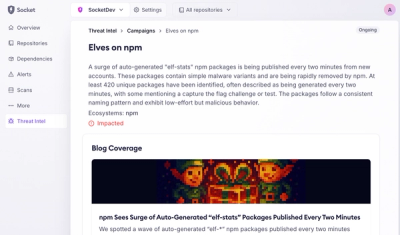
Introducing Supply Chain Attack Campaigns Tracking in the Socket Dashboard
Campaign-level threat intelligence in Socket now shows when active supply chain attacks affect your repositories and packages.
By Philipp Burckhardt - Jan 21, 2026
playwright-proxy
Advanced tools





Proxies Puppeteer Page requests.
This package addresses several issues with Puppeteer:
The side-benefit of this implementation is that it allows to route all traffic through Node.js, i.e. you can use externally hosted Chrome instance (such as Browserless.io) to render DOM & evaluate JavaScript, and route all HTTP traffic through your Node.js instance.
The downside of this implementation is that it will introduce additional latency, i.e. requests will take longer to execute as request/ response will need to be always exchanged between Puppeteer and Node.js.
puppeteer-proxy intercepts requests after it receives the request metadata from Puppeteer. puppeteer-proxy uses Node.js to make the HTTP requests. The response is then returned to the browser. When using puppeteer-proxy, browser never makes outbound HTTP requests.
You must call page.setRequestInterception(true) before using pageProxy.proxyRequest.
import {
  Agent as HttpAgent,
} from 'http';
import {
  Agent as HttpsAgent,
} from 'https';
import type {
  Page,
  Request,
} from 'puppeteer';
import {
  createPageProxy,
} from 'puppeteer-proxy';

/**
 * @property page Instance of Puppeteer Page.
 */
type PageProxyConfigurationType = {|
  +page: Page,
|};

/**
 * @property agent HTTP(s) agent to use when making the request.
 * @property proxyUrl HTTP proxy URL. A different proxy can be set for each request.
 * @property request Instance of Puppeteer Request.
 */
type ProxyRequestConfigurationType = {|
  +agent?: HttpAgent | HttpsAgent,
  +proxyUrl?: string,
  +request: Request,
|};

type PageProxyType = {|
  +proxyRequest: (configuration: ProxyRequestConfigurationType) => Promise<void>,
|};

createPageProxy(configuration: PageProxyConfigurationType): PageProxyType;
import puppeteer from 'puppeteer';
import {
  createPageProxy,
} from 'puppeteer-proxy';

(async () => {
  const browser = await puppeteer.launch();
  const page = await browser.newPage();

  const pageProxy = createPageProxy({
    page,
  });

  await page.setRequestInterception(true);

  page.on('request', async (request) => {
    await pageProxy.proxyRequest({
      proxyUrl: 'http://127.0.0.1:3000',
      request,
    });
  });

  await page.goto('http://gajus.com');
})();
FAQs
Proxies Playwright Page requests.
We found that playwright-proxy demonstrated a not healthy version release cadence and project activity because the last version was released a year ago. It has 1 open source maintainer collaborating on the project.
Did you know?

Socket for GitHub automatically highlights issues in each pull request and monitors the health of all your open source dependencies. Discover the contents of your packages and block harmful activity before you install or update your dependencies.
Product
Campaign-level threat intelligence in Socket now shows when active supply chain attacks affect your repositories and packages.

Research
Malicious PyPI package sympy-dev targets SymPy users, a Python symbolic math library with 85 million monthly downloads.

Security News
Node.js 25.4.0 makes require(esm) stable, formalizing CommonJS and ESM compatibility across supported Node versions.