pnpm uses a content-addressable filesystem to store all files from all module directories on a disk.
When using npm, if you have 100 projects using lodash, you will have 100 copies of lodash on disk.
With pnpm, lodash will be stored in a content-addressable storage, so:
If you depend on different versions of lodash, only the files that differ are added to the store.
If lodash has 100 files, and a new version has a change only in one of those files,
pnpm update will only add 1 new file to the storage.
All the files are saved in a single place on the disk. When packages are installed, their files are linked
from that single place consuming no additional disk space. Linking is performed using either hard-links or reflinks (copy-on-write).
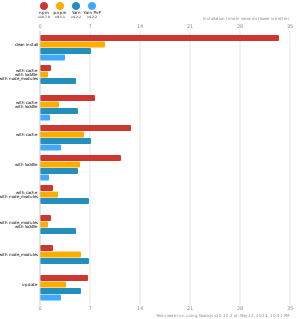
As a result, you save gigabytes of space on your disk and you have a lot faster installations!
If you'd like more details about the unique node_modules structure that pnpm creates and
why it works fine with the Node.js ecosystem, read this small article: Flat node_modules is not the only way.
npm is the default package manager for Node.js and is the most widely used. It has a large ecosystem and is well-supported, but it can be slower and use more disk space compared to pnpm.
Yarn is a package manager that was created by Facebook to address some of npm's shortcomings. It introduced lockfiles and deterministic installations. Yarn is faster than npm but can still use more disk space compared to pnpm.
The npm package pnpm receives a total of 61,727,163 weekly downloads. As such, pnpm popularity was classified as popular.
We found that pnpm demonstrated a healthy version release cadence and project activity because the last version was released less than a year ago.It has 2 open source maintainers collaborating on the project.
Package last updated on 23 Apr 2026
Did you know?
Socket for GitHub automatically highlights issues in each pull request and monitors the health of all your open source dependencies. Discover the contents of your packages and block harmful activity before you install or update your dependencies.
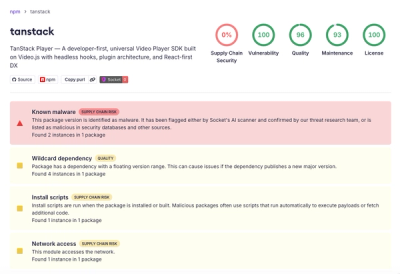
A brand-squatted TanStack npm package used postinstall scripts to steal .env files and exfiltrate developer secrets to an attacker-controlled endpoint.
Compromised SAP CAP npm packages download and execute unverified binaries, creating urgent supply chain risk for affected developers and CI/CD environments.