


Research
Malicious fezbox npm Package Steals Browser Passwords from Cookies via Innovative QR Code Steganographic Technique
A malicious package uses a QR code as steganography in an innovative technique.
By Olivia Brown - Sep 22, 2025
pptr-mock-server
Advanced tools





Tiny library for backendless testing using Puppeteer.
This library allows to define mock backend responses when testing web app with Puppeteer.
Internally it works purely via Puppeteer API using built-in
setRequestInterception mechanism. It doesn't set up any servers and doesn't
modify any window APIs like XMLHttpRequest. This provides great flexibility
and performance when handling requests, since it operates on browser internal
level.
NOTE: we use this library heavily in automated tests for Dock and related projects, but api surface is minimalistic, so it may not fit your needs. Contributions are welcome, so we can make this library more flexible and cover more usage scenarios.
Recommended reading: Automated UI Testing at Dock.
yarn add -D pptr-mock-server
import puppeteer from 'puppeteer';
import mockServer from 'pptr-mock-server';

// typically your global test setup
const browser = await puppeteer.launch();
const page = await browser.newPage();
const baseAppUrl = 'http://localhost';
const mockRequest = await mockServer.init(page, {
  baseAppUrl,
  baseApiUrl: baseAppUrl + '/api/'
});
Once you have an instance of MockRequest you can pass it to your tests for registering mock responses:
const responseConfig = {body: {result: 'ok'}};
mockRequest.on('GET', 'http://localhost/api/account', 200, responseConfig);
But since you provided baseApiUrl as http://localhost/api, you can use relative endpoint name. Also you can use .get() shorthand method instead of .on():
const responseConfig = {body: {result: 'ok'}};
mockRequest.get('account', 200, responseConfig);
When your app performs request to the specified resource, it will respond with the mock response provided.
Once you setup a mock request handler, every matching request will be responded with it. However it's a common scenario when you need to mock a sequence of requests, when over time the same request produces different results. Recommended way to do it is to replace previously registered mock response using new one:
const responseConfig = {body: {result: 'ok'}};
mockRequest.get('account', 200, responseConfig); // returns 200 on each request
// test deleting account logic here
// after account is deleted we want to return 401 instead of 200
mockRequest.get('account', 401); // replaces existing handler
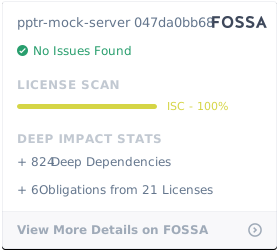
FAQs
Tiny library for backendless testing using Puppeteer
We found that pptr-mock-server demonstrated a healthy version release cadence and project activity because the last version was released less than a year ago. It has 1 open source maintainer collaborating on the project.
Did you know?

Socket for GitHub automatically highlights issues in each pull request and monitors the health of all your open source dependencies. Discover the contents of your packages and block harmful activity before you install or update your dependencies.
Research
A malicious package uses a QR code as steganography in an innovative technique.

Research
/Security News
Socket identified 80 fake candidates targeting engineering roles, including suspected North Korean operators, exposing the new reality of hiring as a security function.
Application Security
/Research
/Security News
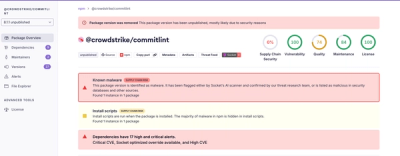
Socket detected multiple compromised CrowdStrike npm packages, continuing the "Shai-Hulud" supply chain attack that has now impacted nearly 500 packages.