

Product
Introducing Data Exports
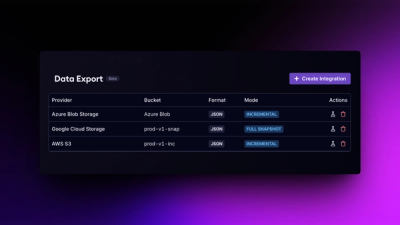
Export Socket alert data to your own cloud storage in JSON, CSV, or Parquet, with flexible snapshot or incremental delivery.
By Ola Adekola - Apr 23, 2026
react-layer-stack
Advanced tools
Simple but ubiquitously powerful and agnostic layering system for React. Useful for any kind of windowing/popover/modals/tooltip application
I've designed react-layer-stack to fix one of the most tricky problems React users are facing with: bottom-to-up UI communication. top-to-bottom flow covers the most UI needs naturally, but sometimes you need to take control over UI element which is linked to parent logically (means you need to use the local context of), but physically located in the different DOM branch. Modals, drag'n'drops, popovers, popups, windows - are the various examples of bottom-to-up UI elements (good analogy https://en.wikipedia.org/wiki/Zooming_user_interface).
This lib allows to hold (or share) context (closure) of deep children components with the top layers: you can use variables from closure (which will propagate automatically if you'll provide it to use property of Layer). Anonymous function which renders Layer into LayerStackMountPoint receives: layer info (state, index in stack), callbacks (to show and hide layers) and event data from the toggle which controlls this Layer.
npm install --save react-layer-stack
Public API consist 2 key components: Layer, LayerStackMountPoint and 1 additional: LayerToggle (sometimes toggle needs to know which popover is open now).
Set the LayerStackMountPoint somewhere on the top of the tree:
import { LayerStackMountPoint } from 'react-layer-stack'
// ...
//  render() {
        return (
          <Container>
            <LayerStackMountPoint />
            <AppBar />
            <Container className={styles.container}>
              {children}
            </Container>
          </Container>
    )
//  }
Define your Layer. This example shows how to propagate variables from lexical context (https://developer.mozilla.org/en/docs/Web/JavaScript/Closures) to the Layer, which will be displayed in the LayerStackMountPoint. Each layer should have an id and use properties. use property is needed to determine if we should update the lexical context of the anonymous function which renders Modal into Layer if Cell is re-rendered.
import { Layer, LayerToggle } from 'react-layer-stack'
// ... for each `object` in array of `objects`
const modalId = 'DeleteObjectConfirmation' + objects[rowIndex].id
return (
    <Cell {...props}>
        // the layer definition. The content will show up in the LayerStackMountPoint when `show(modalId)` be fired in LayerToggle
        <Layer use={[objects[rowIndex], rowIndex]} id={modalId}> {({
            hideMe, // alias for `hide(modalId)`
            index } // useful to know to set zIndex, for example
            , e) => // access to the arguments (click event data in this example)
          <Modal onClick={ hideMe } zIndex={(index + 1) * 1000}>
            <ConfirmationDialog
              title={ 'Delete' }
              message={ "You're about to delete to " + '"' + objects[rowIndex].name + '"' }
              confirmButton={ <Button type="primary">DELETE</Button> }
              onConfirm={ this.handleDeleteObject.bind(this, objects[rowIndex].name, hideMe) } // hide after confirmation
              close={ hideMe } />
          </Modal> }
        </Layer>

        // this is the toggle for Layer with `id === modalId` can be defined everywhere in the components tree
        <LayerToggle id={ modalId }> {({showMe}) => // showMe is alias for `show(modalId)`
          <div style={styles.iconOverlay} onClick={ (e) => showMe(e) }> // additional arguments can be passed (like event)
            <Icon type="trash" />
          </div> }
        </LayerToggle>
    </Cell>)
// ...
Currently we use the redux store as a backend, but that could be changed in the future. Consider it just as an initialization logic and not as the public API. Therefore you should add the layers reducer to the store:
import { createStore, combineReducers } from 'redux';
import { DEFAULT_STORE_KEY as DEFAULT_LAYERS_STORE_KEY, reducer as layersReducer } from 'react-layer-stack';
// ...
const reducer = combineReducers({...reducers, [DEFAULT_LAYERS_STORE_KEY]: layersReducer});
// ...
export default createStore(reducer);
The is a lot of alternative ways to archive the desirable bottom-to-up link b/w components.
The most obvious (and naiive as well) way is to use redux (or another flux/data lib) as a transport to hold the "modals" or "popover" state. It's good and robust solution (moreover react-layer-stack use redux as a store currently), but the problem is that it's not universal, consumes time to implement and grasp, not because of complications, more because you have to reinvent the same pattern again and again (slightly different in each case).
Another solution is to use on of ready-to-use components. But lot of times are you need slightly different bahavior/look and more productive to implememnt home-grown ad-hock solution.
And the last option is to find library, like https://github.com/tajo/react-portal, desined ot address needs of bottom-to-up communication. The problem is these libs are often quite opinionated to their cases and doesn't solve the problem in its roots. react-layer-stack aims to give an answer how to organise bottom-to-up communication in the most natural, reasonable and flexible way.
FAQs
Simple but ubiquitously powerful and agnostic layering system for React. Useful for any kind of windowing/popover/modals/tooltip application
The npm package react-layer-stack receives a total of 94 weekly downloads. As such, react-layer-stack popularity was classified as not popular.
We found that react-layer-stack demonstrated a not healthy version release cadence and project activity because the last version was released a year ago. It has 1 open source maintainer collaborating on the project.
Did you know?

Socket for GitHub automatically highlights issues in each pull request and monitors the health of all your open source dependencies. Discover the contents of your packages and block harmful activity before you install or update your dependencies.
Product
Export Socket alert data to your own cloud storage in JSON, CSV, or Parquet, with flexible snapshot or incremental delivery.
Research
/Security News
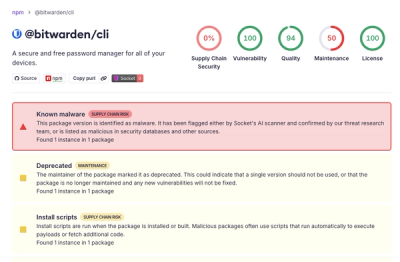
Bitwarden CLI 2026.4.0 was compromised in the Checkmarx supply chain campaign after attackers abused a GitHub Action in Bitwarden’s CI/CD pipeline.

Research
/Security News
Docker and Socket have uncovered malicious Checkmarx KICS images and suspicious code extension releases in a broader supply chain compromise.