react-material-ui-step-loader


Stepped Progress react component using material-ui
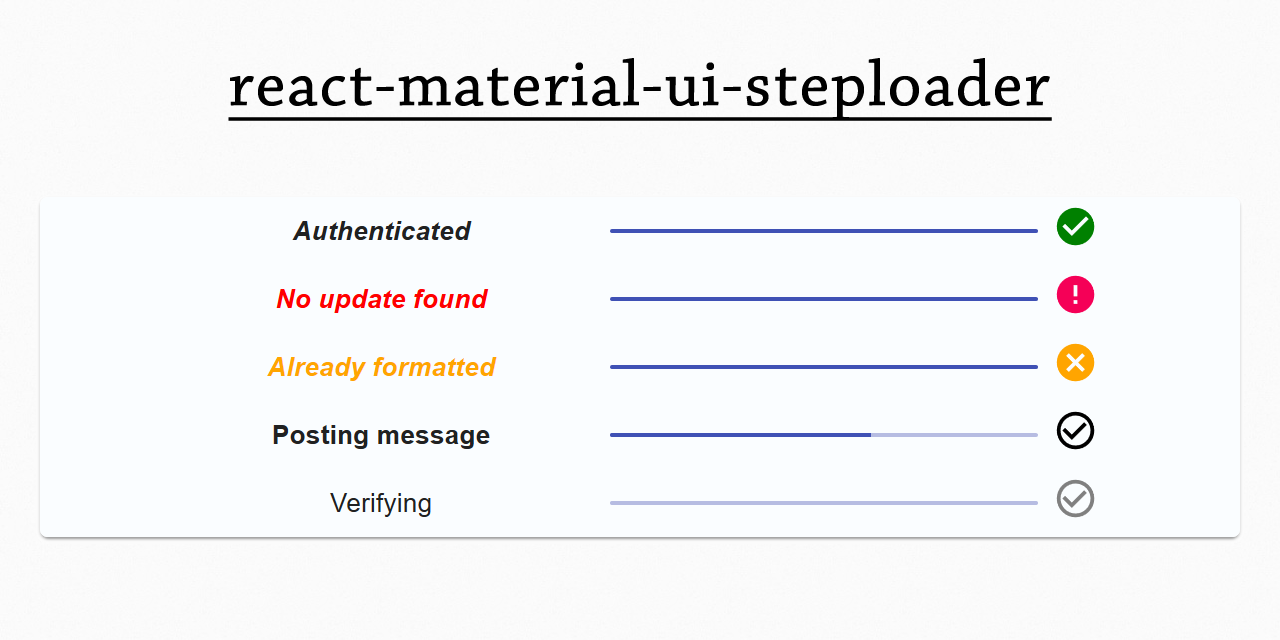
Overview
Installation
npm install react-material-ui-step-loader
Usage
import { StepLoader } from 'react-material-ui-step-loader';
const steps = [
{ label: 'Authenticating', labelAfter: 'Authenticated' },
{ label: 'Checking updates', labelAfter: 'Updated', labelError: 'No update found' },
{ label: 'Formatting message', labelAfter: 'Message formatted', labelSkip: 'Already formatted' },
{ label: 'Posting message', labelAfter: 'Message posted' },
{ label: 'Verifying', labelAfter: 'Verified' },
];
<StepLoader
steps={steps}
currentStep={2}
currentProgress={75}
/>
Props API
StepLoader
Stepped LinearProgress component using material-ui
| steps | arrayOf | yes | | An array of 'step' object with the following shape (label:string, [labelAfter:string],[labelSkip:string],[labelError:string],[color:string "primary"|"secondary"]). |
| currentStep | number | yes | | The current step. |
| height | number | no | 2 | The LinearProgress height. |
| color | enum | no | | The color of the progress bars. |
| variant | enum | no | | The variant type for the LinearProgress outline. 'square' | 'rounded' | 'round' |
| currentProgress | number | no | -1 | The current progress [0-100] of the current step. If ommited the LinearProgress will use the 'undeterminate' variant. |
| errors | arrayOf | no | | An array of int representing the failed steps. |
| skips | arrayOf | no | | An array of int representing the skipped steps. |
Developers
Development
You should use YARN for development as NPM seems to be causing some issues!
(Using NPM for just installing and using as a component is OK)
Demo app
yarn start for live-testing the demo app
Storybook
yarn storybook for live-testing the storybook app
GitHub Page
yarn github-page for testing a temporary build of the full github-page without an possible theme that you will choose later on GitHub (no live-testing)
Prod
Generate Readme.md
Will generate a readme according to your package.json info and the following files :
-
- setup_readme.md (if not present, it will use the default
npm i YOUR_PACKAGE_NAME)
-
-
You can then edit your readme.md file if you need to before building/publishing/deploying
NPM
Will transpile and publish to npm, it will prompt you the version incrementing.
GitHub Page
Will build the static demo and storybook apps for prod into the build folder
Will deploy the built apps from 'build' folder to the 'gh-pages' github branch
Helper scripts
yarn build-and-deploy This helper script will call all the scripts for a complete GitHub building and deploying (yarn build && yarn deploy-github-page)yarn publish-build-and-deploy This helper script will call all the scripts for a complete NPM and GitHub transpiling/building and publishing/deploying (yarn publish && yarn build-and-deploy)
You should then commit and push sources on GitHub the usual way.
This document was generated by the Create React Readme v1.0.7.





