

Security News
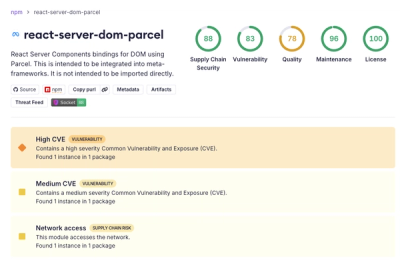
New React Server Components Vulnerabilities: DoS and Source Code Exposure
New DoS and source code exposure bugs in React Server Components and Next.js: what’s affected and how to update safely.
By Sarah Gooding - Dec 12, 2025
react-native-a11y-order
Advanced tools
React Native A11y Order Library: Advanced control of screen reader order.
Setting the right reading order can be a challenge, but there is a way to do it. The react-native-a11y-order is a native-first library designed to solve problems with the ordering of screen readers on both Android and iOS platforms.
| iOS reader | Android reader |
|---|---|
 |  |
We’ve improved and fixed the accessibility focus order logic for Android and iOS.
The A11y.Index component has been updated. The definition of accessible components is now controlled by the orderType property. It should resolve problem with android order between groups. You can choose from the following options: default, legacy, or search to configure the desired behavior.
| Prop: orderType | Description |
|---|---|
default | Defines the root component as an order element. It can be a group of elements or a single element. If there are multiple elements inside, navigation goes through the inner elements and proceeds to the next index. |
legacy | Uses the previous implementation of the element search, retrieving the first child as the accessibility element for order. |
search | Searches for the first accessible element in the child tree. |
The A11y.Container component has been added to support the UIAccessibilityContainerType feature on iOS.
| Props | Description |
|---|---|
| ViewProps | Default view props, including style, testID, etc. |
| type?: | none | table | list | landmark | group — representation of UIAccessibilityContainerType. The default value is group. |
The inner implementation of A11y.Group has been replaced by A11y.Container with the none value as the default for the type prop, as it provides a more appropriate implementation. The previous implementation is now available under the legacy option.
| Props | Description |
|---|---|
| ViewProps | Default view props, including style, testID, etc. |
| type?: | legacy or none | table | list | landmark | group — representation of UIAccessibilityContainerType. The default value is none. |
npm install react-native-a11y-order
yarn add react-native-a11y-order
You can also use version react-native-a11y-order@0.2.5. Version 0.3.0 is released solely to support React Native versions 0.79.x to 0.80.x.
There is always a question about how to set the focus order for a screen reader in React Native. A11y.Order and A11y.Index are designed to assist with this task. A11y.Order is a container component that defines an ordering group, while A11y.Index is a wrapper component that helps define a position within the order.
To illustrate, let's look at an example:
import { A11y } from 'react-native-a11y-order';

// ...

export default function App() {
  return (
    <View style={styles.container}>
      <A11y.Order>
        <A11y.Index index={1}>
          <Text style={styles.font}>
            First
          </Text>
        </A11y.Index>
        <A11y.Index index={3}>
          <Text style={styles.font}>
            Third
          </Text>
        </A11y.Index>
        <A11y.Index index={2}>
          <Text style={styles.font}>
            Second
          </Text>
        </A11y.Index>
      </A11y.Order>
      <Text style={styles.font}>Fourth</Text>
      <Text style={styles.font}>Fifth</Text>
      <Text style={styles.font}>Sixth</Text>
    </View>
  );
}
Additionally, for dynamic interaction scenarios, setting focus programmatically can be very useful. This can be achieved using the focus command via a component ref.
import { A11y, IndexCommands } from 'react-native-a11y-order';

// ...

export default function App() {
  const ref = React.useRef<IndexCommands>(null);

  return (
    <View style={styles.container}>
      <A11y.Order>
        <A11y.Index ref={ref} index={1}>
          <Text style={styles.font}>
            First
          </Text>
        </A11y.Index>
      </A11y.Order>
      <Button onPress={() => ref.current?.focus()}>
    </View>
  );
}
| View | A11y.Container |
|---|---|
 |  |
The A11y.Container component for configuration UIAccessibilityContainerType feature on iOS.
| Props | Description |
|---|---|
| ViewProps | Default view props, including style, testID, etc. |
| type?: | none | table | list | landmark | group — representation of UIAccessibilityContainerType. The default value is group. |
The previous versions of this library used native modules to update order, but in a world with Fabric components and new architecture, there is no visible future for managing native components via modules or findNodeHandler.
I thought a lot about retaining the previous API for support and compatibility, but after investigation, it was decided to deprecate the 'old' API and remove it in future releases.
The new approach is better: we no longer need to manage refs, worry about attaching nodes to the screen, and it works natively. Additionally, this new approach follows the React Native concept, which will make it easier to support in the future (hello there: bridgeless).
A11yOrder to A11y.Order Previous: <A11yOrder a11yOrder={a11yOrder}>
Now: <A11y.Order>
A11y.Index Previous: <Text style={styles.font} ref={refs[0]}>
First
</Text>
Now: <A11y.Index index={1}>
<Text style={styles.font} ref={refs[0]}>
First
</Text>
</A11y.Index>
<A11y.Index index={1}>
  <Text style={styles.font}>
    First
  </Text>
</A11y.Index>
useFocusOrder, useDynamicFocusOrder, useA11yOrderManager.That's all. The index changes, removals, etc., should work out of the box.
A11y.Group (A11y.Container) can be used to enhance the experience of screen readers navigating through ScrollView or FlatList with the horizontal property enabled. You can skip this if you are using the new architecture; however, it is the best for applications that have not yet migrated.
| View | A11y.Group |
|---|---|
| |
import { A11y, IndexCommands } from 'react-native-a11y-order';

// ...

export default function App() {
  return (
    <ScrollView
      style={styles.slider}
      contentContainerStyle={styles.sliderContainer}
      horizontal
    >
      <A11y.Group style={styles.slide}>
        <View>
          <Text>Title: 1</Text>
        </View>
        <View>
          <Text>Description: 1</Text>
        </View>
      </A11y.Group>
      <A11y.Group style={styles.slide}>
        <View>
          <Text>Title: 2</Text>
        </View>
        <View>
          <Text>Description: 2</Text>
        </View>
      </A11y.Group>
    </ScrollView>
  );
}
| Props | Description |
|---|---|
| ViewProps | Default view props, including style, testID, etc. |
| type?: | legacy or none | table | list | landmark | group — representation of UIAccessibilityContainerType. The default value is none. |
See the contributing guide to learn how to contribute to the repository and the development workflow.
MIT
Made with create-react-native-library
FAQs
ReactNative library for managing screen reader focus ordering
We found that react-native-a11y-order demonstrated a healthy version release cadence and project activity because the last version was released less than a year ago. It has 1 open source maintainer collaborating on the project.
Did you know?

Socket for GitHub automatically highlights issues in each pull request and monitors the health of all your open source dependencies. Discover the contents of your packages and block harmful activity before you install or update your dependencies.
Security News
New DoS and source code exposure bugs in React Server Components and Next.js: what’s affected and how to update safely.

Security News
Socket CEO Feross Aboukhadijeh joins Software Engineering Daily to discuss modern software supply chain attacks and rising AI-driven security risks.

Security News
GitHub has revoked npm classic tokens for publishing; maintainers must migrate, but OpenJS warns OIDC trusted publishing still has risky gaps for critical projects.