


Security News
Deno 2.6 + Socket: Supply Chain Defense In Your CLI
Deno 2.6 introduces deno audit with a new --socket flag that plugs directly into Socket to bring supply chain security checks into the Deno CLI.
By Sarah Gooding - Dec 12, 2025
react-use-opentok
Advanced tools



React Hook for conveniently use @opentok/client SDK.
See our demo site: react-use-opentok

Install it with npm:
npm i @opentok/client@2.x react-use-opentok
Or with yarn:
yarn add @opentok/client@2.x react-use-opentok
NOTE: remember to install the peer dependency of @opentok/client
useOpenTok hookapiKey, sessionId, and token from servertokenimport React, { useEffect } from 'react';
import useOpenTok from 'react-use-opentok';
const Component = () => {
// STEP 1: get utilities from useOpenTok;
const [opentokProps, opentokMethods] = useOpenTok();

const {
  // connection info
  isSessionInitialized,
  connectionId,
  isSessionConnected,

  // connected data
  session,
  connections,
  streams,
  subscribers,
  publisher,
} = opentokProps;

const {
  initSessionAndConnect,
  disconnectSession,
  publish,
  unpublish,
  subscribe,
  unsubscribe,
  sendSignal,
} = opentokMethods;
// STEP 2: Mockup fetching apiKey, sessionId, and token from server
useEffect(() => {
fetch('<get credentials from server>').then(
({ apiKey, sessionId, token }) => {
initSessionAndConnect({
apiKey,
sessionId,
token,
});
}
);
}, [initSessionAndConnect]);
return <div>...</div>;
};
export default Component;
You can get all utilities from useOpenTok hook.
const [opentokProps, opentokMethods] = useOpenTok();
const {
// connection info
isSessionInitialized,
connectionId,
isSessionConnected,
// connected data
session,
connections,
streams,
subscribers,
publisher,
} = opentokProps;
const {
initSessionAndConnect,
disconnectSession,
publish,
unpublish,
subscribe,
unsubscribe,
sendSignal,
} = opentokMethods;
Before starting use openTok session object, remember to initialize session with apiKey and sessionId by initSessionAndConnect method:
const [opentokProps, opentokMethods] = useOpenTok();
const { initSessionAndConnect } = opentokMethods;

// apiKey, sessionId, and token could get from your server or tokbox dashboard
initSessionAndConnect({
  apiKey,
  sessionId,
  token,
});
This methods will first initialize the session object, and continue connected to the session.
After session initialized, the value of isSessionInitialized will be `true.
After connect to session, you can get the session, connectionId , isSessionConnected, and connections properties from opentokProps:
session: a session object from OT.initSession()connectionId: your own connectionIdisSessionConnected: whether you are connected to the sessionconnections: all connections in the sessionconst [opentokProps, opentokMethods] = useOpenTok();
const { session, connectionId, isSessionConnected, connections } = opentokProps;
By disconnectSession, you can disconnect from the session:
const [opentokProps, opentokMethods] = useOpenTok();
const { disconnectSession } = opentokMethods;

disconnectSession();
If you want to control the process of session initialization and connect to session on your own, check the method
initSession({ apiKey, sessionId, sessionOptions })andconnectSession({token, sessionToConnect }).
You can publish stream from camera or screen to session through the publish method.
name: should be unique every time you invoke publish method which is for unpublish stream later.element: should be a DOM element or the id attribute of the existing DOM element.options: (optional) other optional properties which will pass into OT.initPublisher.const [opentokProps, opentokMethods] = useOpenTok();
const { publish } = opentokMethods;
// publish stream from the camera
publish({
name: 'camera',
element: 'camera',
});
// publish stream from screen sharing
publish({
name: 'screen',
element: 'screen',
options: {
insertMode: 'append',
width: '100%',
height: '100%',
videoSource: 'screen',
},
});
// publish support Promise way to catch errors
publish({
name: 'camera',
element: 'camera',
}).catch((ex) => {
console.log(ex);
});
According to the name you publish, you could use the same name to unpublish it:
const [opentokProps, opentokMethods] = useOpenTok();
const { unpublish } = opentokMethods;

// unpublish stream from the name 'camera'
unpublish({ name: 'camera' }
You can get all streams in the session through streams property in opentokProps. After finding the stream for subscribing, use the subscribe method to subscribe to the stream:
stream: the Stream Object wanted to subscribeelement: should be a DOM element or the id attribute of the existing DOM element.const [opentokProps, opentokMethods] = useOpenTok();
const { streams } = opentokProps;
const { subscribe } = opentokMethods;
const streamToSubscribe = streams[0];
subscribe({ stream: streamToSubscribe, element: 'subscriber' });
For each stream be subscribed, a subscriber object will be created and save as subscribers in opentokProps:
const [opentokProps, opentokMethods] = useOpenTok();
const { streams, subscribers } = opentokProps;
You can stop subscribing the stream with unsubscribe method:
const [opentokProps, opentokMethods] = useOpenTok();
const { unsubscribe } = opentokMethods;

const streamToUnsubscribe = streams[0];
unsubscribe({ stream: streamToUnsubscribe });
You can send signal in session with sendSignal method:
const [opentokProps, opentokMethods] = useOpenTok();
const { sendSignal } = opentokMethods;

sendSignal({
  type: 'foo',
  data: 'bar',
});
You could register all valid session events on session object. Take registering signal event, as an example, use the session object in opentokProps, register the session event with on, and unregister the event with off:
const [opentokProps, opentokMethods] = useOpenTok();
const { session } = opentokProps;

const handleSignal = useCallback(e => {
  console.log('handleSignal', e);
}, []);

useEffect(() => {
  if (!isSessionConnected) {
    return;
  }

  session.on('signal', handleSignal);
  return () => {
    session.off('signal', handleSignal);
  };
}, [handleSignal, isSessionConnected, session]);
NOTICE: for
sessionDisconnectedevent, you can yousession.once('sessionDisconnected', <eventHandler>)
You may want to split OT.initPublisher and session.publish and invoke it in different stage. To solve the requirement you can use initPublisher and publishPublisher instead. If you need to cancel preview you can use removePublisher as well.
NOTE:
initPublisher - Same with OT.initPublisher but support state which means you can access publisher.removePublisher - The method can only remove publisher without publish. Once you publish the publisher you should use unpublish instead.publishPublisher - Publish for initPublisher.initPublisher + publishPublisher = publish
For example:
const Component = () => {
  const [opentokProps, opentokMethods] = useOpenTok();

  const {
    initPublisher,
    publishPublisher,
    removePublisher,
  } = opentokMethods;

  // ...

  const onInitPublisher = () => {
    initPublisher({
      name: 'guest',
      element: 'guest',
      options: {
        insertMode: 'append',
        width: '480px',
        height: '360px',
      },
    });
  };
  const onPublishPublisher = () => {
    publishPublisher({
      name: 'guest',
    });
  };
  const onRemovePublisher = () => {
    removePublisher({
      name: 'guest',
    });
  };

  return (
    <div>
      <div id="guest"></div>
      <div>
        <button onClick={onInitPublisher}>Init Publisher without publish</button>
        <button onClick={onRemovePublisher}>Remove Publisher before publish</button>
        <button onClick={onPublishPublisher}>Publish Publisher</button>
      </div>
    </div>
  );
}
$ npm install
$ npm start         # rollup will watch the files change
$ npm build         # rollup will build the package
$ npm test
$ cd site
$ npm install
$ npm start         # start gatsby develop server
Thanks goes to these wonderful people (emoji key):
 andyyou 💻 🎨 💡 🚧 🤔 👀 |  PJCHENder 💻 📖 ⚠️ 💡 🚧 👀 |  Maximillian Rink 💻 |
This project follows the all-contributors specification. Contributions of any kind welcome!
FAQs
React Hook for @opentok/client SDK
The npm package react-use-opentok receives a total of 24 weekly downloads. As such, react-use-opentok popularity was classified as not popular.
We found that react-use-opentok demonstrated a not healthy version release cadence and project activity because the last version was released a year ago. It has 2 open source maintainers collaborating on the project.
Did you know?

Socket for GitHub automatically highlights issues in each pull request and monitors the health of all your open source dependencies. Discover the contents of your packages and block harmful activity before you install or update your dependencies.
Security News
Deno 2.6 introduces deno audit with a new --socket flag that plugs directly into Socket to bring supply chain security checks into the Deno CLI.
Security News
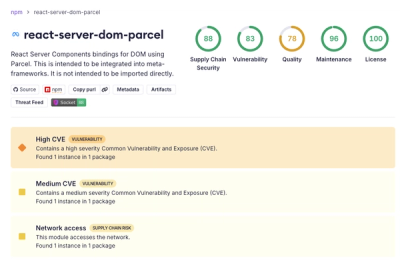
New DoS and source code exposure bugs in React Server Components and Next.js: what’s affected and how to update safely.

Security News
Socket CEO Feross Aboukhadijeh joins Software Engineering Daily to discuss modern software supply chain attacks and rising AI-driven security risks.