


Security News
Deno 2.6 + Socket: Supply Chain Defense In Your CLI
Deno 2.6 introduces deno audit with a new --socket flag that plugs directly into Socket to bring supply chain security checks into the Deno CLI.
By Sarah Gooding - Dec 12, 2025
redux-struct
Advanced tools
Toolset to keep and update async data state in Redux store when working with REST APIs
redux-struct is a toolset to keep and update async data state in Redux store when working with REST APIs. It also drastically reduces boilerplate actions and reducers when working with such APIs.
One struct is a piece of store incapsulating fetching state, data and error from one endpoint. They are referred by string ids — for example, order with id 15 can be kept under struct id order/15. Structs are initiated automatically when the first action with given id is dispatched.
All structs have the same initial structure:
{
  isFetching: false,
  data: null,
  error: null,
}
redux-struct provides set of action creators to start fetching data on struct with given id, stop it with result or error, update or reset it. There is also a selector to get struct by its id.
There is no built-in async middleware, redux-struct is just a data level abstraction to keep all async stuff organized.
$ npm i redux-struct
Add redux-struct reducer to your root reducer:
import { combineReducers } from 'redux';
import { reducer as struct } from 'redux-struct';

const rootReducer = combineReducers({
  struct,
  // other reducers
});
Make an async wrapper for redux-struct actions. Implementation depends from tool you choose to maintain side effects in Redux. Here is example for redux-saga:
import { put, call } from 'redux-saga/effects';
import { startStructFetch, stopStructFetch } from 'redux-struct';

import api from 'utils/api';

export function* fetchStruct(structId, url) {
  try {
    yield put(startStructFetch(structId));
    const result = yield call(api.get, url);
    yield put(stopStructFetch(structId, result));
    return { result };
  } catch (error) {
    yield put(stopStructFetch(structId, error));
    return { error };
  }
};
Call this async wrapper in other sagas or async action creators:
import { call } from 'redux-saga/effects';

import { fetchStruct } from 'utils/sagas';

function* fetchUser(id) {
  const { result, error } = yield call(fetchStruct, `user/${id}`, `api/user/${id}`);
};
Get current state of struct from Redux store for usage in React component:
import { getStruct } from 'redux-struct';

const mapStateToProps = (state, props) => {
  const { userId } = props;
  return {
    user: getStruct(userId)(state),
  };
}
reducer()The struct reducer. Should be mounted to your Redux state at struct
getStruct(structId:String, [getStructState:Function]), returns state => struct:ObjectSelector, gets struct by name. Will return default struct if nothing was found. Has optional second argument getStructState() that is used to select the mount point of the redux-struct reducer from the root Redux reducer. It defaults to state => state.struct.
startStructFetch(structId:String)Action creator, sets structs isFetching to true and error to null. Ignores other fields.
stopStructFetch(structId:String, payload:any)Action creator, sets structs isFetching to false. If payload is instance of Error, sets error to payload and keep the data. Otherwise sets data to payload and error to null.
updateStruct(structId:String, payload:any)Action creator, merges struct with payload.
resetStruct(structId:String)Action creator, resets struct to its default state.
FAQs
Toolset to keep and update async data state in Redux store when working with REST APIs
The npm package redux-struct receives a total of 6 weekly downloads. As such, redux-struct popularity was classified as not popular.
We found that redux-struct demonstrated a not healthy version release cadence and project activity because the last version was released a year ago. It has 2 open source maintainers collaborating on the project.
Did you know?

Socket for GitHub automatically highlights issues in each pull request and monitors the health of all your open source dependencies. Discover the contents of your packages and block harmful activity before you install or update your dependencies.
Security News
Deno 2.6 introduces deno audit with a new --socket flag that plugs directly into Socket to bring supply chain security checks into the Deno CLI.
Security News
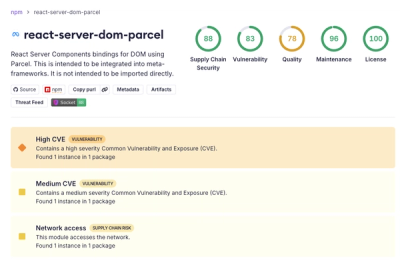
New DoS and source code exposure bugs in React Server Components and Next.js: what’s affected and how to update safely.

Security News
Socket CEO Feross Aboukhadijeh joins Software Engineering Daily to discuss modern software supply chain attacks and rising AI-driven security risks.