


Company News
Socket Has Acquired Secure Annex
Socket has acquired Secure Annex to expand extension security across browsers, IDEs, and AI tools.
By Feross Aboukhadijeh - Apr 28, 2026
reverse-iterable-map
Advanced tools
The ReverseIterableMap object is a reverse-iterable map implementation based on the built-in Map object.
It implements a linked list meaning that each element in the internal data structure (a Map object) knows about its previous and next element; thus, allowing iteration in both directions at the same time. This implies added memory usage because in addition to its key and value, an element also needs to store the two references for the previous and next elements.
Links:
See also:
ReverseIterableArray: reverse-iterable-arrayReverseIterableSet: reverse-iterable-setDownload only the ES module file:
curl -O https://raw.githubusercontent.com/kleinfreund/reverse-iterable-map/master/src/reverse-iterable-map.mjs
(Requires Node version 8.5 or higher for ES module support)
Installs the node package as a dependency. It doesn’t have any dependencies itself.
npm install --save reverse-iterable-map
Note, that Node.js version 8.5 or higher is required, as it comes with experimental support for ES modules. If you don’t want to use it as an ES module, you will need to transpile the package yourself.
import { ReverseIterableMap } from './src/reverse-iterable-map.mjs';

const map = new ReverseIterableMap();
For more usage examples, clone the repository and run:
npm install && npm run examples
Then, open http://127.0.0.1:8080/examples in your browser.
… with Node’s experimental ES module feature:
npm test
Disclaimer: The documentation section copies a lot of content from the Map documentation on the Mozilla Developer Network.
A ReverseIterableMap object iterates its elements in insertion or reverse-insertion order — a for...of loop returns an array of [key, value] for each iteration.
new ReverseIterableMap([iterable])
Parameters:
iterable: An iterable object whose elements are key-value pairs.
In order to construct a ReverseIterableMap object from an array, it can be passed by calling the Array.prototype.entries() method.
const map = new ReverseIterableMap([1, 2, 3].entries());
const map = new ReverseIterableMap();
Arrayconst map = new ReverseIterableMap([1, 2, 3].entries());
Array of Arraysconst map = new ReverseIterableMap([[0, 1], [1, 2], [2, 3]]);
Mapconst builtInMap = new Map([['key1', 1], ['key2', 2], ['key3', 3]]);
const map = new ReverseIterableMap(builtInMap);
NodeListconst nodeList = document.querySelectorAll('a');
const map = new ReverseIterableMap(nodeList.entries());
sizeThe size accessor property returns the number of elements in a ReverseIterableMap object.
map.size
const map = new ReverseIterableMap();

map
  .set('one', 'I')
  .set('two', 'lack')
  .set('three', 'creativity');

map.size
//> 3
clear()map.clear();
Return value:
// Clears the underlying Map object
// Sets the first and last node references to null
map.clear();
delete()map.delete(key);
Parameters:
ReverseIterableMap object.Return value:
true if an element in the ReverseIterableMap object existed and has been removed, or false if the element does not exist.const map = new ReverseIterableMap(['hey', 'beauty'].entries());
map.delete(0);
//> true (deletes the key value pair [0, 'hey'])
map.delete(1);
//> true (deletes the key value pair [1, 'beauty'])
map.delete(2);
//> false (key 2 does not exist in map)
entries()Returns an iterator containing the [key, value] pairs for each element in the ReverseIterableMap object in insertion order.
An iterator containing the same pairs in reverse-insertion order can be obtained with entries().reverseIterator().
map.entries();
Return value:
A new ReverseIterableMap iterator object.
forEach()The forEach() method executes a provided function once per each [key, value] pair in the ReverseIterableMap object, in insertion order.
map.forEach(callback[, thisArg]);
Parameters:
this when executing callback.Return value:
forEachReverse()The forEachReverse() method executes a provided function once per each [key, value] pair in the ReverseIterableMap object, in reverse-insertion order.
map.forEachReverse(callback[, thisArg]);
Parameters:
this when executing callback.Return value:
get()map.get(key);
Parameters:
ReverseIterableMap object.Return value:
undefined if the key can't be found in the ReverseIterableMap object.const map = new ReverseIterableMap(['hey', 'beauty'].entries());
map.get(0);
//> 'hey'
map.get(1);
//> 'beauty'
map.get(2);
//> undefined
has()map.has(key);
Parameters:
ReverseIterableMap object.Return value:
true if an element with the specified key exists in the ReverseIterableMap object; otherwise false.const map = new ReverseIterableMap(['hey', 'beauty'].entries());
map.has(0);
//> true
map.has(1);
//> true
map.has(2);
//> false
iteratorFor()Returns an iterator containing the [key, value] pairs for each element in the ReverseIterableMap object in insertion order starting with the pair specified by the key parameter.
This allows starting iteration at a specific element in the map.
An iterator containing the same pairs in reverse-insertion order can be obtained with iteratorFor().reverseIterator().
map.iteratorFor(key);
Parameters:
Return value:
A new ReverseIterableMap iterator object.
const map = new ReverseIterableMap([1, 2, 4].entries());

// Iterator, starting at the element with key 1.
const iterator = map.iteratorFor(1);

iterator.next().value;
//> [1, 2]

iterator.next().value;
//> [2, 4]

iterator.next().value;
//> undefined

// Reverse-iterator, starting at the element with key 1.
const reverseIterator = map.iteratorFor(1).reverseIterator();

reverseIterator.next().value;
//> [1, 2]

reverseIterator.next().value;
//> [0, 1]

reverseIterator.next().value;
//> undefined
keys()Returns an iterator containing the keys for each element in the ReverseIterableMap object in insertion order.
An iterator containing the same keys in reverse-insertion order can be obtained with keys().reverseIterator().
map.keys();
Return value:
A new ReverseIterableMap iterator object.
reverseIterator()In theory, following the semantics of [Symbol.iterator](), this should be [Symbol.reverseIterator](). However, as a developer, I cannot define a well-known symbol myself and make use of it. In the future, the a proposal like The ReverseIterable Interface, by Lee Byron might make it’s way into the specification. For the time being, the reverseIterator() function serves the same purpose.
map.reverseIterator();
Return value:
The map reverse-iterator function, which is the entries().reverseIterator() function by default.
const map = new ReverseIterableMap([1, 2, 4].entries());

const reverseIterator = map.reverseIterator();

reverseIterator.next().value;
//> [2, 4]

reverseIterator.next().value;
//> [1, 2]

reverseIterator.next().value;
//> [0, 1]

reverseIterator.next().value;
//> undefined
set()map.set(key, value);
Parameters:
ReverseIterableMap object.ReverseIterableMap object.Return value:
ReverseIterableMap object.const map = new ReverseIterableMap();
map.set('you', 'beauty');
//> map
map.set('the-magic-key', 'hey');
//> map
The set() method returns a reference to the map object. This makes the set operation chainable.
const map = new ReverseIterableMap()
  .set('key', '… is spelled like tea')
  .set('hey', '… somehow ney');
setFirst()The setFirst() method functions like set() but uses reverse-insertion order.
map.set(key, value);
Parameters:
ReverseIterableMap object.ReverseIterableMap object.Return value:
ReverseIterableMap object.const map = new ReverseIterableMap()
.setFirst('key1', 'was inserted first')
.setFirst('key2', 'was inserted last');
map.values().next().value;
//> 'was inserted last'
map.values().reverseIterator().next().value;
//> 'was inserted first'
[Symbol.iterator]()Returns the map iterator function. By default, this is the entries() function.
map[Symbol.iterator]();
Return value:
The map iterator function, which is the entries() function by default.
const map = new ReverseIterableMap([1, 2, 4].entries());

const iterator = map[Symbol.iterator]();

iterator.next().value;
//> [0, 1]

iterator.next().value;
//> [1, 2]

iterator.next().value;
//> [2, 4]

iterator.next().value;
//> undefined
values()Returns an iterator containing the values for each element in the ReverseIterableMap object in insertion order.
An iterator containing the same values in reverse-insertion order can be obtained with values().reverseIterator().
map.values();
Return value:
A new ReverseIterableMap iterator object.
Part of the additions to ECMAScript 2015 are the iteration protocols: Iterable and iterator. The former allows arbitrary objects to become iterable. Following the rules of the protocol gives one iteration capabilities via the following techniques:
However, only the iteration in one direction is considered by the specification at the time. This means that we only get forward-iteration by default. There is a draft for a proposal to add a ReverseIterable interface to the specification: “The ReverseIterable Interface” by Lee Byron.
Now, with the iteration protocols, we could redefine the iteration behavior for our purpose and make an object backwards-iterable. At the same time, this means losing the ability to iterate forwards.
If you need both a forwards- and backwards-iterable object, this implementation might be for you.
But why a map?
That’s what I needed. To be precise, I needed to access an iterator at a specific location in my data structure and be able to iterate in both directions.
I tried to stick to the Map interface as close as possible.
Implementing a reverse-iterable array, for example, can be accomplished by using the same techniques of this implementation.
… because I keep forgetting that.
Let’s assume an update to version v3.1.0 should be made. First of all, the working directory needs to cleaned up; all changes need to be comitted and pushed.
git add .
git commit -m "Implemented extremely nice feature"
git push
Next, make sure you have a valid NPM authentication token set up:
npm whoami
If not, do that with npm login and continue. We now create a new commit with the version tag (i.e. v3.1.0) and update the package.json. Actually, the following command will do that:
npm version v3.1.0
This creates a new git tag that we need to publish as well. With that, we can now publish the new version.
git push origin v3.1.0
npm publish
That’s it.
FAQs
A reverse-iterable map implementation based on the built-in Map object
We found that reverse-iterable-map demonstrated a not healthy version release cadence and project activity because the last version was released a year ago. It has 1 open source maintainer collaborating on the project.
Did you know?

Socket for GitHub automatically highlights issues in each pull request and monitors the health of all your open source dependencies. Discover the contents of your packages and block harmful activity before you install or update your dependencies.
Company News
Socket has acquired Secure Annex to expand extension security across browsers, IDEs, and AI tools.

Research
/Security News
Socket is tracking cloned Open VSX extensions tied to GlassWorm, with several updated from benign-looking sleepers into malware delivery vehicles.
Product
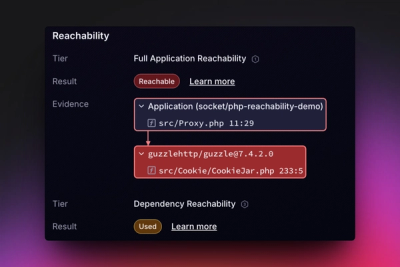
Reachability analysis for PHP is now available in experimental, helping teams identify which vulnerabilities are actually exploitable.