

Security News
Socket Security Analysis Is Now One Click Away on npm
npm now links to Socket's security analysis on every package page. Here's what you'll find when you click through.
By Sarah Gooding - Feb 19, 2026
server-timings
Advanced tools
This is a very early release of server-timings module, intended as an Express middleware.
Firstly you need to load the middleware as early as possible to record the request timing:
const express = require('express');
const app = express();
const timings = require('server-timings');

app.use(timings);
app.use(require('./routes'));
This will automatically add a Server-Timing header shown in milliseconds (note that in stable Chrome shows timings in seconds, this will change):
$ curl https://jsonbin.org/remy/urls -I
HTTP/1.1 200 OK
Content-Type: application/json; charset=utf-8
Server-Timing: 0=72.45; "Request"
To include additional timings the middleware exposes two methods on the res.locals.timings property:
start(label) - record the start timeend(label) - end the record time - if this isn't called, it will be called when the request is finishedAs well as being exposed in res.locals.timings you can also call start and end as middleware:
app.use(timings);
app.use(timings.start('routing'));
app.use(require('./routes'));
app.use(timings.end('routing'));
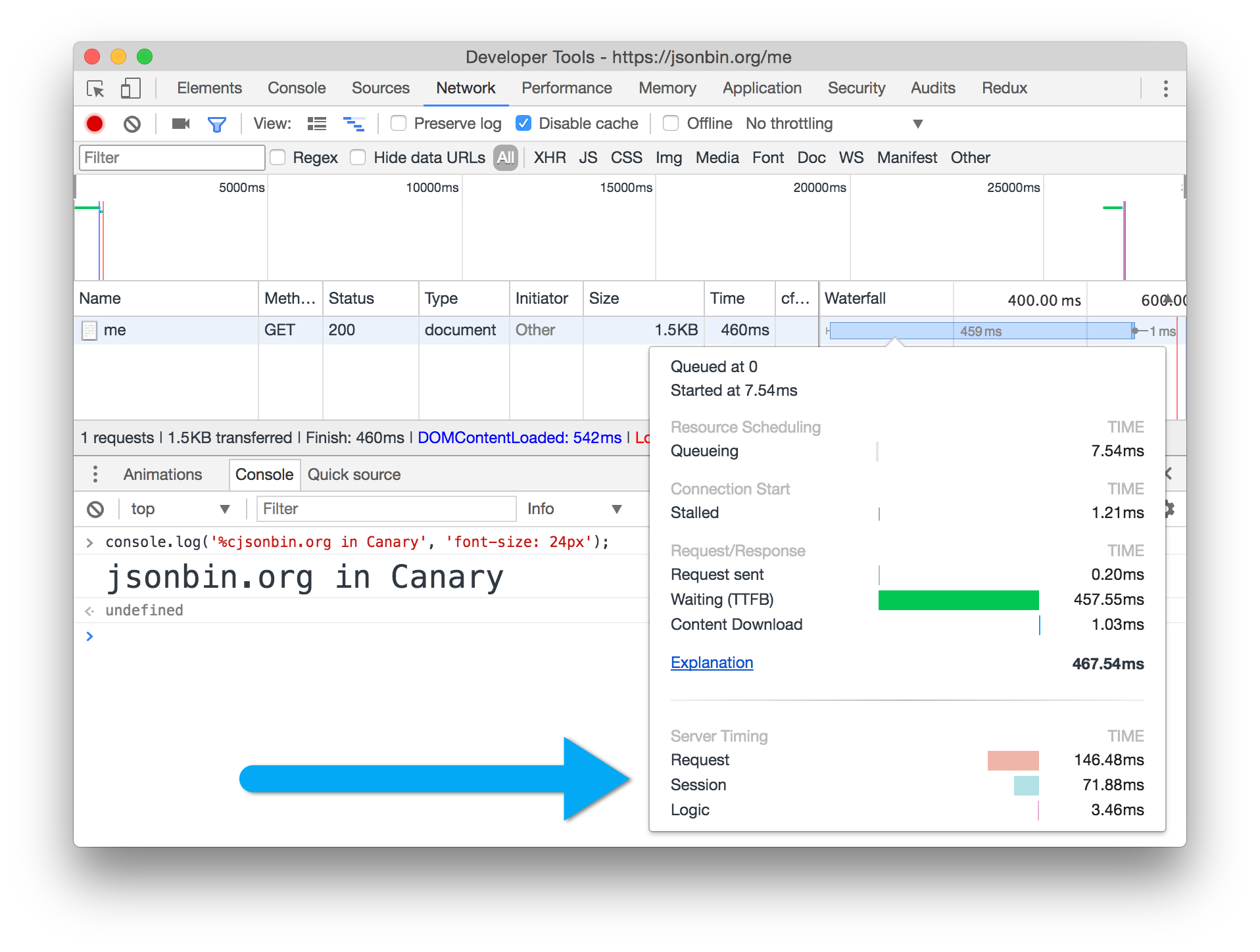
See jsonbin.org for a working example. As of March 2017, the networking timings can be seen in Canary:
next() so limited to ExpressFAQs
Adds `Server-Timings` header
We found that server-timings demonstrated a not healthy version release cadence and project activity because the last version was released a year ago. It has 1 open source maintainer collaborating on the project.
Did you know?

Socket for GitHub automatically highlights issues in each pull request and monitors the health of all your open source dependencies. Discover the contents of your packages and block harmful activity before you install or update your dependencies.
Security News
npm now links to Socket's security analysis on every package page. Here's what you'll find when you click through.

Security News
A compromised npm publish token was used to push a malicious postinstall script in cline@2.3.0, affecting the popular AI coding agent CLI with 90k weekly downloads.

Product
Socket is now scanning AI agent skills across multiple languages and ecosystems, detecting malicious behavior before developers install, starting with skills.sh's 60,000+ skills.