SIMDope 5.1.0
A Color Trafficking Library Designed for Lightning-Fast Processing


SIMDope is a library that optimizes color processing by leveraging arrays of bytes and specialized classes. The primary class, SIMDope.Colors, enhances performance when working with color lists. The secondary class, SIMDope.Color, facilitates transformation, conversion, and operations on individual colors. Notably, elements retrieved from a new instance of SIMDope.Colors are not copied, contributing to its exceptional speed and reduced burden on the garbage collector.
Performance
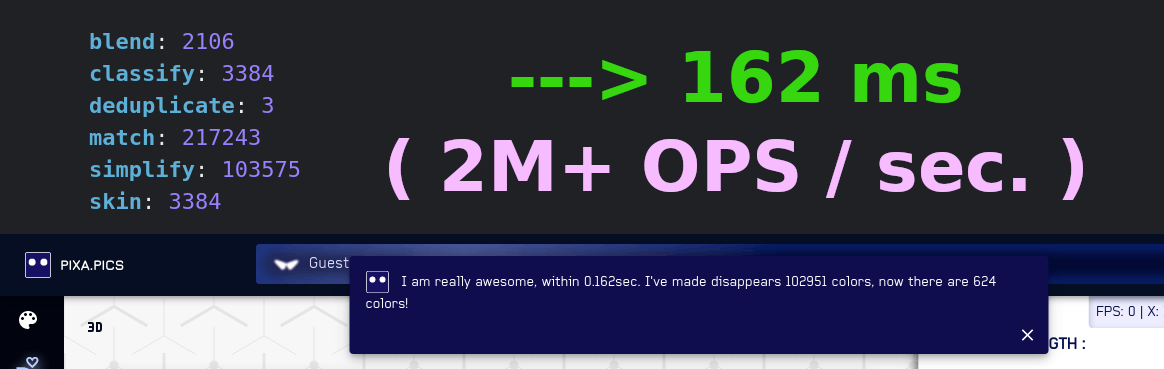

Instead of copying elements, a view of the TypedArray colors data is obtained, allowing for faster operations. Changes made to retrieved elements are reflected in the original TypedArray, resulting in optimized performance.
Fun Fact
Using our color quantization algorithm (coming soon to NPM), we can reduce 250K colors to 1K in just 0.3-0.4 seconds. The capability to blend them all together is truly remarkable.
A canvas of 512x512 is approximately 250K pixels, yet this library handles multiple millions of operations per second. It is expected to be 4-16 times faster than most other libraries, thanks to SIMD JS & ASM JS!
How to Use SIMDope.Color?
To understand its usage, especially given its performance-oriented nature, refer to the source code. However, here are various ways to create a new color object.
Installing the Library
npm install simdope
Importing the Library
Browser
var Color = window.SIMDOPE.Color;
var Colors = window.SIMDOPE.Colors;
NodeJS
import { Color, Colors } from "simdope";
Installing the library
npm install simdope
Importing the library
Browser
var Color = window.SIMDOPE.Color;
var Colors = window.SIMDOPE.Colors;
NodeJS
import {Color, Colors} from "simdope";
Instantiate an object of the single color class
Color(with_main_buffer, offset_4bytes)
Color.new_zero()
Color.new_of(r, g, b, a)
Color.new_safe_of(r, g, b, a)
Color.new_from(agbr_array)
Color.new_array(rgba_array)
Color.new_array_safe(rgba_array)
Color.new_uint32(uint32)
Color.new_hsla(h, s, l, a)
Color.new_hex(hex_anything)
Properties
color.r
color.g
color.b
color.a
color.uint32
color.hex
color.hsla
color.lab
color.ycbcra
color.skin
color.tail
color.rgbaon4bits
color.rgbaon6bits
color.rgbaon8bits
color.rgbaon12bits
color.offset
color.buffer_
color.subarray_
color.slice_
Methods
color.get_buffer()
color.get_subarray()
color.get_slice()
color.sum_rgba()
color.sum_rgb()
color.is_dark()
color.is_skin()
color.is_fully_transparent()
color.is_fully_opaque()
color.is_not_skin()
color.is_not_fully_transparent()
color.is_not_fully_opaque()
color.set(with_buffer)
color.set_from_simdope(color);
color.set_from_array(new Uint8Array(4));
color.set_from_buffer(with_buffer, offset_four_bytes);
color.set_tail(simdope_instance, premultiply_alpha_255_optional)
color.simplify(divider)
color.blend_with(another_color, strength_on_255, should_return_transparent, is_alpha_addition)
color.blend_first_with(another_color, strength_on_255, should_return_transparent, is_alpha_addition)
color.blend_first_with_tails(is_alpha_addition);
color.match_with(another_color, threshold_on_255)
color.manhattan_match_with(another_color, threshold_float)
color.euclidean_match_with(another_color, threshold_float)
color.cie76_match_with(another_color, threshold_float)
color.set_r(r)
color.set_g(g)
color.set_b(b)
color.set_a(a)
color.to_greyscale();
color.to_greyscale_luma();
Functions
Color.with_r(color, r)
Color.with_g(color, g)
Color.with_b(color, b)
Color.with_a(color, a)
Color.with_inverse(color)
Color.with_match(color_a, color_b, threshold_on_255)
Color.blend(color_a, color_b, strength_on_one, should_return_transparent, is_alpha_addition)
Please, look at the source code to know more about other cool ways of using it ...
How to use SIMDope.Colors?
Instantiate an object of the multiple colors class
Colors(with_main_buffer)
Properties
colors.length
colors.buffer
Methods
colors.get_element(index, old_color_object_optional_faster)
colors.subarray_uint32(start, end)
colors.slice_uint32(start, end)
colors.subarray_uint8(start, end)
colors.slice_uint8(start, end)
colors.get_deduplicated_uint32a()
colors.get_deduplicated_sorted_uint32a()
colors.set_element(index, color_object)
colors.buffer_setUint8(index, number)
colors.buffer_setUint32(index, number)
How it should be used (LOOK HERE)
var white = Color.new_of(255, 255, 255, 255);
var green = Color.new_of(0, 255, 0, 255);
var red = Color.new_of(255, 0, 0, 255);
var simdope_my_colors = Colors(imagedata);
simdope_my_colors.get_element(0).blend_with(white.copy(), 192, false, false);
simdope_my_colors.get_element(1).blend_with(white, 0.25*255, false, false) ;
simdope_my_colors.get_element(2)
.blend_with(white.copy(), 0.25*255, false, true)
.blend_with(green.copy(), 0.75*255, false, true)
.blend_with(red.copy(), 0.25*255, false, true)
var purple = simdope_my_colors.get_element(2);
var purple_copy = purple.copy();
var purple_hex = purple.hex;
var purple_uint32 = purple.uint32;
var is_purple_dark = purple.is_dark();
var is_purple_dark_but_from_hex = Color.new_hex(purple_hex).is_dark();
var purple_alpha_but_from_uint32 = Color.new_uint32(purple_uint32).a;
var some_uint32array_colors = simdope_my_colors.subarray_uint32(0, 3);
var some_colors = new Colors(some_uint32array_colors.buffer);
some_colors.set_uint32_element(0, purple.uint32);
some_colors.set_uint32_element(1, purple.uint32);
For more usage scenarios, explore the source code.
Please refer to the source code for additional information and advanced usage scenarios.





